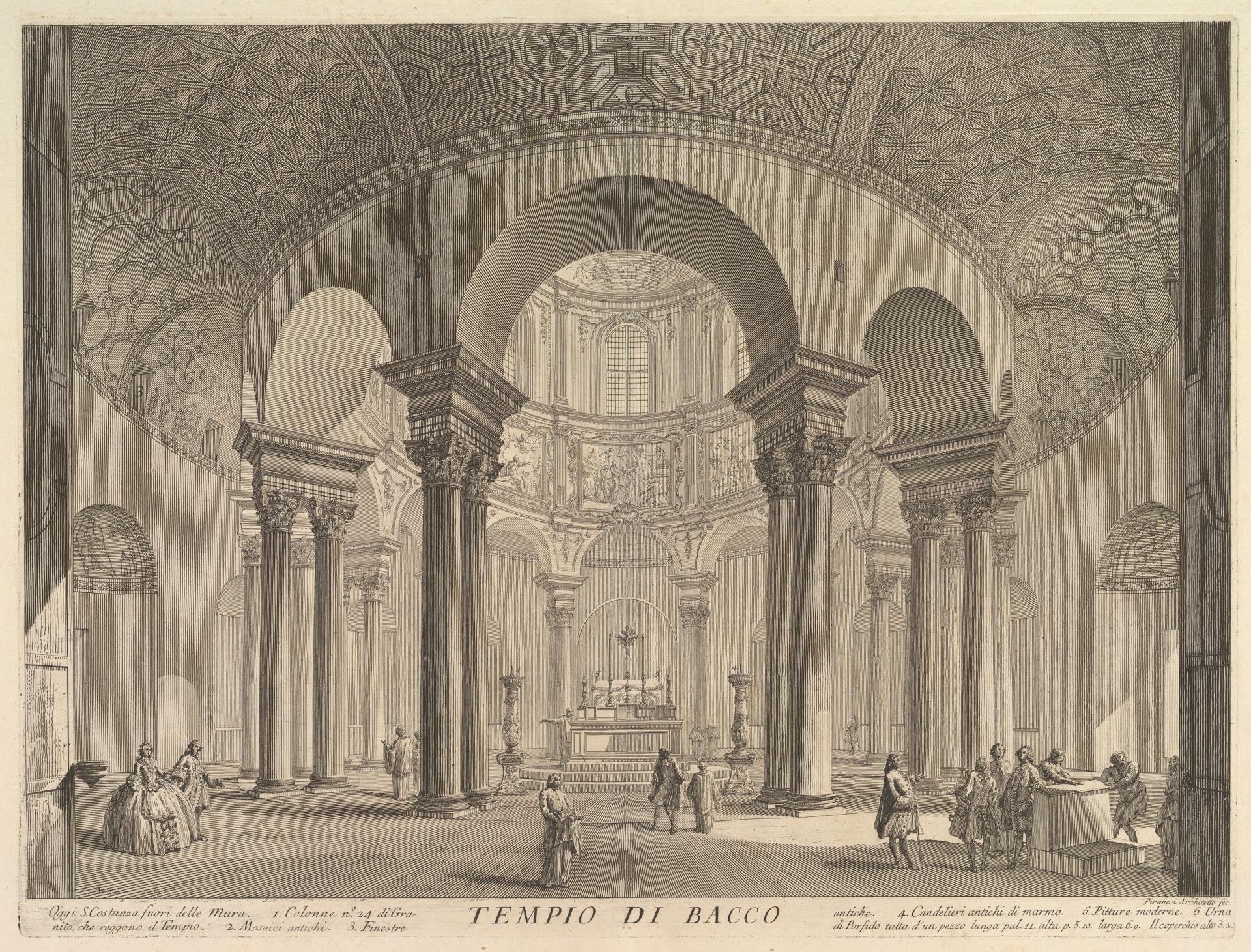
S. Constanza (erroneously callled Temple of Bacchus) (Veduta interna del Sepolcro di S. Constanza, fabbricato da Costantino Magno, ed erroneamente detto il Tempio di Bacco, inoggi Chiesa della medisme Santa), from "Vedute di Roma"
Original title: S. Constanza (erroneously callled Temple of Bacchus) (Veduta interna del Sepolcro di S. Constanza, fabbricato da Costantino Magno, ed erroneamente detto il Tempio di Bacco, inoggi Chiesa della medisme Santa), from "Vedute di Roma"
kurzbeschreibung
This etching by Giovanni Battista Piranesi dates from around 1756 and shows the interior of the church of Santa Costanza in Rome, which at the time was mistakenly called the Temple of Bacchus. The print belongs to the series 'Vedute di Roma' and is executed as an etching.
Description
A broad space spanned by a patterned vault opens up before the viewer. An altar forms the focal point, with several figures in historical dress gathered around it, praying or looking at the altar. Columns on the left and right frame the space and mark entrances to adjoining areas. Mosaics and reliefs adorn the walls; light entering through windows accentuates the architectural details. The layout is symmetrical and emphasizes the verticals of columns and vault.
Context
The 'Vedute di Roma' appeared from 1745 as a series of views of Roman buildings. Santa Costanza was built in the 4th century as a mausoleum for Constantina, daughter of Constantine the Great. In the 18th century, the incorrect name Temple of Bacchus persisted because the mosaics and the central dome were taken for a pagan cult building. Piranesi recorded the structure with archaeological precision in order to highlight the grandeur of ancient Roman architecture.
Impact
The precise linework and emphasized spatial depth give the print a solemn, almost monumental mood. The symmetrical arrangement and the incoming light direct the eye to the altar and reinforce the sacred dignity of the place.
Technique
The drawing is incised into a metal plate bitten with acid; printing produces fine, even lines that render architectural details and shading. The grey tones typical of etching define the image.
AI-generated description text
Source: Metropolitan Museum of Art · Public Domain (CC0 1.0)