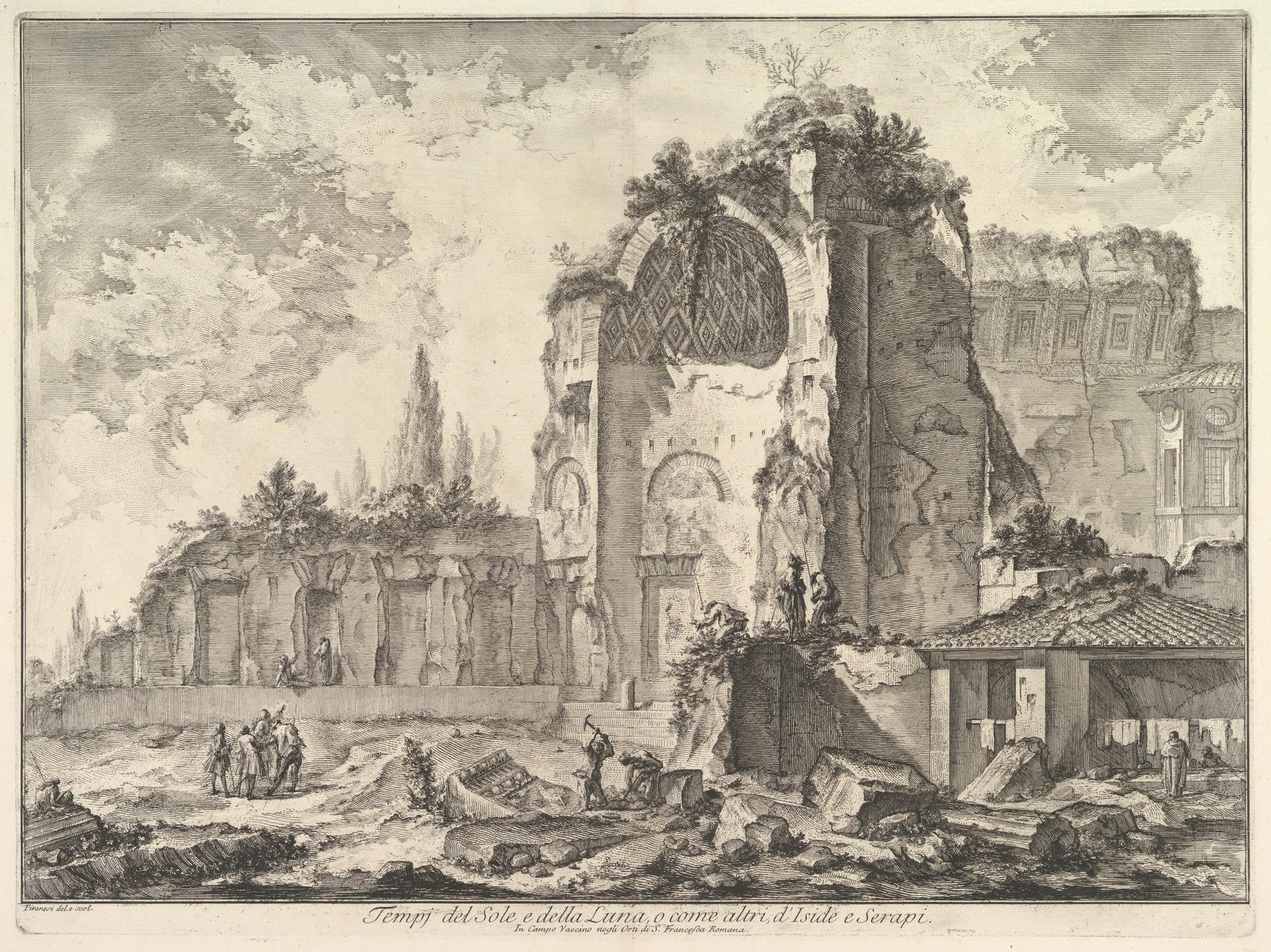
The Temple of Venus and Roma (erroneously called Temple of Sol and Luna) (Veduta degli avanzi di due triclini che appartenevano alla Casa aurea di Nerone), from "Vedute di Roma"
Original title: The Temple of Venus and Roma (erroneously called Temple of Sol and Luna) (Veduta degli avanzi di due triclini che appartenevano alla Casa aurea di Nerone), from "Vedute di Roma"
kurzbeschreibung
Giovanni Battista Piranesi's etching of around 1759 leads the viewer to the remains of the Temple of Venus and Roma in Rome and belongs to his series 'Vedute di Roma'. The print records the ancient ruins, enlivened by a few figures scattered among them.
Description
What survives of a supposed ancient temple precinct fills the view. In the foreground people move about between the walls, walking, some working, others looking on. Trees and shrubs have spread over the masonry and columns. Behind stand further ruined buildings, overgrown with vegetation. A layer of cloud softens and scatters the light, giving the place something remote and sombre.
Context
The sheet comes from Piranesi's well-known series 'Vedute di Roma', with which he recorded Rome's ancient buildings around 1759. Emperor Hadrian had the Temple of Venus and Roma built in the second century AD; it was considered the largest temple in Rome. In the eighteenth century its ruins were still partly visible and often overgrown with vegetation. Calling them the 'Temple of Sol and Luna' rested on a widespread error, which Piranesi corrected in his title.
Impact
A melancholy mood of decay and transience runs through the print. The dense hatching and subdued light create a rather gloomy atmosphere with a romantic tinge, in which the former grandeur of antiquity and its decline are both perceptible.
Technique
The work was executed as an etching; the needlework can be seen in the fine hatching and graduated shading used to model the surfaces of masonry and plants. Piranesi used this process for highly detailed views with controlled linework, as is characteristic of his vedute.
AI-generated description text
Source: Metropolitan Museum of Art · Public Domain (CC0 1.0)