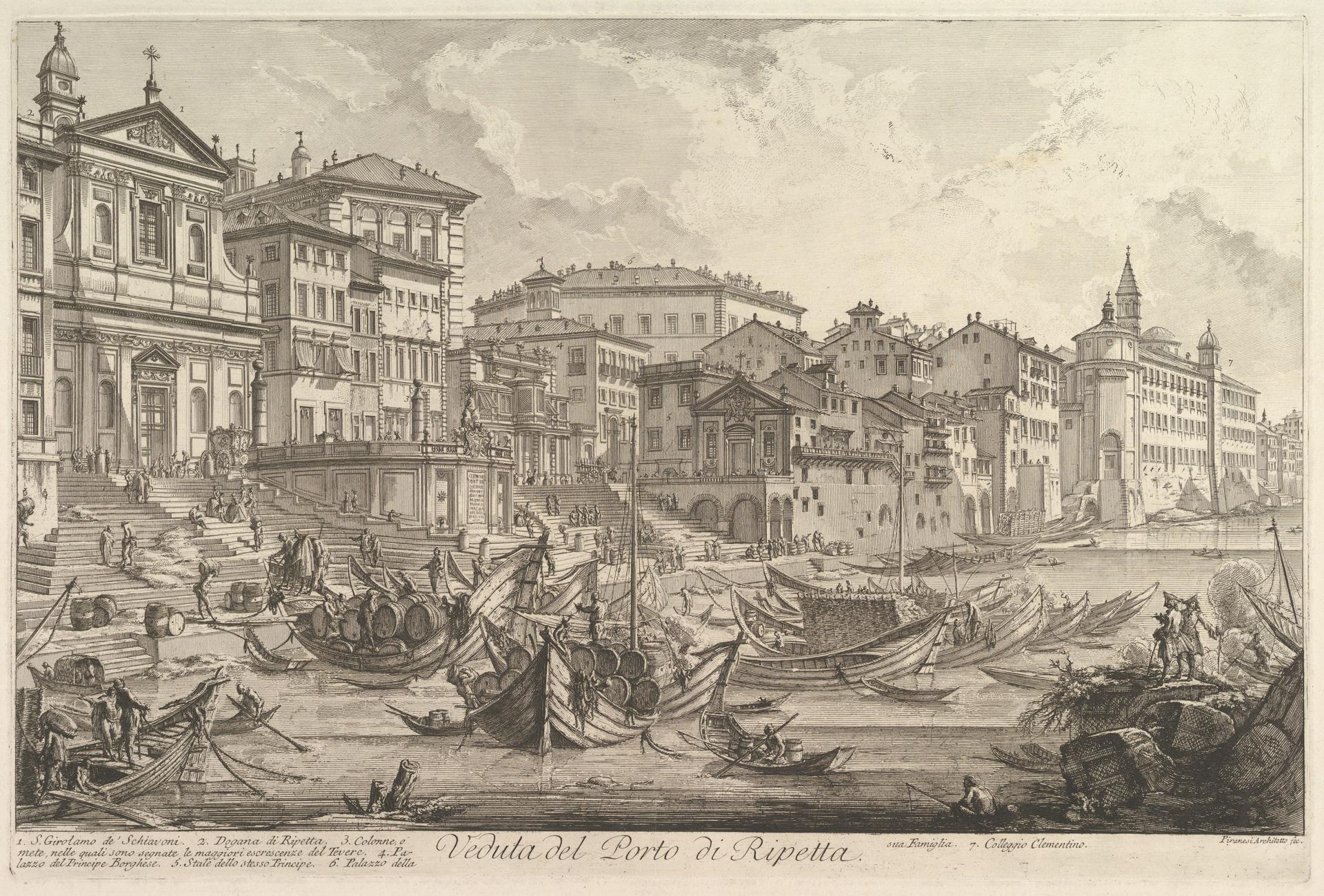
The smaller harbor, called the Porto di Ripetta (Veduta del Porto di Ripetta)
Original title: The smaller harbor, called the Porto di Ripetta (Veduta del Porto di Ripetta)
kurzbeschreibung
Boats lie at anchor on the Tiber with people aboard, while figures on the bank go about their work: this etching by Giovanni Battista Piranesi, made around 1753, brings the Roman harbour of Porto di Ripetta before the eye. The sheet belongs to the artist's series of vedute and captures the bustle of city life along the river.
Description
Several boats are spread across the water of the Tiber, with people visible between them and on the shore, busy with harbour activity. This strip of bank runs the full width of the sheet, and behind it churches and palaces rise, mixing Baroque and Neoclassical forms. The buildings are drawn down to the last detail and sharply outlined; the light falls evenly, and the tones stay monochrome, as is usual in an etching.
Context
Made around 1753, this view falls in a period when Rome was a sought-after destination for artists and Grand Tour travellers. The Porto di Ripetta then served the transport of goods on the Tiber, until it was demolished in the late nineteenth century. With his etchings Piranesi systematically recorded both the ancient and the contemporary buildings of Rome. The veduta takes its place in a series that presented the Rome of the day from changing viewpoints.
Impact
Cleanly drawn lines and a clear separation of water and buildings give the sheet a level, sober tone. The closely observed harbour life comes near, yet is not prettified. Because the light stays soft and colour is absent, the view gains a dense, almost timeless mood.
Technique
For this etching the drawing was incised into a metal plate, which acid then worked. This produces thin, sharp lines outlining architecture and figures. The monochrome print allows only gradations of light and dark, so that the structure of the image stands out clearly.
AI-generated description text
Source: Metropolitan Museum of Art · Public Domain (CC0 1.0)