The Temple of Vespian (Veduta del Tempio di giove Tonante)
Original title: The Temple of Vespian (Veduta del Tempio di giove Tonante)
kurzbeschreibung
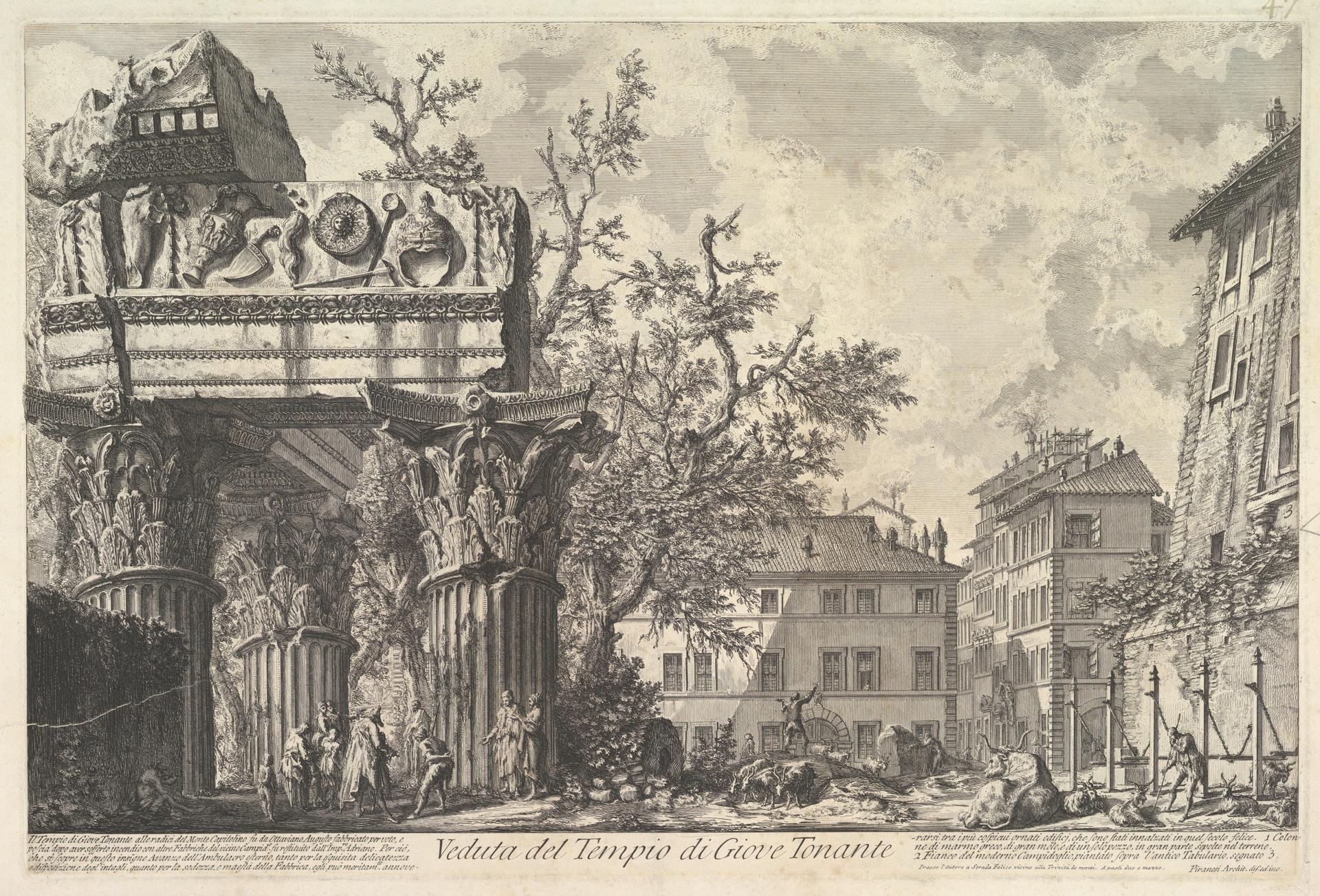
Around 1756 Giovanni Battista Piranesi published the etching Der Tempel des Vespasian, titled as a view of the Temple of Jupiter Tonans. It belongs to a series of vedute of Roman buildings. The print records the remains of an ancient temple with Corinthian columns and reliefs, set within a built-up urban surroundings.
Description
The eye is caught first by the weight of the ancient temple's columns, their Corinthian capitals worked out with care. Above the structure a rocky outcrop rises, topped by a sculpture. Farther into the picture come trees and the buildings of a city. Figures animate the scene, some standing, others walking. A cloudy sky casts a muted light. Monochrome throughout, the etching relies on sharp, closely observed linework.
Context
In the mid-eighteenth century Rome was a chief destination of the Grand Tour, and ancient ruins drew intense interest. Piranesi documented Roman antiquities with archaeological care while giving them a dramatic staging. This sheet comes from his early period, when he concentrated on views of Roman architecture. Naming the temple both 'Vespasian' and 'Jupiter Tonans' reflects how uncertain the identification of the ruins still was at the time.
Impact
Monumental architecture and a busy setting make a strong impression. Muted light and sharp lines produce a mood that is sublime and almost melancholy. The viewer is carried back into Rome's past and experiences the ruins as a living part of the city.
Technique
This graphic work is an etching, an intaglio process in which the drawing is scratched into a plate bitten with acid. Piranesi used fine, precise lines to render architectural detail and texture. The monochrome palette is typical of prints of the period and stresses the graphic character of the sheet.
AI-generated description text
Source: Metropolitan Museum of Art · Public Domain (CC0 1.0)