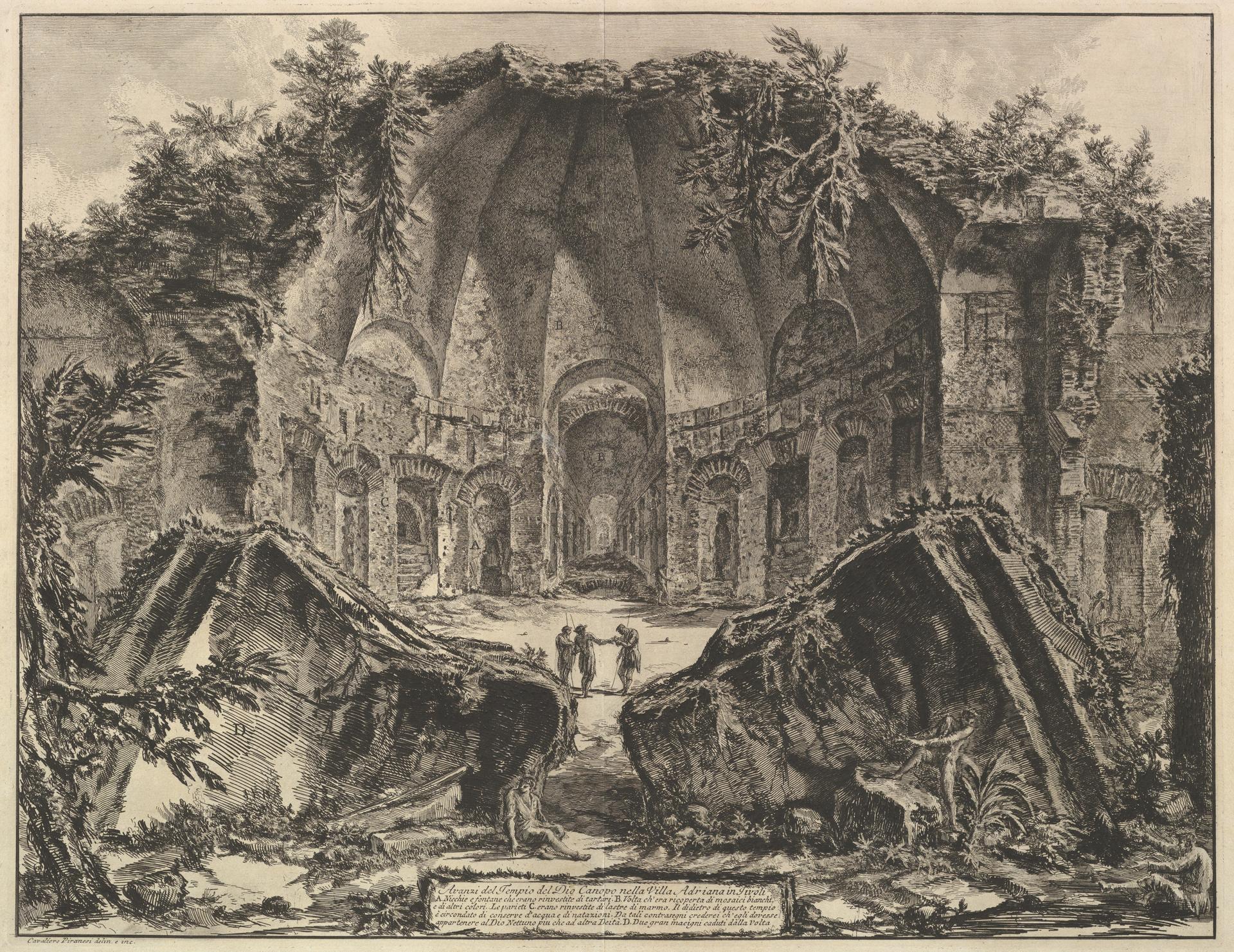
Hadrian's Villa: The Canopus (Avanzi del Tempio Dio Canopo nella Villa Adriana in Tivoli)
Original title: Hadrian's Villa: The Canopus (Avanzi del Tempio Dio Canopo nella Villa Adriana in Tivoli)
kurzbeschreibung
Around 1769 Giovanni Battista Piranesi etched the remains of the Canopus at Hadrian's Villa near Tivoli. The print belongs to a series of vedute that grew out of his wanderings through the countryside around Rome. In the foreground a path runs between two figures and leads deeper into the ruined landscape.
Description
A central path draws the eye into the space of the picture, and the arrangement feels balanced. Trees and shrubs have spread over the walls and columns and lean across them. Columns, arches and arcades lead toward a lower area, while light falls from above and picks out the architecture and the two figures in the foreground. Everything stays in shades of grey, as an etching does, joining detailed architecture with nature.
Context
This etching belongs to Piranesi's long engagement with Roman antiquity and its ruins. In the eighteenth century Hadrian's Villa at Tivoli was a favourite subject for artists recording how buildings and landscape meet. Piranesi was known for precise architectural views that did not shy away from decay and overgrowth. The sheet was made as he turned more and more to the Roman Campagna and its ancient sites.
Impact
Overgrown ruins and the few figures call up a wistful mood. The balanced layout and the falling light bring calm and invite looking. The path in the middle fairly pulls the gaze into depth, so that the scale of the ancient architecture can be felt against its decay.
Technique
For this etching, lines were cut into a copper plate and bitten with acid. Varying density and spacing of the strokes produce the grey tones. With this method Piranesi captured fine details in architecture and vegetation; the precise handling of line marks his prints.
AI-generated description text
Source: Metropolitan Museum of Art · Public Domain (CC0 1.0)