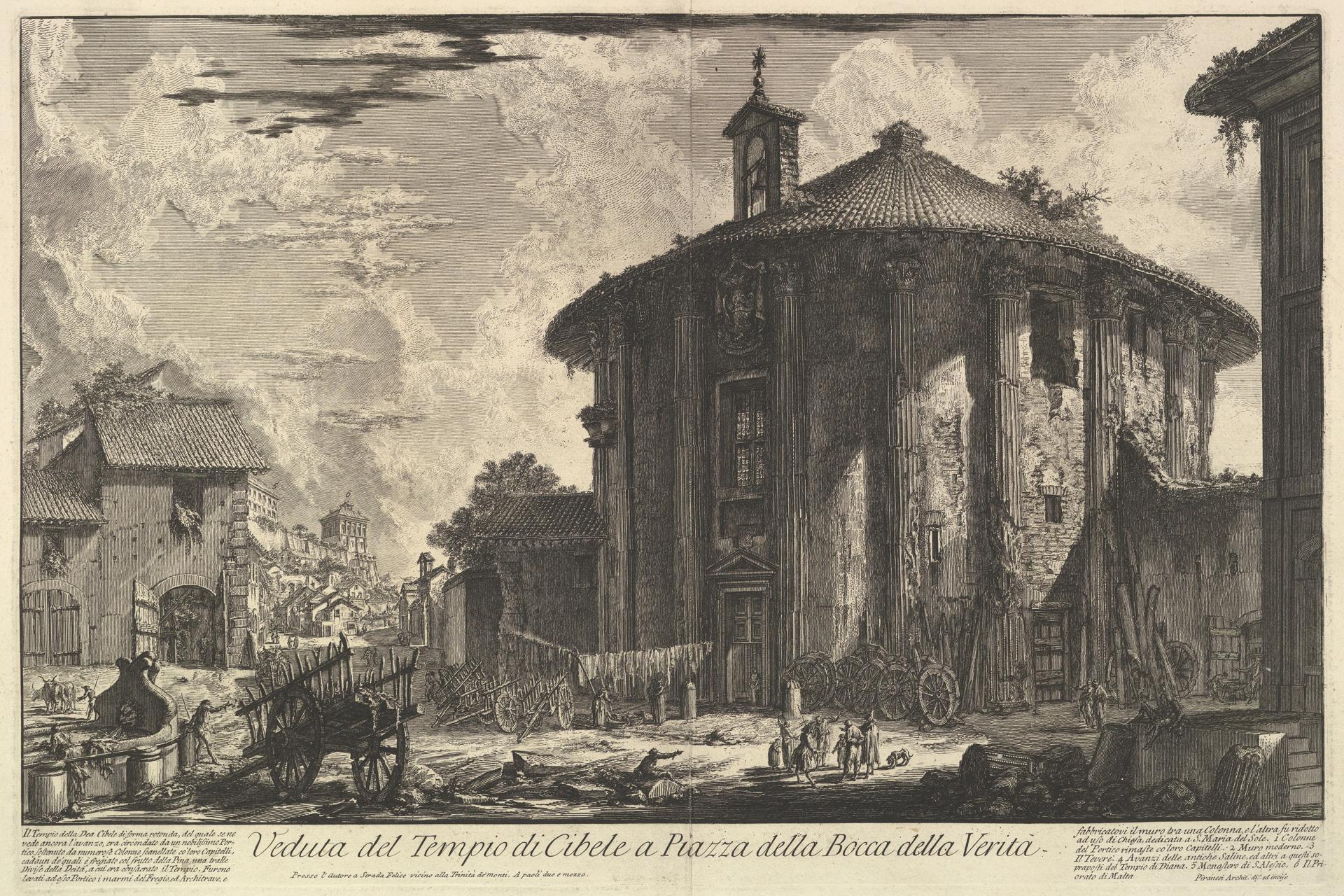
View of the Temple of Cybele in the Piazza of the Bocca della Verità
Original title: View of the Temple of Cybele in the Piazza of the Bocca della Verità (Veduta del Tempio di Cibele a Piazza della Bocca della Verità)
kurzbeschreibung
Unlike many vedute from the same series, this etching by Giovanni Battista Piranesi, made around 1758, presents the round Temple of Cybele on the Piazza della Bocca della Verità in Rome not as an isolated monument but as part of everyday life. The print belongs to Piranesi's survey of the city's ancient and contemporary architecture. A temple-like structure with Ionic columns stands in the foreground, enclosed by a wall, while figures and carts enliven the urban bustle.
Description
A round temple with Ionic columns, ringed by a wall, occupies the front zone of the image. On the left a gate opens onto a road, where several people and wagons are on their way. Further buildings and trees rise behind, hinting at the urban surroundings. The layout feels symmetrical, with the temple as the central focal point. The etching is executed in a single colour in shades of grey; subdued light heightens the sense of depth.
Context
Piranesi made this view at a time when Rome was the favoured destination of the Grand Tour and artists recorded its ancient monuments for a European audience. The Temple of Cybele, also known as the Temple of Hercules Victor, counted as a well-preserved example of Roman architecture. In his prints Piranesi combined archaeological accuracy with picturesque staging to make the grandeur of the ancient city tangible. The etching appeared within a series of views he published in the 1750s.
Impact
The sheet radiates a calm, historical mood and carries the viewer back to eighteenth-century Rome. Its symmetrical arrangement and graded greys produce a clear, almost architectural elegance typical of Piranesi. The subdued light and lively scenes give the work a vivid yet timeless quality.
Technique
For this etching Piranesi scratched the drawing into a wax layer on a copper plate and then bit it with acid. Fine lines and hatching allow a precise rendering of architecture and light. Printing was done in black on paper, which accounts for the monochrome effect.
AI-generated description text
Source: Metropolitan Museum of Art · Public Domain (CC0 1.0)