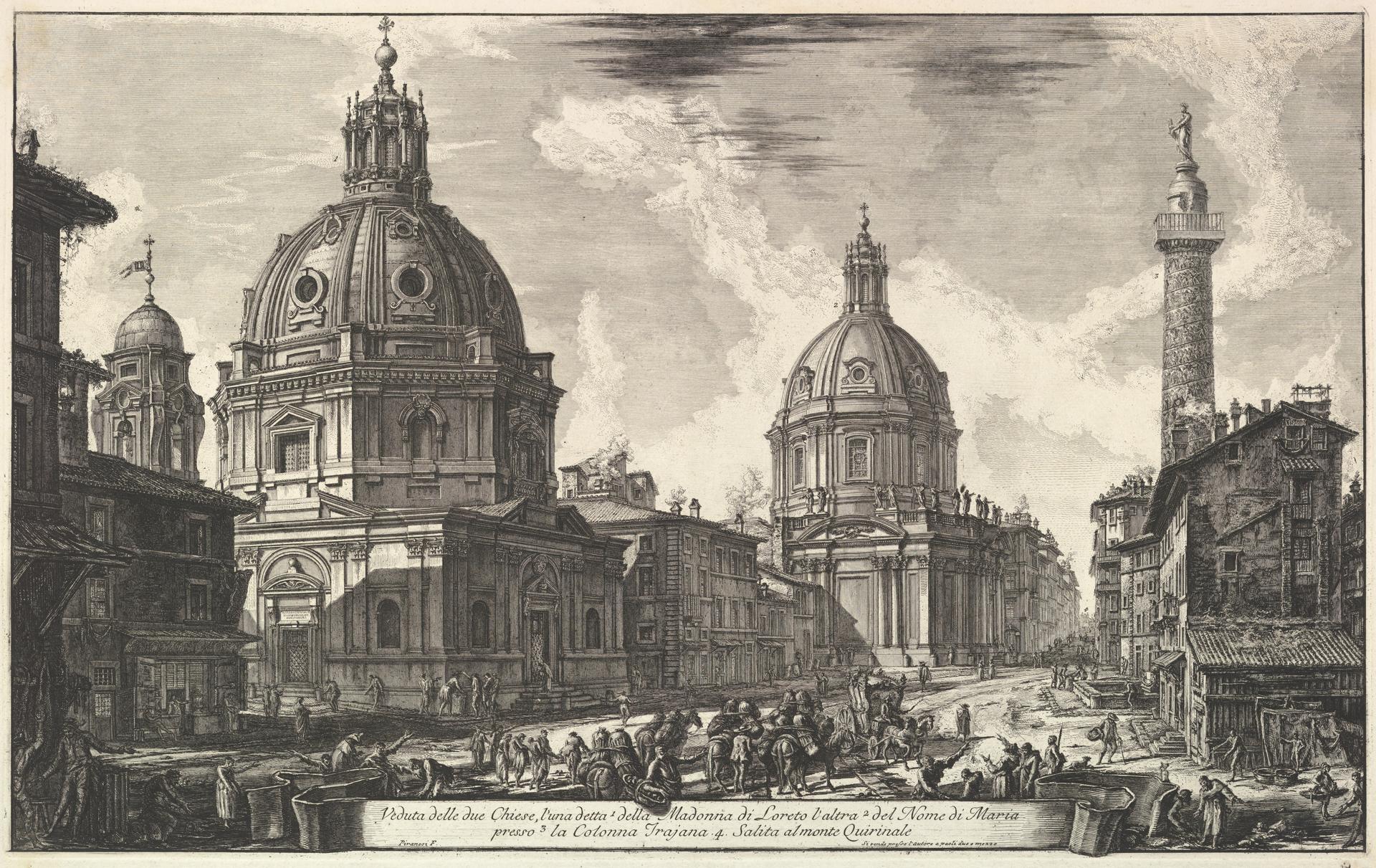
Two churches near Trajan's column, S. Maria di Loreto and Santissimo Nome di Maria (Veduta delle due chiesa, l'una detta della Madonna di Loreto, l'altra del nome di Maria, presso la Colonna Trajana)
Original title: Two churches near Trajan's column, S. Maria di Loreto and Santissimo Nome di Maria (Veduta delle due chiesa, l'una detta della Madonna di Loreto, l'altra del nome di Maria, presso la Colonna Trajana)
kurzbeschreibung
Around 1762 Giovanni Battista Piranesi made this etching of a Roman city view, in which the churches of Santa Maria di Loreto and Santissimo Nome di Maria, together with Trajan's Column, set the subject. The print draws the architecture of the two churches and the ancient memorial into a carefully considered veduta.
Description
On the left Santa Maria di Loreto rises with its unmistakable dome and a cross-topped tower; on the right stands Santissimo Nome di Maria, also with dome and tower. Trajan's Column soars up at the middle of the image, forming the backdrop. The street before the churches is busy: figures and horse-drawn carriages suggest a scene of historic everyday life. The layout feels balanced, with the churches as the central element and the column adding a further accent.
Context
Piranesi made this veduta at a time when Rome was a sought-after destination of the Grand Tour. For an international audience he recorded the city's ancient and Baroque buildings. The two churches stand right by Trajan's Column, an ancient monument the artist often took up in his work. The sheet belongs to a series of vedute documenting the Roman cityscape.
Impact
A calm, ordered mood comes across in the etching, brought about by the diffuse light and the symmetrical arrangement. The precise rendering of the architecture invites close looking and lets the viewer follow the urban situation.
Technique
The etching is carried out in shades of gray. This process allows fine lines and hatching, with which the details of the buildings and figures can be captured. The print on paper matches Piranesi's working method; he is valued for his richly detailed etchings with strong contrasts.
AI-generated description text
Source: Metropolitan Museum of Art · Public Domain (CC0 1.0)