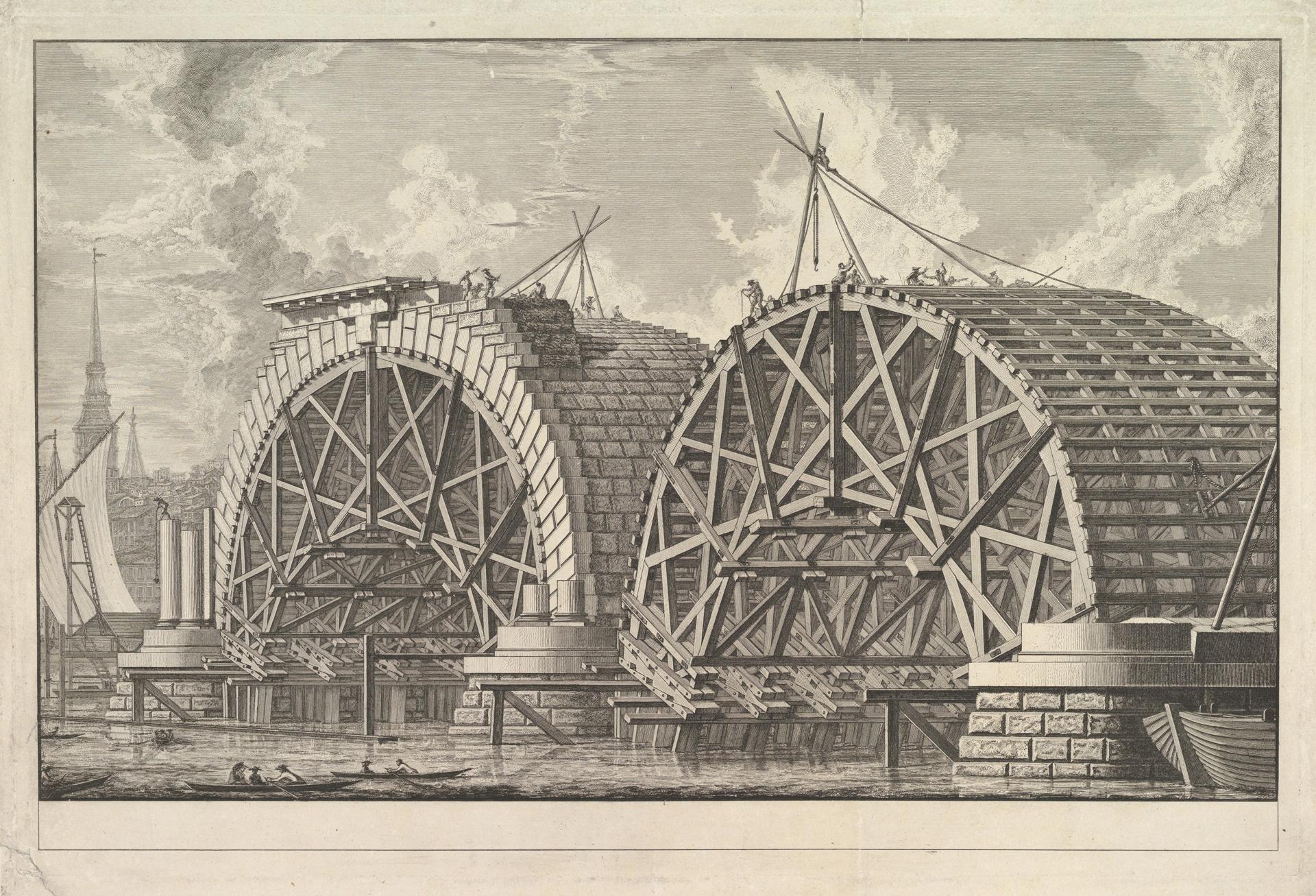
A view of part of the intended Bridge at Blackfriars, London (ca. 1764, Met-Objekt 4012)
Original title: A view of part of the intended Bridge at Blackfriars, London
kurzbeschreibung
In this etching of about 1764, Giovanni Battista Piranesi records the construction of Blackfriars Bridge in London. The timber arch frames stand open, not yet joined, with workers busy among them. The plate was made as an etched print.
Description
Two massive wooden centring structures fill the foreground, raised for the bridge arches still to come. Built up from framed scaffolding and covered with planks and boards, they carry men at work on the construction. Beyond the site, London church towers rise, a sign of how close the bridgehead lies. Along the lower edge, boats and figures move on the river. A clouded sky gives the light a muted quality, and the whole stays in black and white.
Context
Blackfriars Bridge was built between 1760 and 1769 as London's third crossing of the Thames. Piranesi, better known for vedute and architectural capricci, was in England during those years to sell his prints. This sheet probably belongs to a series that followed the bridge's construction. It records the site at a stage shortly before the arches were closed.
Impact
The print makes the engineering effort and the scale of the project legible. Cleanly drawn lines and a precise account of the timber scaffolding give the view a factual, documentary tone. The overcast sky, in turn, lends it a quiet, almost solemn mood.
Technique
The work is an etching, an intaglio process in which the drawing is scratched into a metal plate and the plate then bitten with acid. Piranesi used both delicate and forceful strokes to render the bridge structure and the figures in rich detail. The black-and-white treatment matches his usual printed work and brings out the architectural forms.
AI-generated description text
Source: Metropolitan Museum of Art · Public Domain (CC0 1.0)