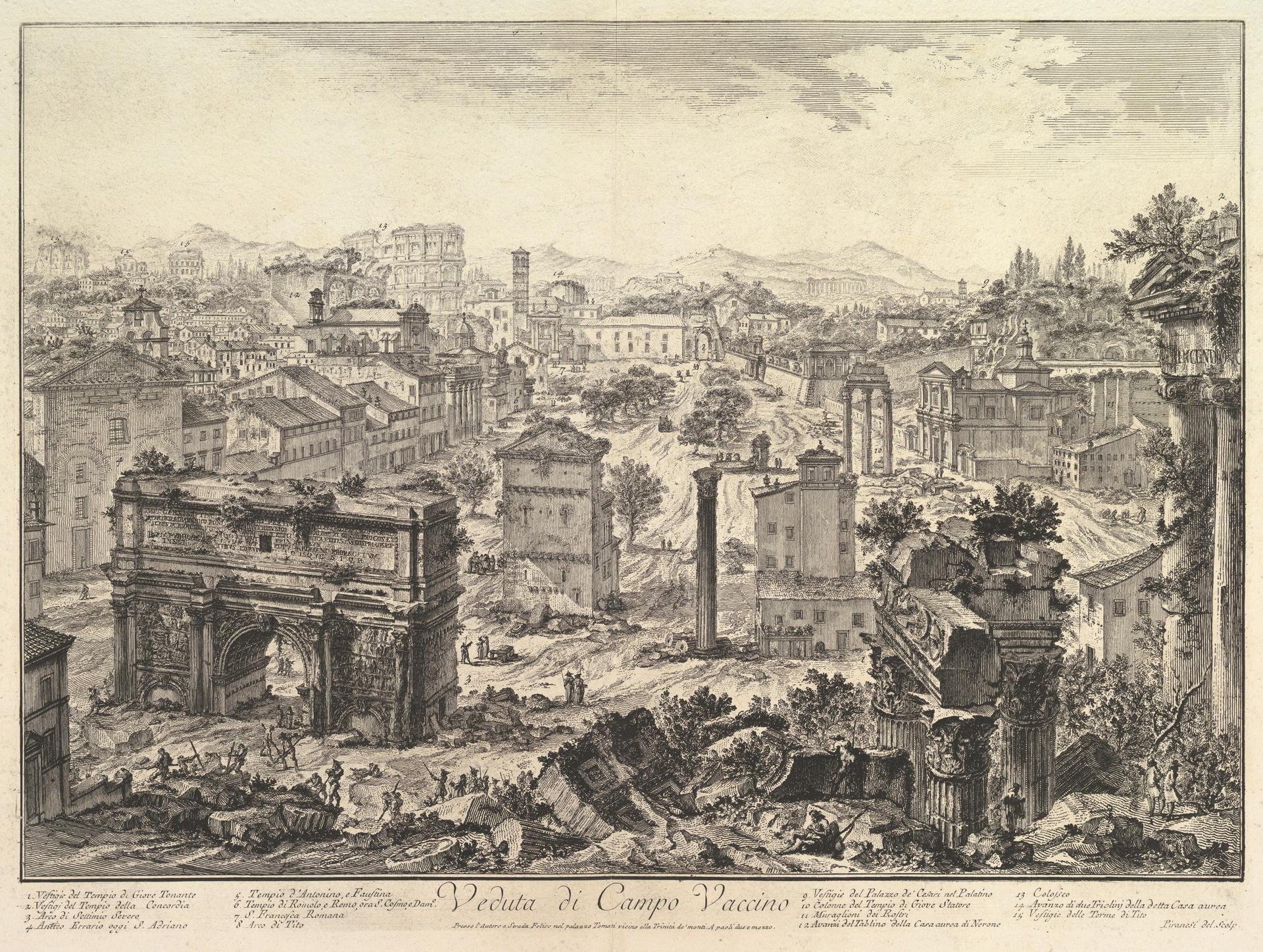
The Forum Romanum, or Campo Vaccino, from the capitol, with the Arch of Septimus Severus in the foreground left, Temple of Vespian right, and the Colosseum in the distance (Veduta di Campo Vaccino), from "Vedute di Roma"
Original title: The Forum Romanum, or Campo Vaccino, from the capitol, with the Arch of Septimus Severus in the foreground left, Temple of Vespian right, and the Colosseum in the distance (Veduta di Campo Vaccino), from "Vedute di Roma"
kurzbeschreibung
Created around 1775, this etching by Giovanni Battista Piranesi belongs to his series 'Vedute di Roma'. It presents a view of the Roman Forum in Rome, with the Arch of Septimius Severus, the Temple of Vespasian, and the Colosseum visible in the distance. The ancient Forum, with its ruins and monuments, forms the subject.
Description
The view opens horizontally across the Roman Forum. In the left foreground stands the Arch of Septimius Severus, with the Temple of Vespasian beside it to the right. Far off in the distance rises the Colosseum. Ancient columns and ruins run through the layout, underscoring the historical significance of the site. The image is rendered in monochrome, with even light and no strong shadows.
Context
Piranesi made this veduta during his years in Rome, where he studied ancient architecture in depth. The series 'Vedute di Roma' began in the 1740s and continued until his death. This sheet from around 1775 counts among the later works of the series, which circulated throughout Europe. Piranesi recorded the ruins of Rome to convey their grandeur, and in doing so he shaped the eighteenth-century view of antiquity.
Impact
A calm, sublime mood emanates from the etching, arising from the precise rendering of the ruins. The wide perspective invites exploration of the scene and an appreciation of the site's historical magnitude. The detailed execution feels documentary yet aesthetically compelling.
Technique
This sheet is an etching, an intaglio process in which the drawing is incised into a metal plate etched with acid. Piranesi used fine lines and hatching to bring out architectural details and the texture of the ruins. The monochrome printing technique emphasizes the graphic quality and the play of light in the veduta.
AI-generated description text
Source: Metropolitan Museum of Art · Public Domain (CC0 1.0)