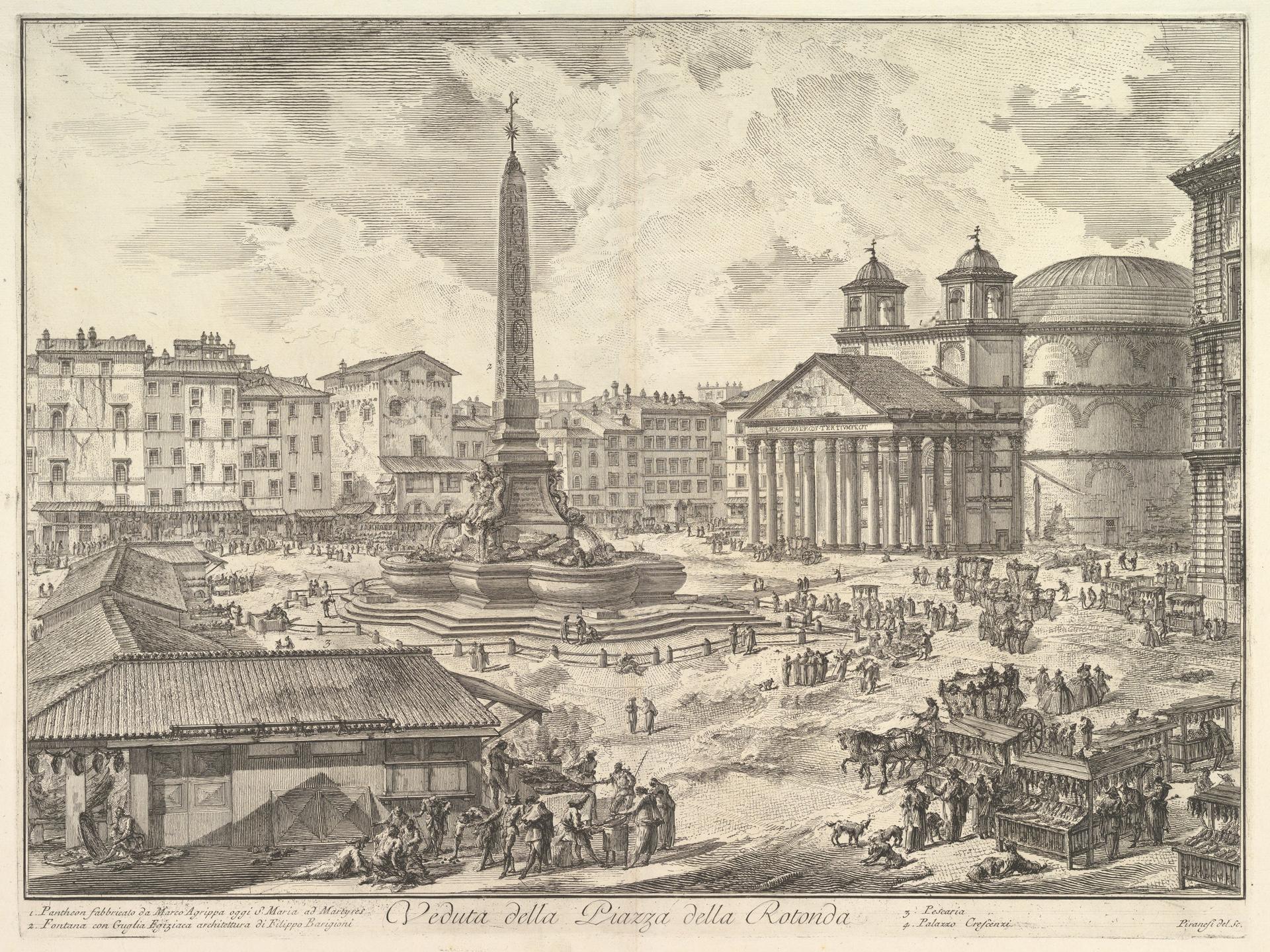
The Piazza della Rotonda, with the Pantheon and Obelisk (Veduta della Piazza della Rotonda), from "Vedute di Roma"
Original title: The Piazza della Rotonda, with the Pantheon and Obelisk (Veduta della Piazza della Rotonda), from "Vedute di Roma"
kurzbeschreibung
Giovanni Battista Piranesi captured the Piazza della Rotonda in an etching around 1751, showing the Roman square, the Pantheon, a fountain in the foreground, and an obelisk at its center. The print belongs to the series 'Vedute di Roma' and was made as an etched plate.
Description
A fountain supported by a column, topped with figures, occupies the foreground. Behind it rises the Pantheon, recognizable by its round dome and colonnade. To the rear right, the Pantheon appears again, while the obelisk marks the middle of the square. Small figures and horse-drawn carriages are scattered across the sheet, giving a sense of the place's expanse. The layout leads the eye toward the Pantheon, with the obelisk as a focal point; soft, diffused light deepens the perspectival space.
Context
From the 1740s onward, Piranesi worked on the 'Vedute di Roma,' a series of etchings recording both ancient and contemporary buildings of Rome. The Piazza della Rotonda was a hub of city life; the Pantheon, once a Roman temple, served as a church in the 18th century. In those years, Rome attracted many Grand Tour travelers, and artists like Piranesi pictured the city for a European audience.
Impact
The print presents the square as both monumental and lively, with the architecture clearly and richly detailed. The orderly arrangement and the bustle of figures create a balance of calm and movement that draws the viewer into the view.
Technique
Piranesi used etching, an intaglio process: the drawing is scratched into a wax layer on a copper plate, which is then etched. With thin lines and hatching, he modeled light and shadow and rendered architectural details precisely. The monochrome print makes perspective and surface textures stand out clearly.
AI-generated description text
Source: Metropolitan Museum of Art · Public Domain (CC0 1.0)