The Piazza di Spagna (Veduta di Piazza di Spagna)
Original title: The Piazza di Spagna (Veduta di Piazza di Spagna)
kurzbeschreibung
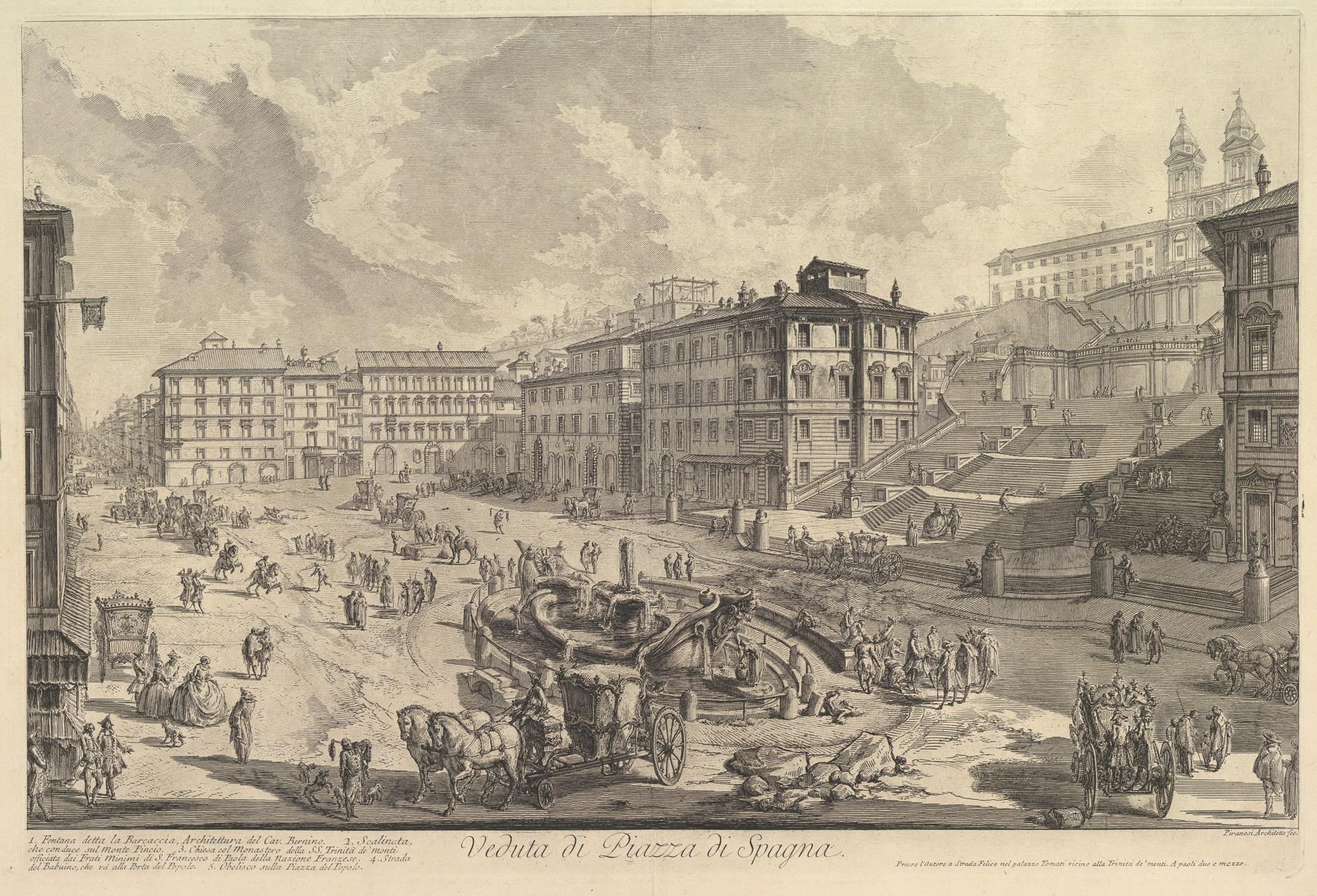
Around 1750, Giovanni Battista Piranesi captured the Piazza di Spagna in an etching. In the foreground, a fountain complex with jets and columns stands amid moving people and horse-drawn carts. Behind it rises a palace with a staircase leading up a hill.
Description
The layout feels balanced, with the fountain as the focal point. Figures in historical dress and horse-drawn carts in the foreground add movement. The buildings behind show Baroque forms, including vaulted roofs and elaborate facades. Light falling from above casts shadows and emphasizes the architecture's structure. The etching stays in grays and whites and is rich in detail.
Context
This veduta was made in the mid-18th century, when Rome was a popular destination on the Grand Tour. Such views served wealthy travelers as souvenirs and recorded the city's ancient and Baroque architecture. Piranesi was regarded as a master of precise and dramatic depictions of Roman buildings. Even then, the Piazza di Spagna was a lively hub of urban life.
Impact
The print evokes the bustling yet spacious atmosphere of the Roman square. The balanced arrangement and bright light give it a calm but lasting presence. The abundance of detail invites a closer look at the view.
Technique
For this etching, the drawing was scratched into a wax layer on a copper plate, and the metal was then etched. Fine lines and hatching bring out architecture and figures in detail. The impressions were made in black on paper, which explains the monochrome effect.
AI-generated description text
Source: Metropolitan Museum of Art · Public Domain (CC0 1.0)