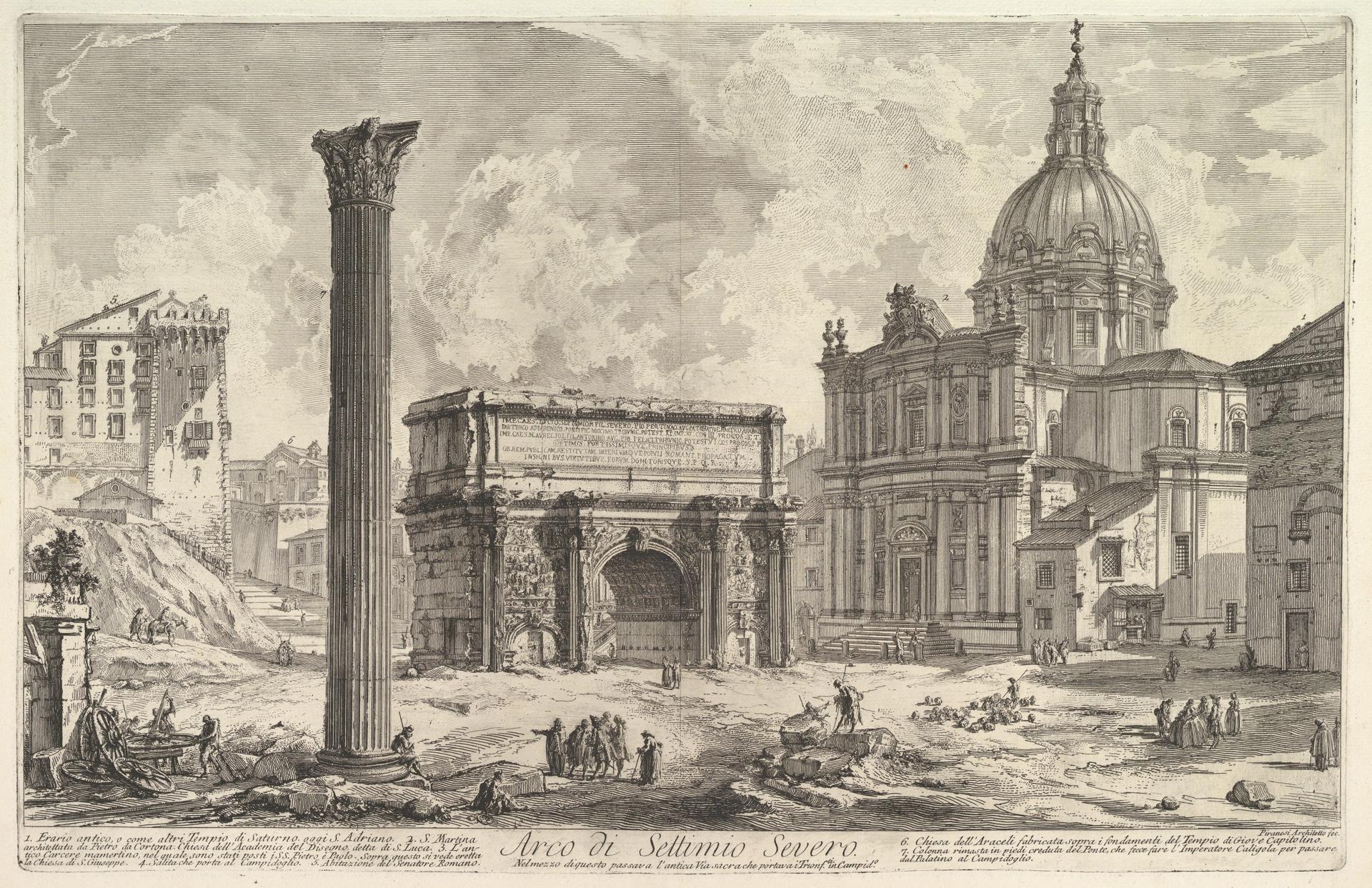
The Arch of Septimius Severus, with the Church of S. Martina on the right (Arco di Settimio Severo), from "Vedute di Roma"
Original title: The Arch of Septimius Severus, with the Church of S. Martina on the right (Arco di Settimio Severo), from "Vedute di Roma"
kurzbeschreibung
Giovanni Battista Piranesi made this etching around 1759 for his Vedute di Roma. It presents the Arch of Septimius Severus in the Roman Forum, with the church of S. Martina rising behind it to the right. This first-state impression records the architecture and its urban setting with remarkable precision.
Description
The layout feels balanced: the triumphal arch anchors the middle, while the church of S. Martina climbs upward on the right with its dome and tower. A column standing in front of the arch dominates the foreground. Numerous small figures populate the sheet, hinting at everyday Roman life. Diffuse light models the architectural members softly, as is typical of Piranesi. The view remains monochrome, drawn with delicate strokes and hatching.
Context
Around 1759 Piranesi was living in Rome and working on his famous series Vedute di Roma. He issued this collection of views of ancient and contemporary buildings from 1748 onward in several editions. The subject of the Arch of Septimius Severus documents the monument's condition in the eighteenth century, embedded among later structures such as the church of S. Martina. Archaeological accuracy went hand in hand with artistic staging, aimed at emphasizing the grandeur of ancient Rome.
Impact
The print feels monumental through its high level of detail and the emphasized architecture. The balanced arrangement and careful linework create a calm, reflective mood. Viewers can wander through the historical scene and sense the grandeur of ancient Rome.
Technique
Piranesi used etching: a copper plate is bitten with acid and then printed. The delicate strokes and hatching result from the etching process and allow precise reproduction of architectural details. The first-state impression shows the work before later revisions, making it especially informative for studying Piranesi's working method.
AI-generated description text
Source: Metropolitan Museum of Art · Public Domain (CC0 1.0)