Della Magnificenza e d'Architettura de' Romani (On the Grandeur and the Architecture of the Romans)
Original title: Della Magnificenza e d'Architettura de' Romani (On the Grandeur and the Architecture of the Romans by Gio. Battista Piranesi, Fellow of the Royal Society of Antiquaries of London)
kurzbeschreibung
This illustrated book by Giovanni Battista Piranesi appeared in 1761 and 1765, gathering etchings and engravings with architectural subjects, above all Ionic capitals. It belongs among his archaeological and architectural-theoretical writings.
Description
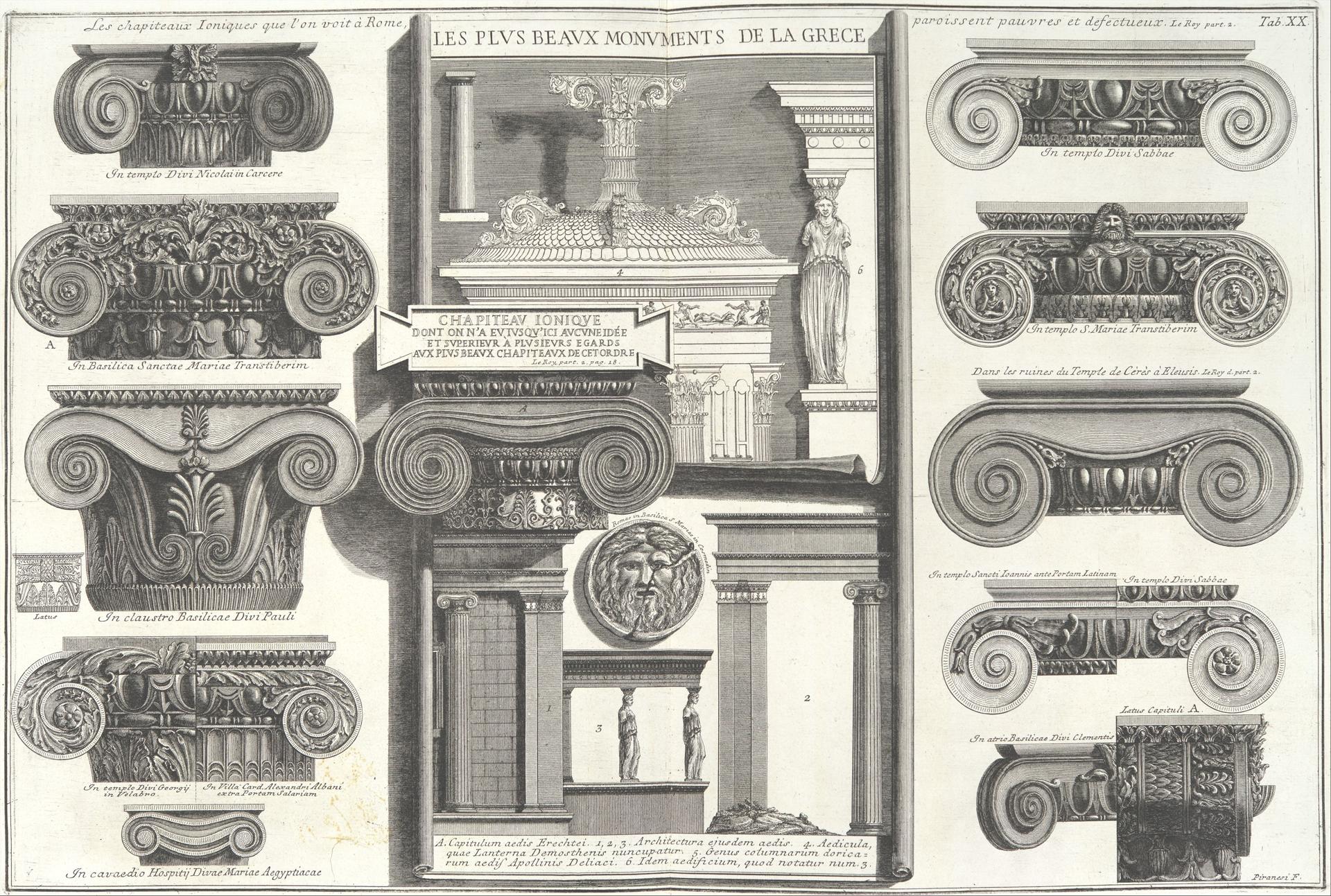
Ionic capitals from several ancient buildings in Rome and Greece are lined up in symmetrical order across the plate. A central capital is shown from different angles, surrounded by further columns and architectural members. Each motif has an explanatory text giving its location and a description. Kept in black and white, the print depends on precise lines and sharp contours; the engraving technique brings out light and shadow and makes the sculptural forms stand out.
Context
The book takes part in the eighteenth-century antiquarian debate over whether Roman or Greek architecture should take precedence, and it argued against positions such as Winckelmann's and others who gave Greek art higher rank. Piranesi worked as an architect and archaeologist and recorded the buildings of ancient Rome with great accuracy. Published in two parts in 1761 and 1765, the work consolidated his reputation as a leading authority on Roman architecture.
Impact
In their precise yet dramatic rendering, the capitals appear monumental and thus underline the grandeur of Roman architecture. The symmetry and wealth of detail in the engravings create an aesthetic order that mirrors the work's scholarly ambition. Sharp contours and the deliberate use of light and shadow give the motifs an almost sculptural presence.
Technique
Etching and engraving are both used, with the lines drawn extremely finely and richly detailed. Spatial depth arises from the etching technique, which allows varying line thickness. The impressions are black and white and printed on high-quality paper, which favors the sharpness of the details.
AI-generated description text
Source: Metropolitan Museum of Art · Public Domain (CC0 1.0)