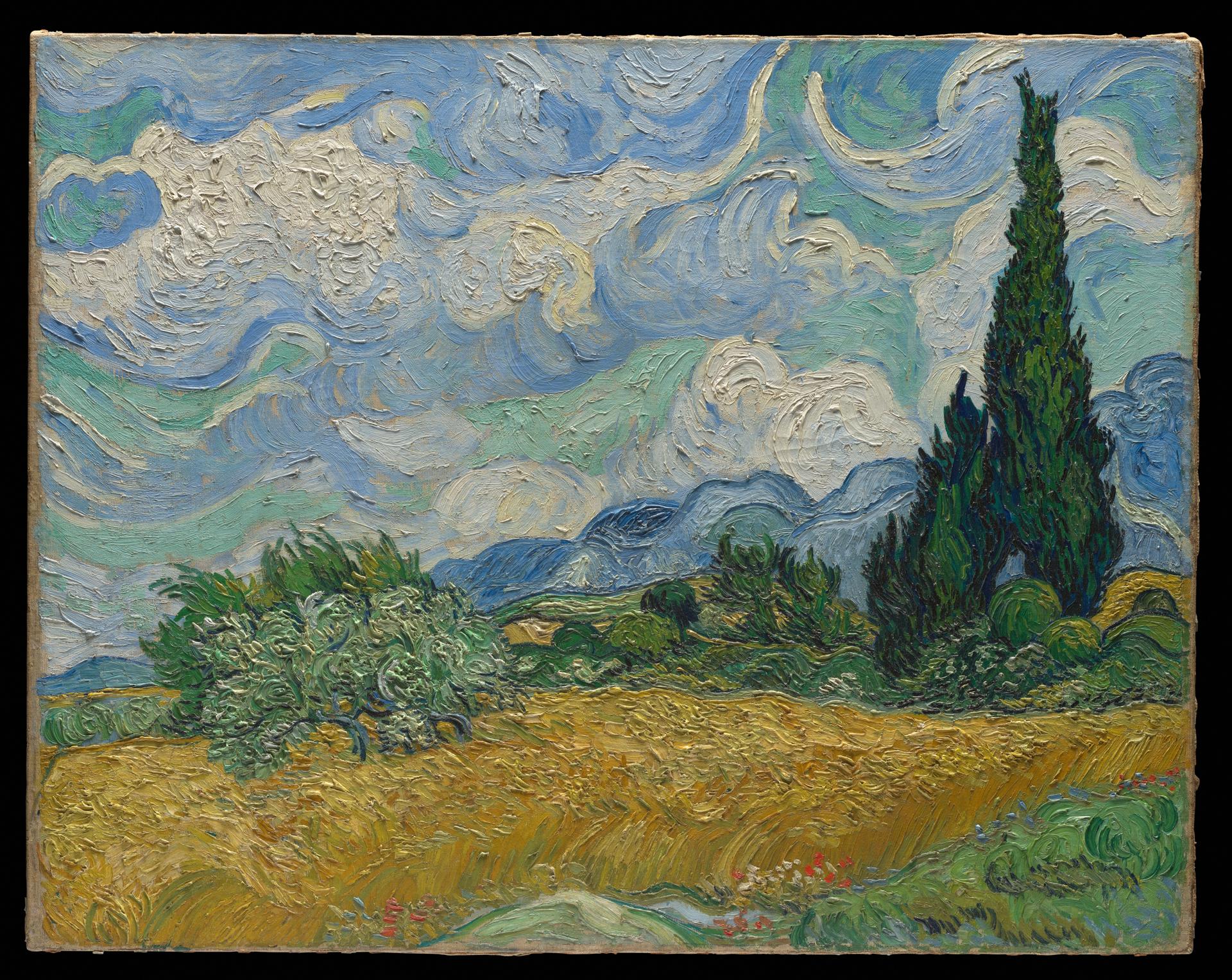
Wheat Field with Cypresses
Original title: Wheat Field with Cypresses
kurzbeschreibung
Vincent van Gogh painted Weizenfeld mit Zypressen in 1889, an oil on canvas that captures a broad, golden wheat field bordered by hills and a restless sky. It belongs to the works he produced during his stay at the Saint-Paul-de-Mausole asylum in Saint-Rémy-de-Provence.
Description
A vast field of intense yellow stretches out, hemmed in by dark shrubs and trees. Behind it rise gentle mountains in blue and green, while the sky is crossed by dynamically swirling blue and white clouds. At the right edge, a single dense green cypress shoots upward, providing a vertical accent. The palette is limited to gradations of yellow, blue, and green, applied in thick, visible brushstrokes.
Context
The picture dates from 1889, when van Gogh had voluntarily committed himself to the psychiatric asylum in Saint-Rémy-de-Provence. He painted it from his room's window, which offered him a view of the surrounding landscape. For van Gogh, the cypress embodied death and eternity, a motif he returned to repeatedly during that time. The work belongs to a series of landscapes made during his stay in the south of France. Van Gogh himself rated it among his finest landscape paintings.
Impact
The luminous yellows and blues evoke a vibrating, almost spiritual mood that makes nature appear powerful and sublime. The thick application of paint gives the picture a tangible presence that pulls the viewer directly into the space of the image. The dynamic brushwork conveys movement and emotional intensity characteristic of van Gogh's mature style.
Technique
The painting is executed in oil on canvas, with broad, visible brushstrokes that clearly bring out the texture of the paint. Van Gogh applied the paint thickly, sometimes straight from the tube, and used the brush hairs to create structure and movement in the picture. The colors were placed side by side in unmixed, strong tones to achieve optical vibrancy.
AI-generated description text
Source: Metropolitan Museum of Art · Public Domain (CC0 1.0)