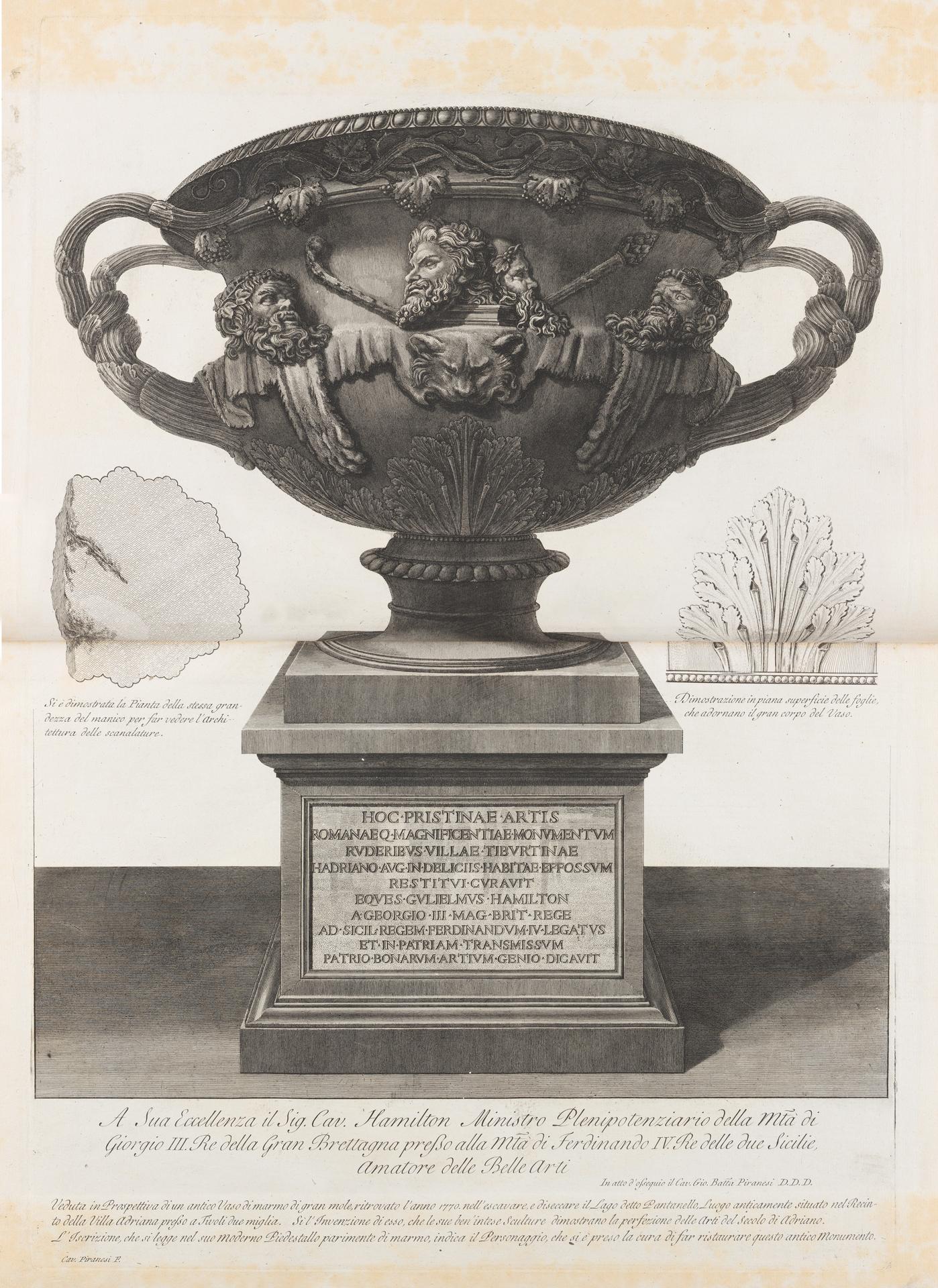
Vasi, candelabri, cippi, sarcofagi, tripodi, lucerne, ed ornamenti antichi disegnati ed incisi dal Cav. Gio. Batt. Piranesi, Vol. I
Original title: Vasi, candelabri, cippi, sarcofagi, tripodi, lucerne, ed ornamenti antichi disegnati ed incisi dal Cav. Gio. Batt. Piranesi, Vol. I (Vases, candelabra, grave stones, sarcophagi, tripods, lamps, and ornaments designed and etched by Cavalieri Giovanni Battista Piranesi)
kurzbeschreibung
With this volume Piranesi opens a series of etchings planned in four parts, produced between 1778 and 1780. Unlike many purely architectural plates of his time, the present image centers on an antique vase with figural decoration, flanked by smaller sketches. Everything is executed in black and white and with that abundance of detail characteristic of the artist's work.
Description
At the heart of the sheet stands a two-handled vessel whose rim is crowned with heads and faces. Bands adorn these heads, which appear in armor or drapery, pointing both to the military and the ceremonial. An inscription panel with Latin words sits on the base and provides information about the piece's origin and significance. To either side are smaller studies reproducing individual parts of the vessel or related objects.
Context
The series was published in Rome, where Piranesi had devoted himself entirely to the study and documentation of ancient Roman art. With the publication he pursued the goal of placing Etruscan and Roman art above Greek art. The models were ancient originals he had studied in collections and at excavations. The intended audience was collectors and scholars interested in the reconstruction of ancient artifacts.
Impact
What sets this print apart from related vase depictions is the interplay between the monumental single figure and the precisely worked subsidiary studies. The carefully controlled line renders the ornaments in such a way that the viewer feels transported to antiquity without losing clarity. The combination of main motif and detail studies creates a documentary density that also carries aesthetically. The black and white enhances the plasticity of the forms and brings out the virtuosity of the etching technique.
Technique
The sheet was made as an etching: the drawing was transferred to a copper plate, which was then exposed to acid. With fine lines and hatching Piranesi worked out shadows and textures. The high level of detail demanded precisely controlled biting as well as several printing passes.
AI-generated description text
Source: Metropolitan Museum of Art · Public Domain (CC0 1.0)