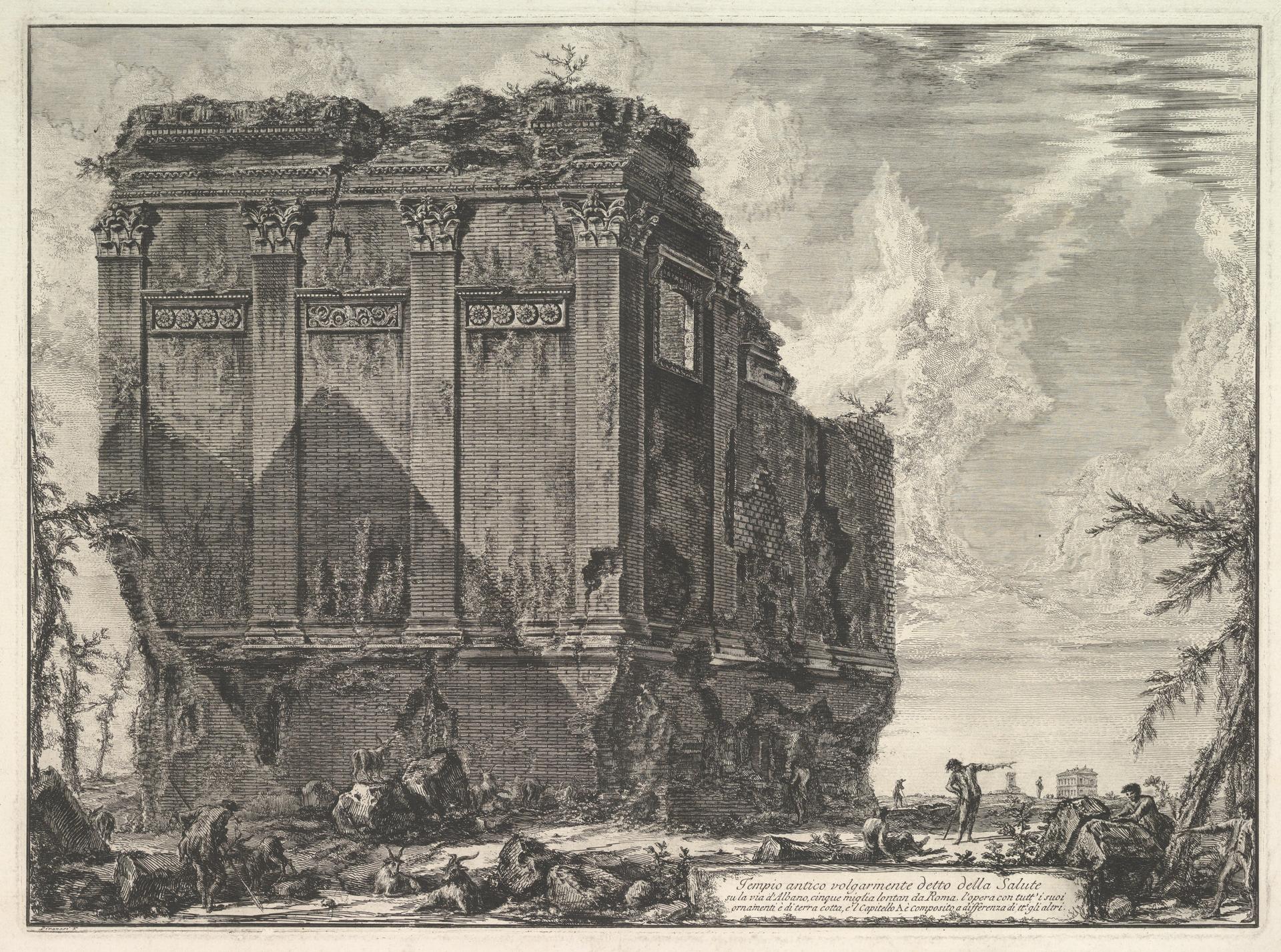
The so-called Temple of Salus, on the road to Albano (Tempio antico volgarmente detto della Salute)
Original title: The so-called Temple of Salus, on the road to Albano (Tempio antico volgarmente detto della Salute)
kurzbeschreibung
Giovanni Battista Piranesi made this etching around 1763. It records the ruin of an ancient temple set down in an Italian landscape, one of the vedute in which he fixed antique buildings within their surroundings. Etching as a process allowed him unusually fine lines and subtly graded shadows.
Description
The layout is balanced and nearly symmetrical, with the broken temple at its heart, hemmed in by trees and shrubs. Goats graze in the foreground, and two figures stand on a clearing farther off. A sky heavy with cloud gives the picture a dramatic mood. The masonry carries Corinthian capitals and visible cracks that drive home the state of decay.
Context
The print belongs to Piranesi's series Antichità d'Albano, which documents the ancient ruins around Rome. At the time the temple was wrongly called the Temple of Salus, though its real purpose is unknown. Piranesi joined archaeological care to staged composition in order to convey the grandeur of antiquity. The work dates from a period when the Grand Tour was sharpening European travellers' appetite for Roman ruins.
Impact
A melancholy note runs through the image, deepened by the diffuse light and the crumbling architecture. The gap in scale between the monumental ruin and the small figures and animals stresses how quickly human works pass. The symmetrical arrangement lends the sheet a calm, almost solemn dignity.
Technique
Piranesi worked as an etcher: the drawing is scratched through a wax ground on a copper plate and then bitten with acid. Fine lines and varied hatching build rich tones and a sense of modelled form. The impression was pulled in black and white on paper, with light and shade controlled by how densely the lines are laid.
AI-generated description text
Source: Metropolitan Museum of Art · Public Domain (CC0 1.0)