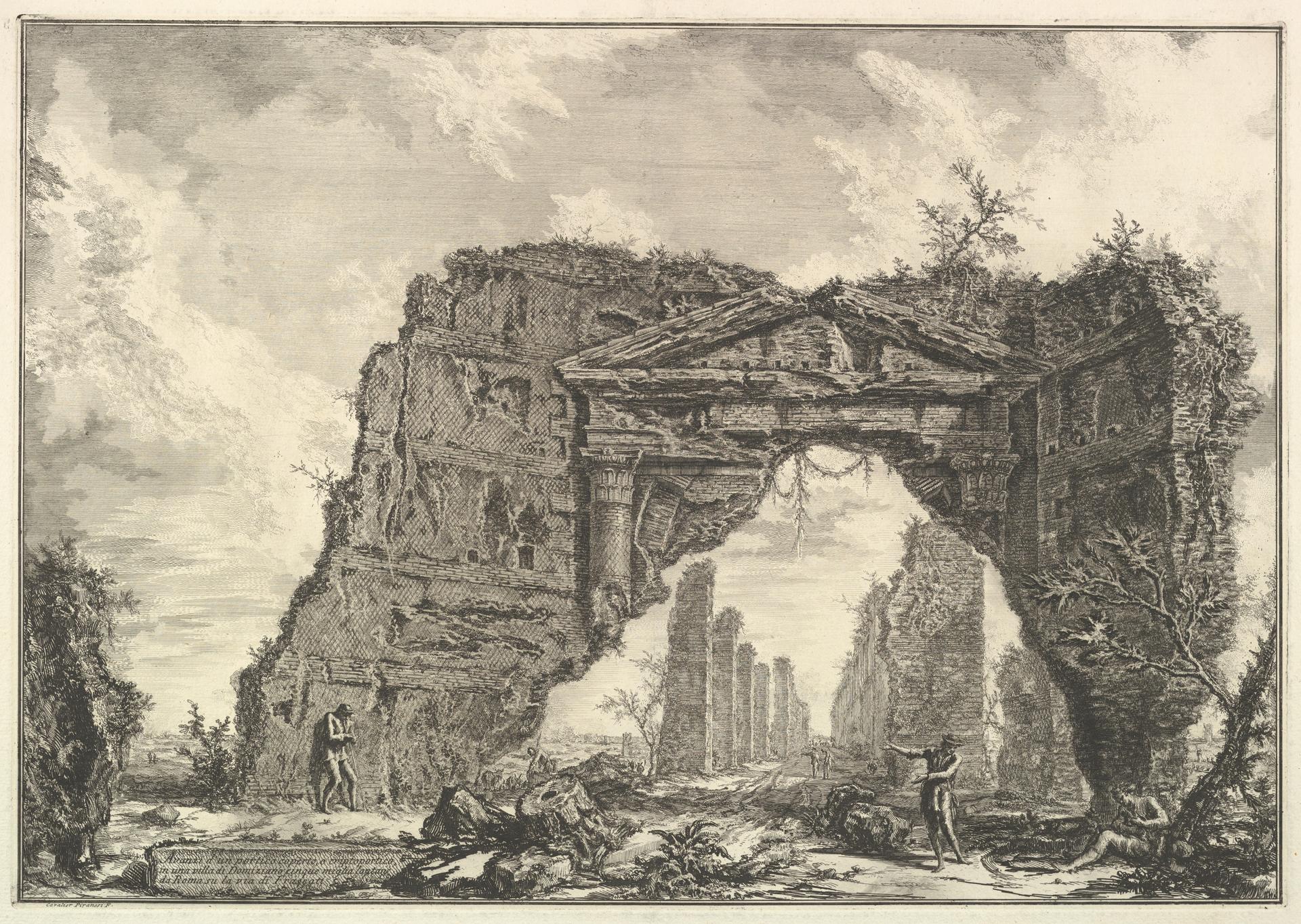
Remains of a covered portico, or a cryptoporticus, in a villa of Domitian, five miles outside Rome on the Frascati road, from Vedute di Roma (Roman Views)
Original title: Remains of a covered portico, or a cryptoporticus, in a villa of Domitian, five miles outside Rome on the Frascati road, from Vedute di Roma (Roman Views)
kurzbeschreibung
This etching records the remains of an ancient covered portico that belonged to a villa of Domitian near Rome. Piranesi made the print around 1766 for his Vedute di Roma, blending an archaeological inventory with a picturesque landscape view.
Description
Overgrown columns of a once-roofed passage fill the image, with shrubs and plants spreading between them. Two small figures walk through the ruins in the foreground, a road runs straight through the structure, and the distant silhouette of Rome traces the horizon. The layout is symmetrical, with the ruin motif at its center. Clouds and architectural forms create strong areas of light and shadow in the black-and-white print.
Context
The Vedute di Roma were produced between 1748 and 1778 as a series of views of Roman buildings. This print, from around 1766, belongs to the first of four states (Hind). Domitian's villa lay about five miles from Rome on the Via di Frascati and was a popular destination for artists and antiquarians in the eighteenth century. In his vedute, Piranesi combined topographical accuracy with a dramatic, subjective vision.
Impact
The overgrown columns and tiny figures evoke a melancholy mood of decay. The immense ruin feels both sublime and transient, in keeping with eighteenth-century aesthetics.
Technique
Fine lines and graded hatching capture the surfaces of stone and plants in this etching, printed in black and white on paper. The sheet measures 52.5 x 67.5 cm, the plate 42.5 x 60.5 cm.
AI-generated description text
Source: Metropolitan Museum of Art · Public Domain (CC0 1.0)