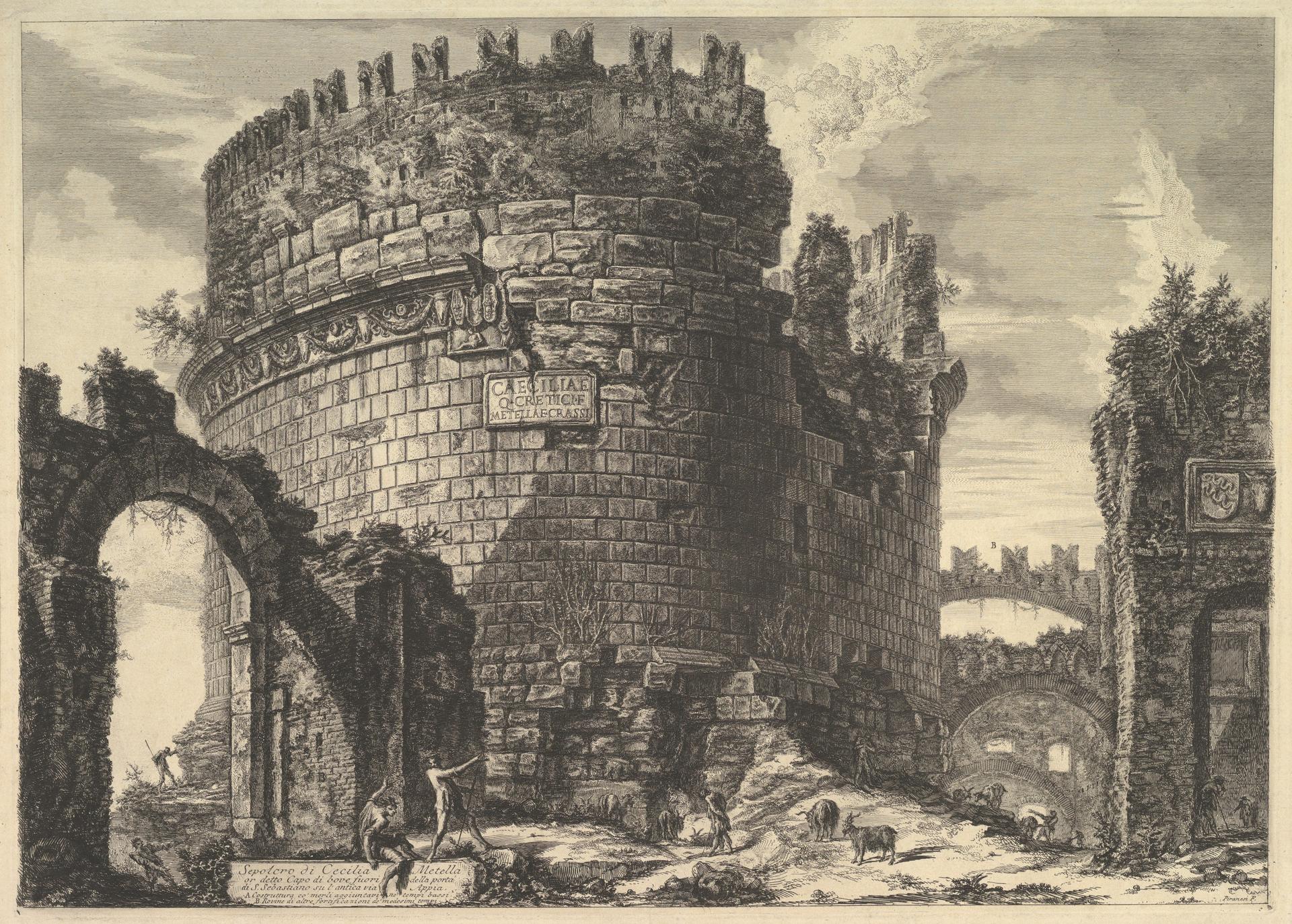
The Tomb of Caecilia Metella, from Vedute di Roma (Roman Views)
Original title: The tomb of Caecilia Metella, from Vedute di Roma (Roman Views)
kurzbeschreibung
Giovanni Battista Piranesi devotes this etching from his Vedute di Roma to the Tomb of Caecilia Metella on the Via Appia Antica. The print dates from about 1762 and is the first of five known states (Hind).
Description
The round burial tower bearing the inscription 'CAECILIAE QVIRINIS CIVIS METELLAE CRASSI' anchors the view. A partly ruined wall overgrown with plants surrounds it. On the left, an arched gateway opens onto the landscape; on the right, another arch belongs to a bridge. People and animals stay in the foreground near the monument. Diffuse light heightens the sense of decay on the tower.
Context
The Vedute di Roma were issued as a series of views of Roman monuments from the 1740s onward. The mausoleum of Caecilia Metella, built in the 1st century BC, was a popular stop on the Grand Tour in the 18th century. In his vedute Piranesi combined topographic accuracy with a dramatic staging of ruins.
Impact
A sublime, melancholic mood pervades the sheet, typical of Piranesi. The monumentally scaled ruin gains further grandeur from the small figures, bringing the transience of Roman greatness into focus.
Technique
Piranesi worked in etching: the drawing is scratched into an acid-resistant ground on a copper plate and then bitten by acid. His prints are distinguished by fine, precise linework and graduated shading.
AI-generated description text
Source: Metropolitan Museum of Art · Public Domain (CC0 1.0)