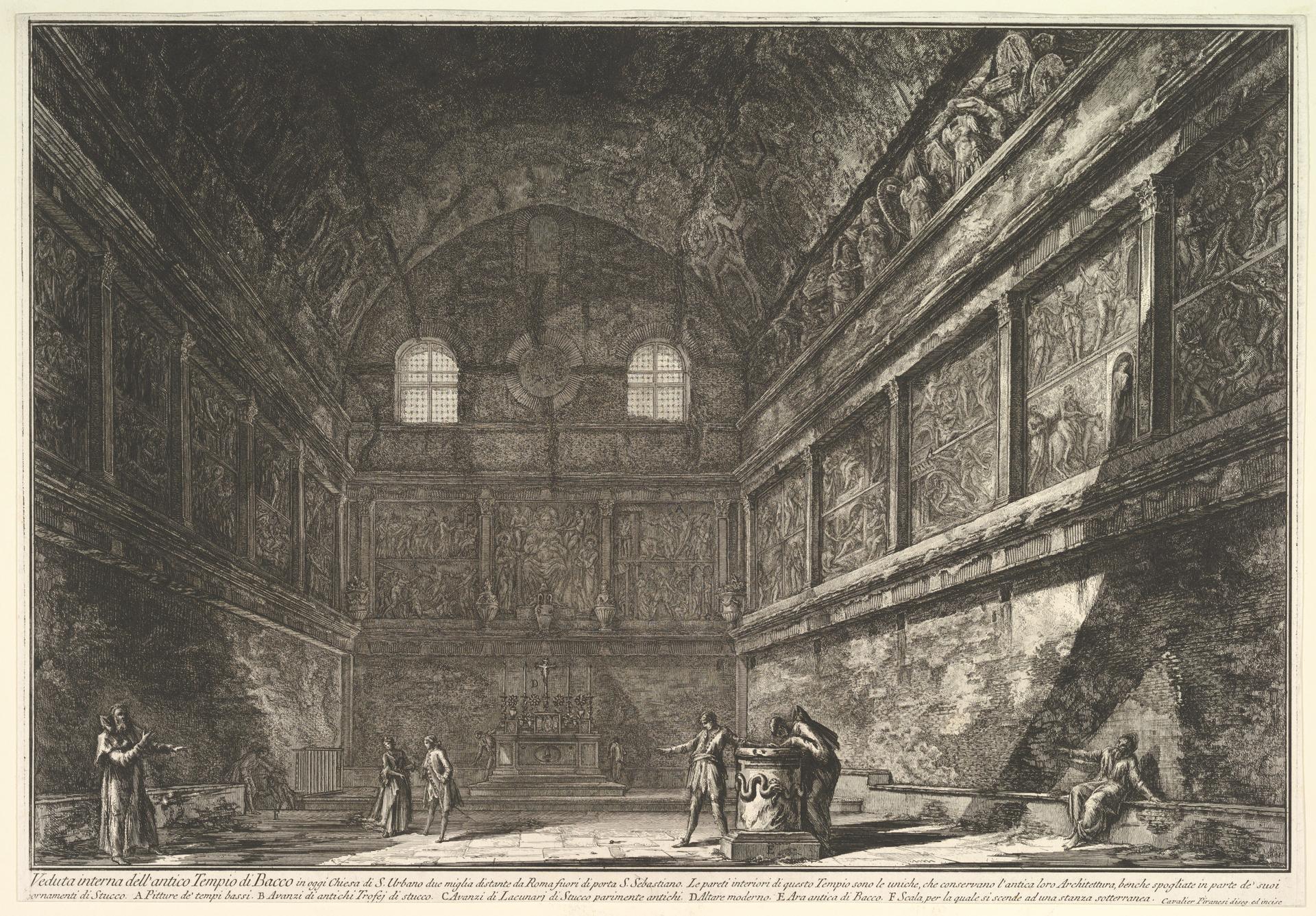
The so-called Temple of Bacchus, now the Church of S. Urban, interior (Veduta interna dell antico Tempio di Bacco, or. di S. Urbano)
Original title: The so-called Temple of Bacchus, now the Church of S. Urban, interior (Veduta interna dell antico Tempio di Bacco, or. di S. Urbano)
kurzbeschreibung
Giovanni Battista Piranesi’s etching from the Vedute di Roma, made around 1767, leads the viewer into the interior of an ancient Roman building that later served as the church of S. Urbano. The print captures the monumental aesthetic of ruins and animates it with small staffage figures.
Description
Several figures in traditional dress stand and sit in the foreground, some in conversation, others motionless. From them, a central axis draws the eye symmetrically into the depth of the space. Reliefs and sculptures adorn the walls, the ceiling carries architectural decoration, and light enters through two openings above. The gray tones of the etching and its graded hatching create a dramatic mood through light and shadow.
Context
This view belongs to the Vedute di Roma, in which Piranesi recorded ancient and baroque buildings of Rome in etchings. The structure was first thought to be a temple of Bacchus before it was identified as the church of San Urbano. In his dramatic architectural scenes, Piranesi combined archaeological interest with artistic license.
Impact
The alternation of bright incoming light and deep shadows gives the sheet a sublime, almost theatrical atmosphere. The staffage figures lend the monumental architecture a human scale and heighten the historical impression.
Technique
As an etching, a metal plate was treated with acid to produce fine lines. Piranesi worked with precise, sharp lines and varied hatching that render buildings and figures in rich detail. The dimensions of 42.2 x 60.3 cm correspond to his large-format vedute.
AI-generated description text
Source: Metropolitan Museum of Art · Public Domain (CC0 1.0)