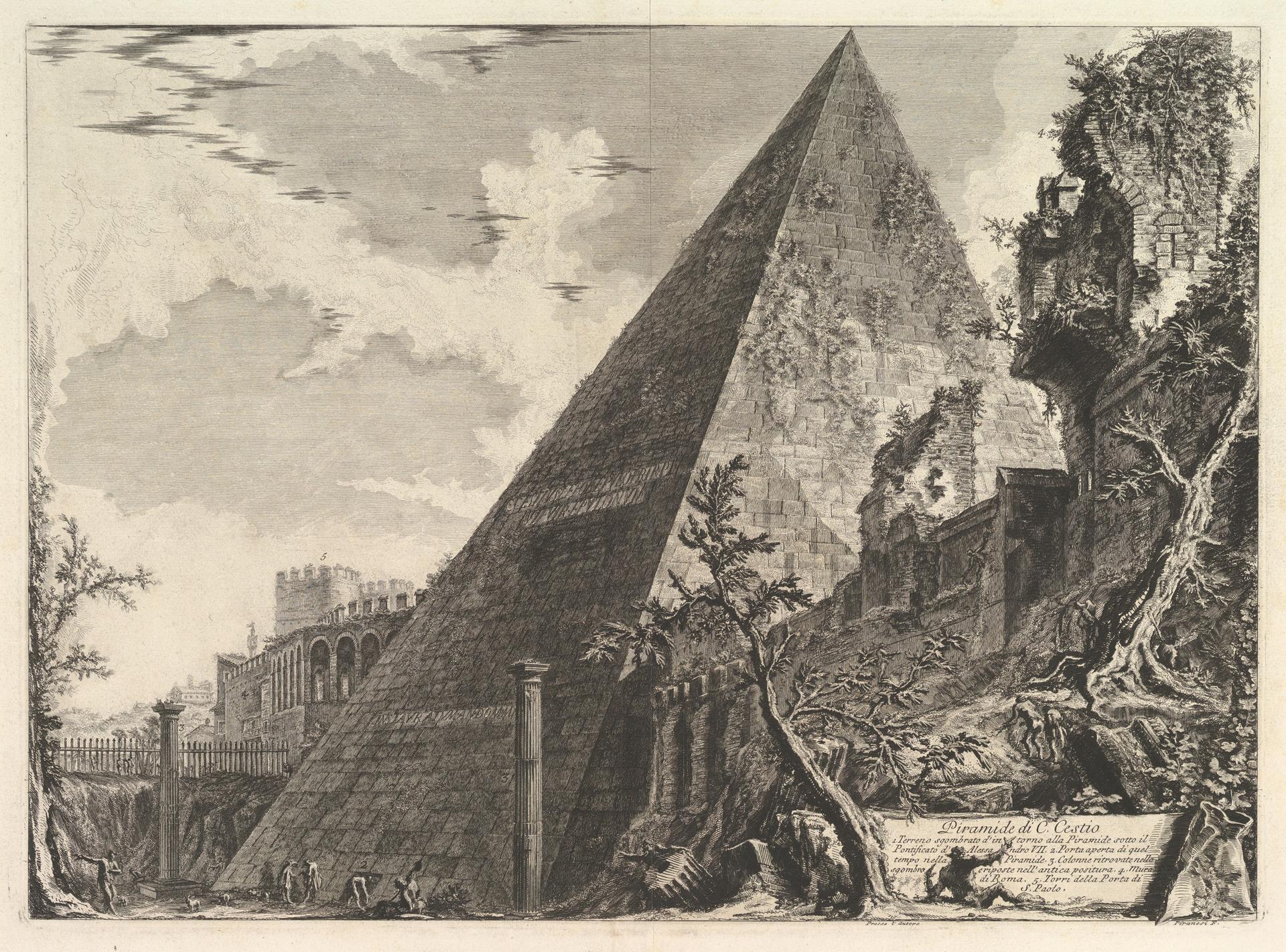
The Pyramid of Gaius Cestius, from Vedute di Roma (Roman Views)
Original title: The Pyramid of Gaius Cestius, from Vedute di Roma (Roman Views)
kurzbeschreibung
Unlike many vedute of its time, this print does not present the Pyramid of Cestius as an isolated monument but ties it closely to the surrounding city wall. Giovanni Battista Piranesi's sheet belongs to the Vedute di Roma series and was made around 1756. It is executed as an etching, printed in the etching technique.
Description
The layout feels balanced, with the pyramid as the still point. In the foreground two figures bend over the ground. On the structure itself, signs of weathering and encroaching plants are visible. Behind it appears a wall with columns, and beside that further ruins. A cloud-covered sky dims the light and keeps the sheet in shades of gray.
Context
The Vedute di Roma gathered views of Roman buildings and appeared from the 1740s onward. The tomb of Cestius was a well-known ancient monument and in the eighteenth century was incorporated into the city wall. Piranesi recorded the architecture of Rome with archaeological interest but also allowed himself artistic liberties. His work fell in a period when Rome was among the most popular stops on the Grand Tour.
Impact
A quiet, almost wistful tone lies over the sheet, brought about by the overcast sky and the aged pyramid. Finely graded lines and shadows form a dense texture that makes the age of the structure palpable.
Technique
Piranesi worked as an etcher: the drawing was scratched into a copper plate and then bitten with acid. In printing, fine lines and hatching model structure and shadow. The present impression is the first state of three, as recorded by Hind.
AI-generated description text
Source: Metropolitan Museum of Art · Public Domain (CC0 1.0)