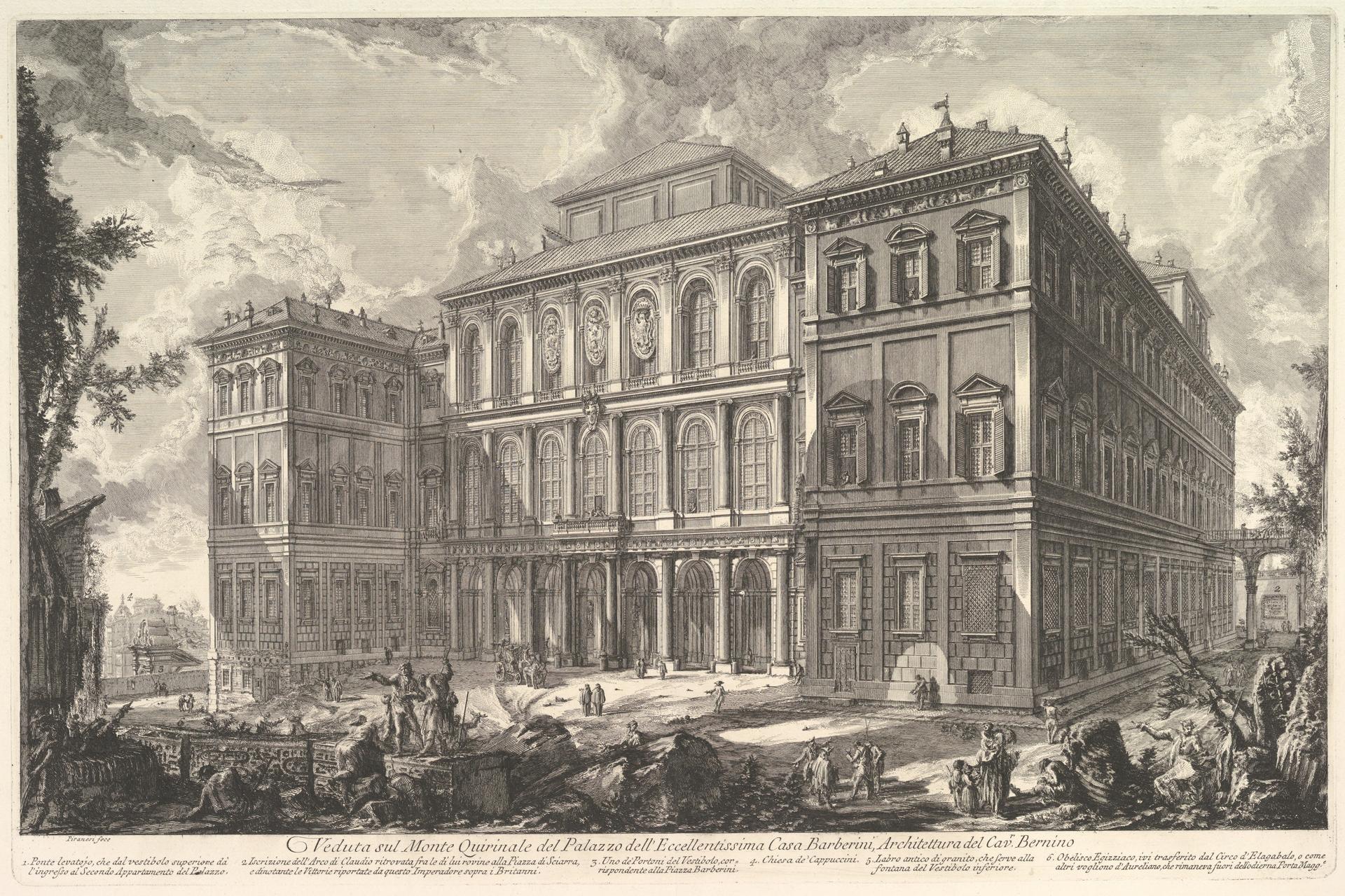
View of the palace of the illustrious Barberini family on the Quirinal Hill, designed by Cavaliere Bernini, from Vedute di Roma (Roman Views)
Original title: View of the palace of the illustrious Barberini family on the Quirinal Hill, designed by Cavaliere Bernini, from Vedute di Roma (Roman Views)
kurzbeschreibung
Giovanni Battista Piranesi captured the Palazzo Barberini on the Quirinal in Rome in an etching; the palace's design is by Gian Lorenzo Bernini. The sheet belongs to the Vedute di Roma series, dates to around 1750–1759, and survives in the first of five states. It offers a highly detailed architectural view, with figures inserted among the buildings.
Description
The Palazzo Barberini dominates the layout, placed symmetrically at the center and rising through several storeys of arcades and columns. Classical columns and pilasters cover the facade in dense profusion. A few isolated figures stand on the paved square in front, flanked by trees and shrubs. Further buildings are suggested beyond the palace, and clouds fill the sky. The etching's greys bring out the depth and structure of the building with great clarity.
Context
Piranesi issued the Vedute di Roma, a series of views of Roman buildings, in several editions between 1748 and 1778. Construction on the Palazzo Barberini began in 1625 to plans by Carlo Maderno and was later completed by Bernini and Francesco Borromini. Piranesi presented the palace as a monument of Baroque architecture, and his views often employed idealized perspectives. The etching falls in a period when Rome was becoming the center of Grand Tour tourism.
Impact
The symmetrical arrangement and the precise rendering of the architecture give the sheet a calm, monumental presence. Scattered figures and the clouded sky lend it a lively, atmospheric mood that carries the viewer back to eighteenth-century Rome.
Technique
Etching as a technique here reveals how fine lines and dense hatching bring out the details of the facade and the landscape. In this process the drawing is incised into a wax layer on a copper plate and then bitten with acid; the inked plate is printed onto paper. This first state preserves an early version that was later reworked.
AI-generated description text
Source: Metropolitan Museum of Art · Public Domain (CC0 1.0)