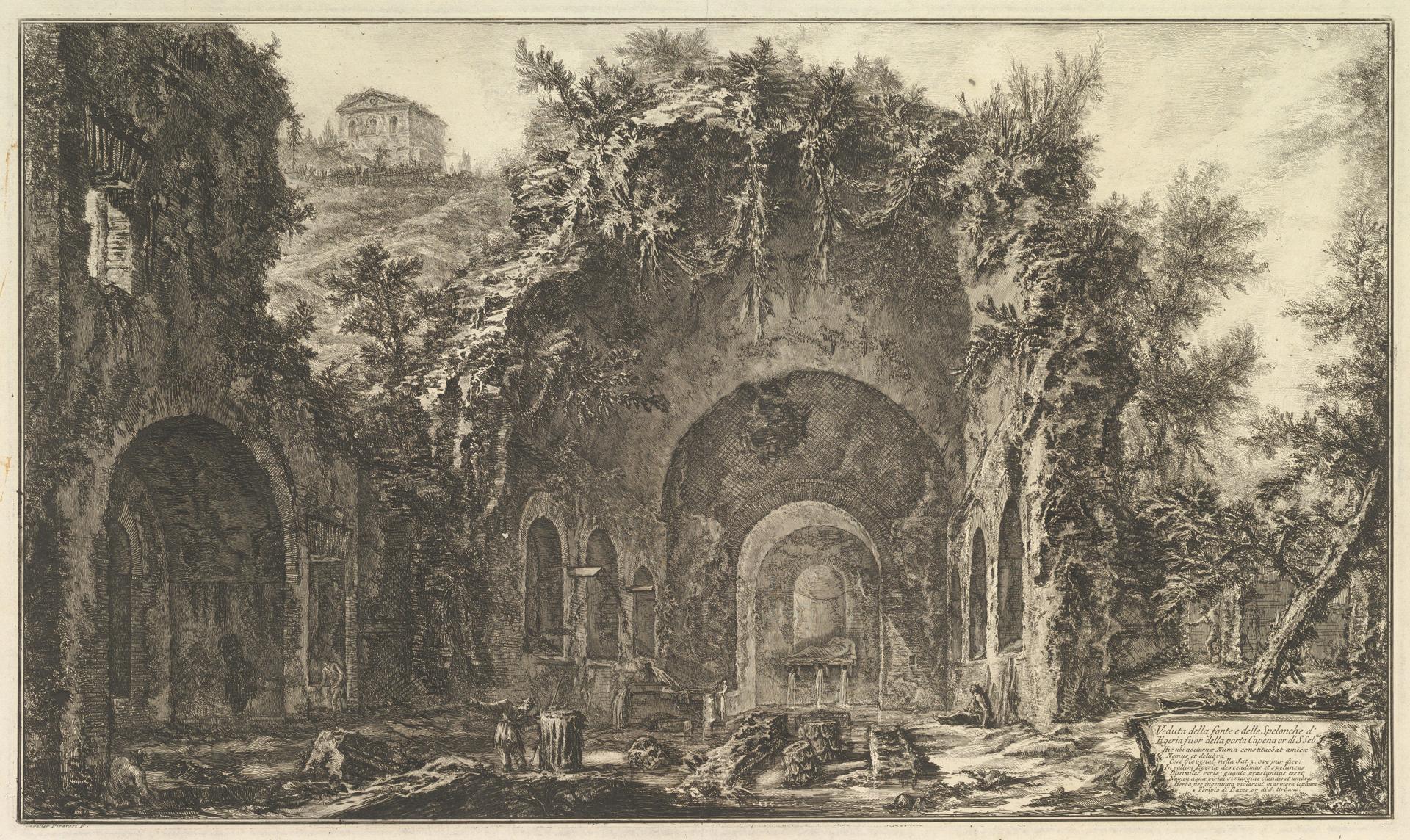
The so-called Grotto of Egeria (Veduta della fonte e delle spelonche d'Egeria fuor della Porta Capena)
Original title: The so-called Grotto of Egeria (Veduta della fonte e delle spelonche d'Egeria fuor della Porta Capena)
kurzbeschreibung
Overgrown arches and columns dominate the foreground of this etching by Giovanni Battista Piranesi, made around 1766. The horizontal print (40.6 x 69.2 cm) records the so-called Grotto of Egeria outside the Porta Capena in Rome and belongs to the series of vedute in which Piranesi set down the ancient sites of the city. The ruined architectural elements are thickly covered with vegetation.
Description
Dense vegetation winds across the stone arches and columns that fill the foreground and read as the remains of a lost structure. Behind them, on a rise, stands a building surrounded by trees and shrubs. Soft, diffuse light lies over the view and brings out the surfaces of stone and foliage. The palette stays within greys and blacks, which carries the quiet, historical mood of the sheet.
Context
This veduta dates from the years when Rome, in the mid-eighteenth century, became the centre of the Grand Tour. The Grotto of Egeria was linked to the nymph of Roman myth who, according to tradition, met King Numa Pompilius here. Piranesi recorded the ancient sites of Rome in etchings in order to document both their grandeur and their decay. The overgrown ruins answered the taste of the period for the aesthetics of ruin and the sublimity of antiquity.
Impact
A calm, melancholy atmosphere emanates from the print, carried by the soft light and the ruins overrun with plants. The precise rendering of architecture and vegetation invites close looking at individual passages. The monochrome palette strengthens the historical, timeless character of the image.
Technique
The drawing was incised into a copper plate and bitten with acid — an etching. Piranesi worked with fine lines and hatching to convey effects of light and shadow and the textures of stone and plants. The process allowed both the precise rendering of architectural detail and a large print run.
AI-generated description text
Source: Metropolitan Museum of Art · Public Domain (CC0 1.0)