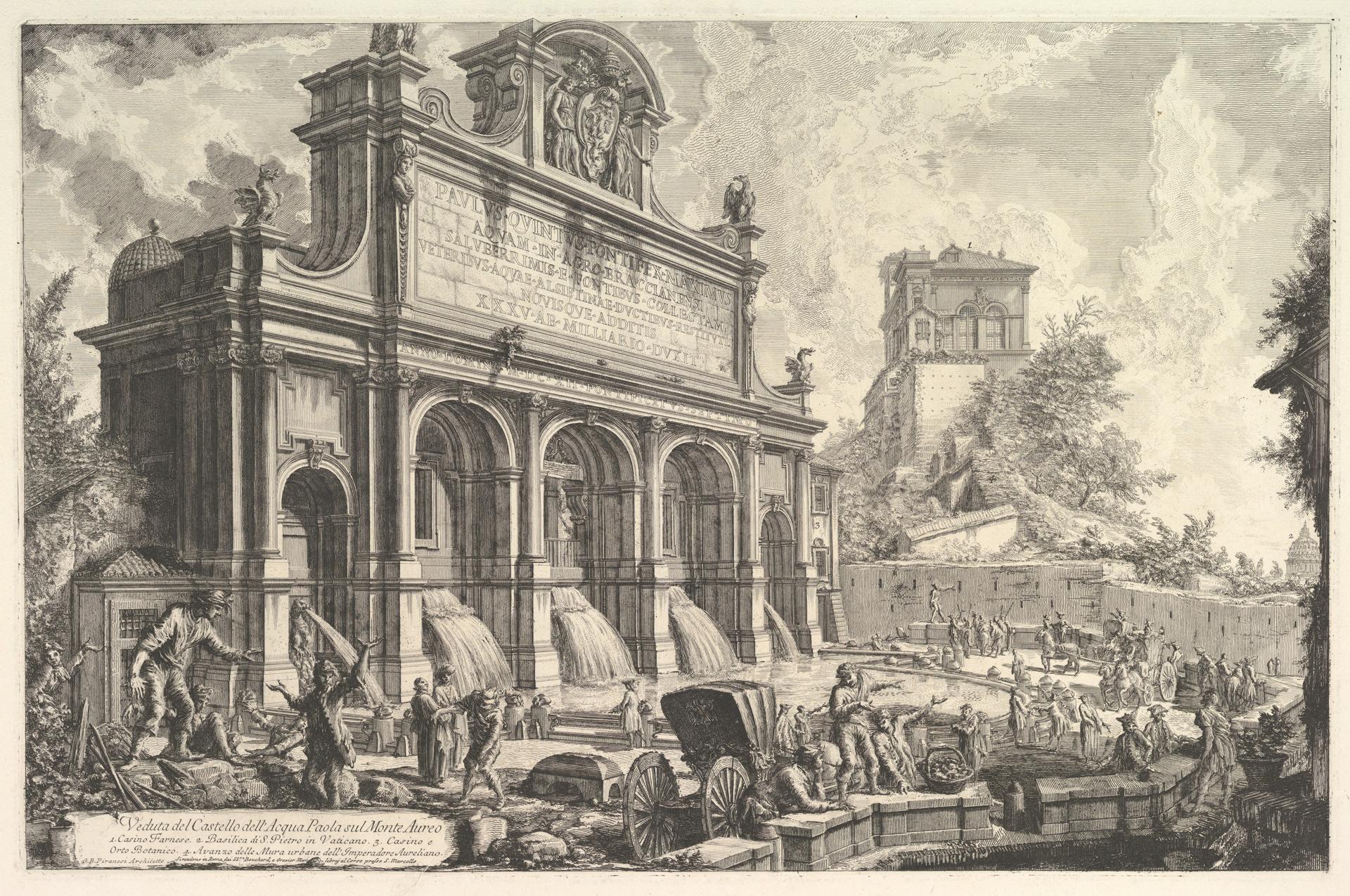
View of the Fountainhead of the Acqua Paola on Monte Aureo, from Vedute di Roma (Roman Views)
Original title: View of the Fountainhead of the Acqua Paola on Monte Aureo, from Vedute di Roma (Roman Views)
kurzbeschreibung
Around 1751, Giovanni Battista Piranesi etched 'The Fountain Head of the Acqua Paola on Monte Aureo' for his series 'Vedute di Roma'. The subject presents the monumental fountain in Rome, with its richly ornamented front and gushing water as the focal point. The print is executed as an etching on paper.
Description
Your eye is drawn first to the large fountain in the foreground, where water pours from several pipes into basins below. Above the fountain head rises an elaborate architectural structure with columns, capitals, and sculptures. Behind it, further buildings of the Roman city are layered. Numerous figures enliven the scene: some work at the fountain, others watch or go about their business. The image remains in shades of gray; the light is soft, bringing out the depth of space.
Context
Piranesi had lived in Rome since 1740 and created this etching there around 1751. It belongs to the 'Vedute di Roma', which he began publishing in 1748 and which presented both ancient and contemporary Rome to a wide audience. The Acqua Paola is a restored ancient aqueduct inaugurated in 1612 on Monte Aureo (the Janiculum). With this veduta, Piranesi pursued a commercial venture aimed at travelers and collectors of the Grand Tour.
Impact
The precise rendering of the powerful fountain architecture stands out, given volume by careful linework and graduated gray tones. Architectural precision combines with a lively staffage of figures, creating a dense atmosphere that immerses the viewer in eighteenth-century Roman daily life.
Technique
For this etching, the drawing was bitten into a copper plate, with acid deepening the lines. The process allows fine strokes and shading, visible in the grayscale reproduction. The sheet measures 47.8 x 69.6 cm, the plate 40.4 x 61.8 cm.
AI-generated description text
Source: Metropolitan Museum of Art · Public Domain (CC0 1.0)