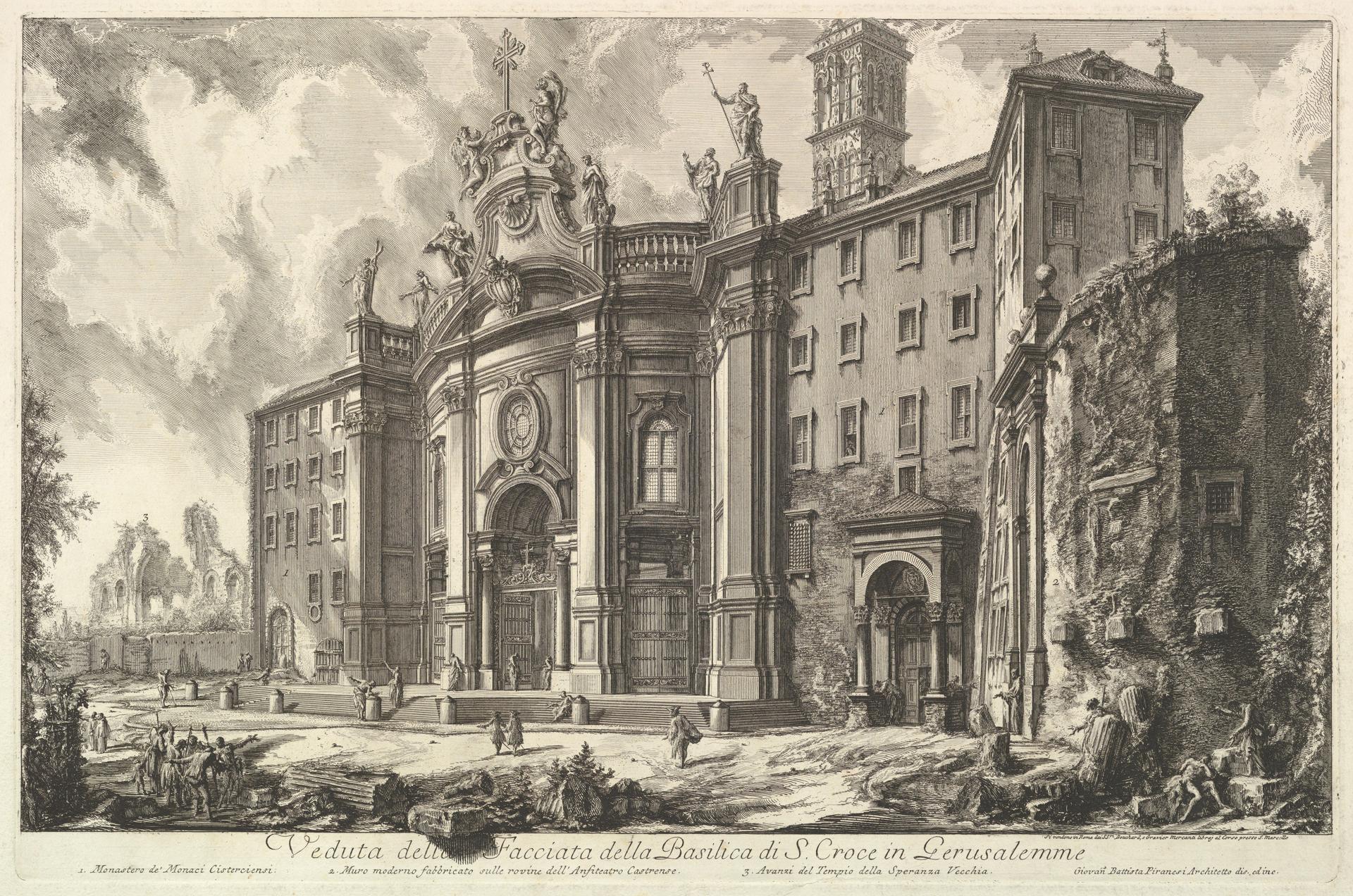
View of the Façade of the Basilica of S. Croce in Gerusalemme, from Vedute di Roma
Original title: View of the Façade of the Basilica of S. Croce in Gerusalemme [the Holy Cross in Jerusalem], from Vedute di Roma (Roman Views)
kurzbeschreibung
The facade of the Roman basilica of S. Croce in Gerusalemme rises as a massive structure in this etching by Giovanni Battista Piranesi. Made around 1750, the print belongs to the Vedute di Roma series and is in its first of six states.
Description
The broad, tall church front, with its columns, pilasters and great portal, is arranged symmetrically before the viewer's eye. Above the entrance a central dome swells, crowned by a cross. To the sides, further buildings and ruins—a temple, a monastery—step back in layers, making the basilica's grandeur stand out. Scattered figures, walking, standing or sitting, populate the square; their small scale makes the monumentality of the architecture truly tangible. Fine hatching and graduated contrasts create light, shadow and the surfaces of the stone in this grayscale etching.
Context
With the Vedute di Roma, Piranesi produced an extensive series of etchings recording both ancient and contemporary buildings of Rome. The basilica of S. Croce in Gerusalemme, founded in the 4th century, had been rebuilt several times by the 18th century. In an era when Rome became the center of the Grand Tour, the artist addressed travelers and collectors who acquired such prints as souvenirs. Piranesi was regarded as a master of precise architectural rendering that emphasized the power of buildings.
Impact
The layout is clear and symmetrical, the account of the architecture rich in detail. Massive building volumes meet tiny figures—a relationship that turns the viewer into an astonished visitor. Precise lines and carefully placed contrasts give the print the graphic sharpness for which Piranesi is known.
Technique
The image is created as an etching, an intaglio process, by scratching the drawing into a wax layer on a copper plate and then etching the plate. Piranesi used fine, sharp lines and varying hatching densities to bring out light and shadow. That the print represents the first of six states indicates careful reworking and refinement of the plate by the artist.
AI-generated description text
Source: Metropolitan Museum of Art · Public Domain (CC0 1.0)