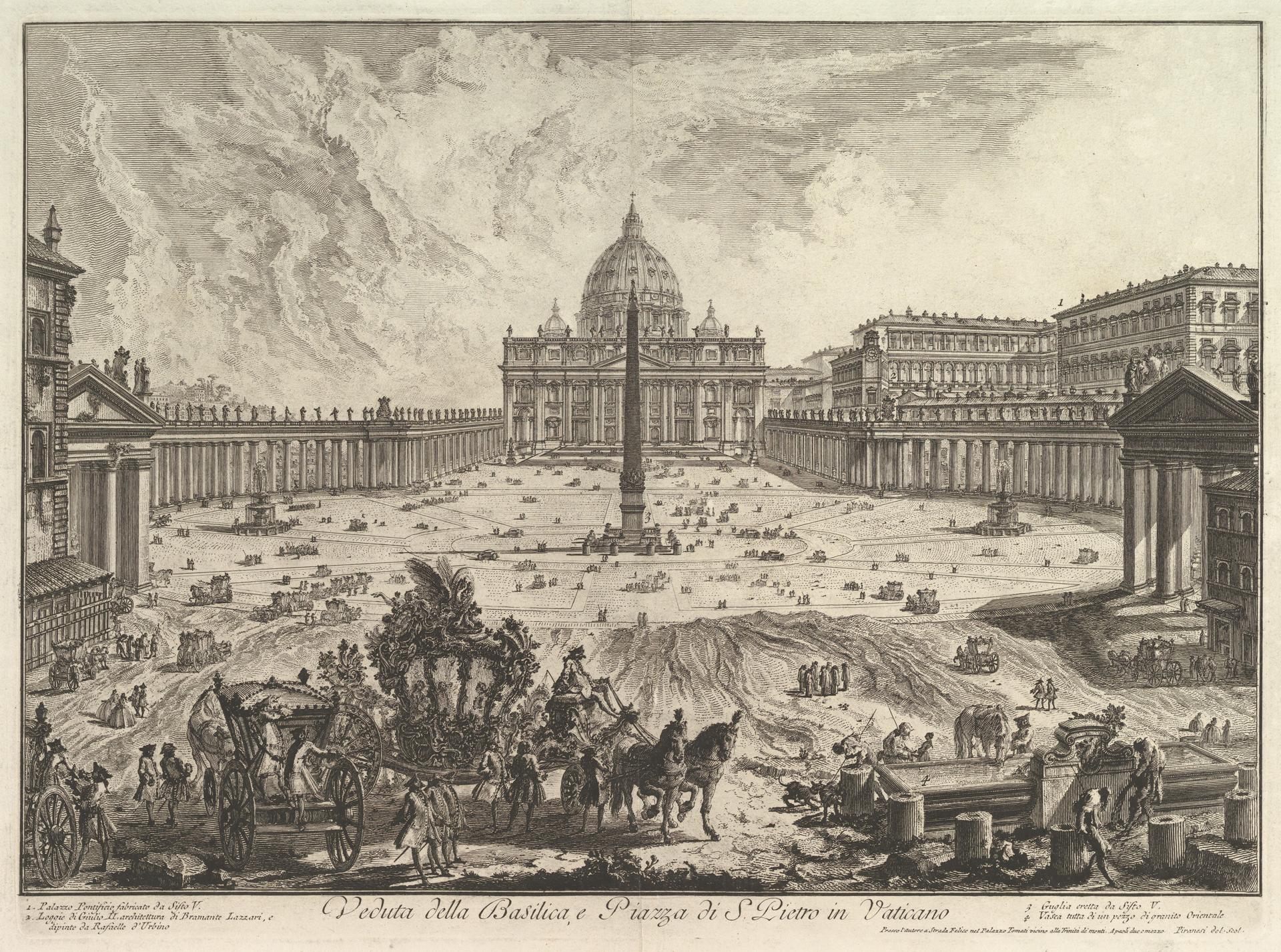
View of St. Peter's Basilica and Piazza in the Vatican, from Vedute di Roma (Roman Views)
Original title: View of St. Peter's Basilica and Piazza in the Vatican, from Vedute di Roma (Roman Views)
kurzbeschreibung
Unlike many vedute that focus on a single monument, this print by Giovanni Battista Piranesi (ca. 1748) draws together St. Peter's Square and St. Peter's Basilica in Rome from an elevated vantage point. It belongs to the series Vedute di Roma and ranks among the views with which eighteenth-century vedute art captured Roman cityscapes.
Description
The basilica's dome curves above the square, and the colonnade of St. Peter's Square wraps around it in a semicircle. An obelisk stands before the church, and along the expansive piazza buildings line up, including a palace with a colonnade. Down on the street people, horses, and carriages move about, so everyday scenes slip into the picture. Printed in shades of gray, the sheet feels calm and rich in detail thanks to the soft, diffuse light.
Context
The Vedute di Roma, a series of views of Roman buildings, appeared between 1748 and 1778. In those years Rome was a sought-after destination of the Grand Tour, and vedute sold briskly to collectors. Piranesi recorded the city's ancient and baroque monuments with great precision, and precisely that established his reputation as an architectural draftsman.
Impact
From a bird's-eye view the image gains a detached, ordering perspective that brings out the expanse of the square and the basilica. The many figures and carriages in the foreground introduce lively everyday life and take some of the severity out of the architectural might.
Technique
The sheet is an etching on paper: the drawing is scratched into a wax layer on the copper plate, and the plate is then etched. The present example is the fourth of seven states, which suggests careful reworking of the printing plate. The gray tones arise from printing with black ink on white paper.
AI-generated description text
Source: Metropolitan Museum of Art · Public Domain (CC0 1.0)