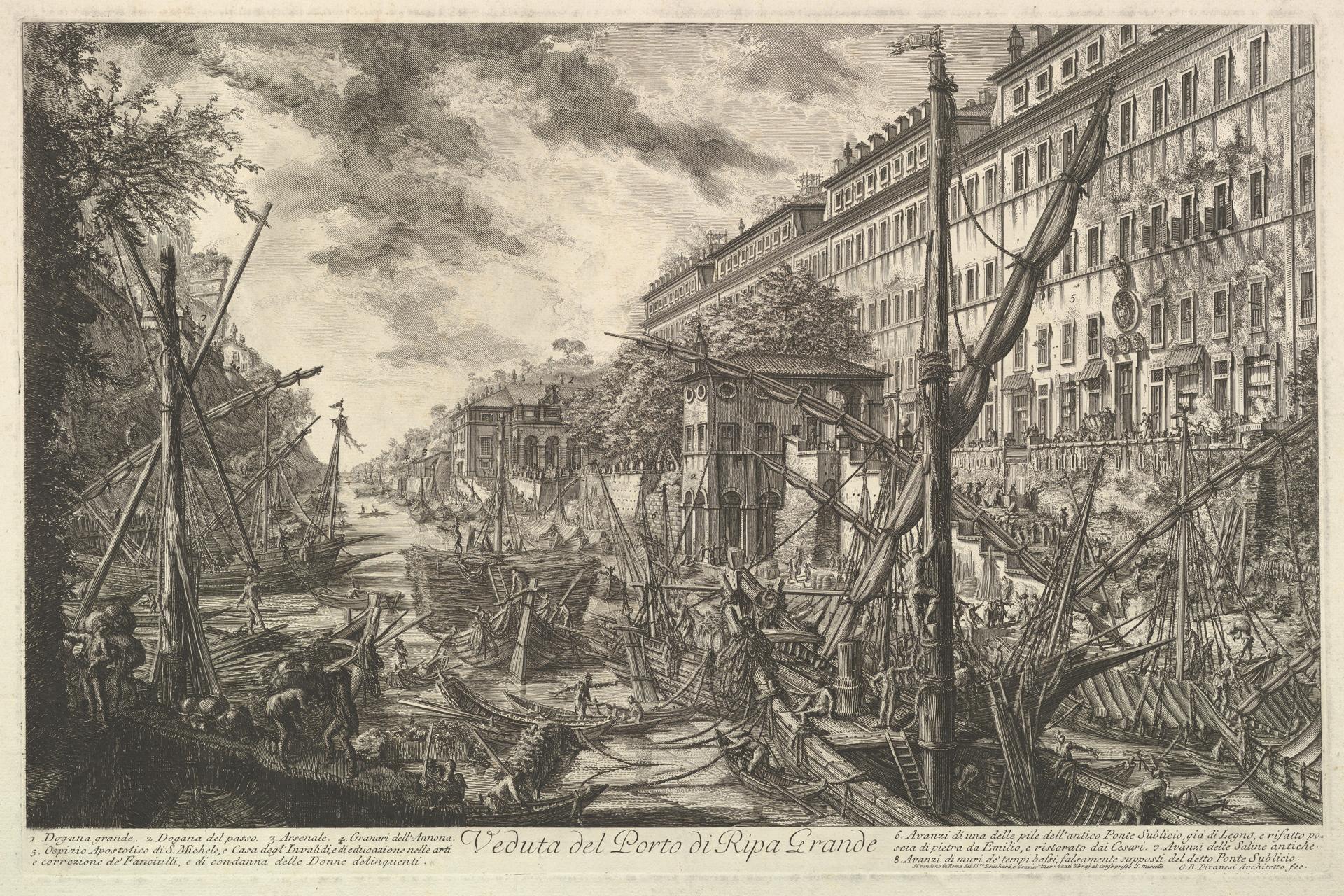
View of the Port of Ripa Grande, from Vedute di Roma (Roman Views)
Original title: View of the Port of Ripa Grande, from Vedute di Roma (Roman Views)
kurzbeschreibung
Giovanni Battista Piranesi made this etching, View of the Harbor of Ripa Grande, around 1753 as part of his series Vedute di Roma. The sheet measures 53.5 x 76.5 cm (sheet) and 40.8 x 61.8 cm (plate) and is in the first of six states. It depicts the Roman harbor of Ripa Grande on the Tiber.
Description
Several ships and boats lie in the foreground, some damaged or under repair, while workers handle the hulls. On the left, trees and a tree trunk jut into the harbor. Along the harbor edge, buildings and a palace can be seen. A cloudy sky casts a muted light. The realistic rendering, with detailed line work and shading, is in black and white.
Context
Between 1748 and 1778 Piranesi produced the Vedute di Roma, a series of over 130 etchings documenting ancient and contemporary buildings of Rome. The view of Ripa Grande was made around 1753, when the harbor was an important transshipment point for goods arriving in Rome via the Tiber. Piranesi had settled in Rome in 1740 and worked there as a draftsman and etcher. The series was aimed at Grand Tour travelers and collectors seeking authentic views of the city.
Impact
The etching conveys a quiet, almost documentary atmosphere of everyday harbor life. The fine line work and subtle shading create plastic depth and draw the viewer into the scene. The cloudy mood emphasizes the realistic character and underlines Piranesi's objective observation.
Technique
Piranesi used etching, in which the drawing is scratched into a wax layer on a copper plate and then bitten with acid. With fine needles and varying etching times, he achieved different shades of gray. This sheet is a print of the first of six states, indicating an early version of the plate.
AI-generated description text
Source: Metropolitan Museum of Art · Public Domain (CC0 1.0)