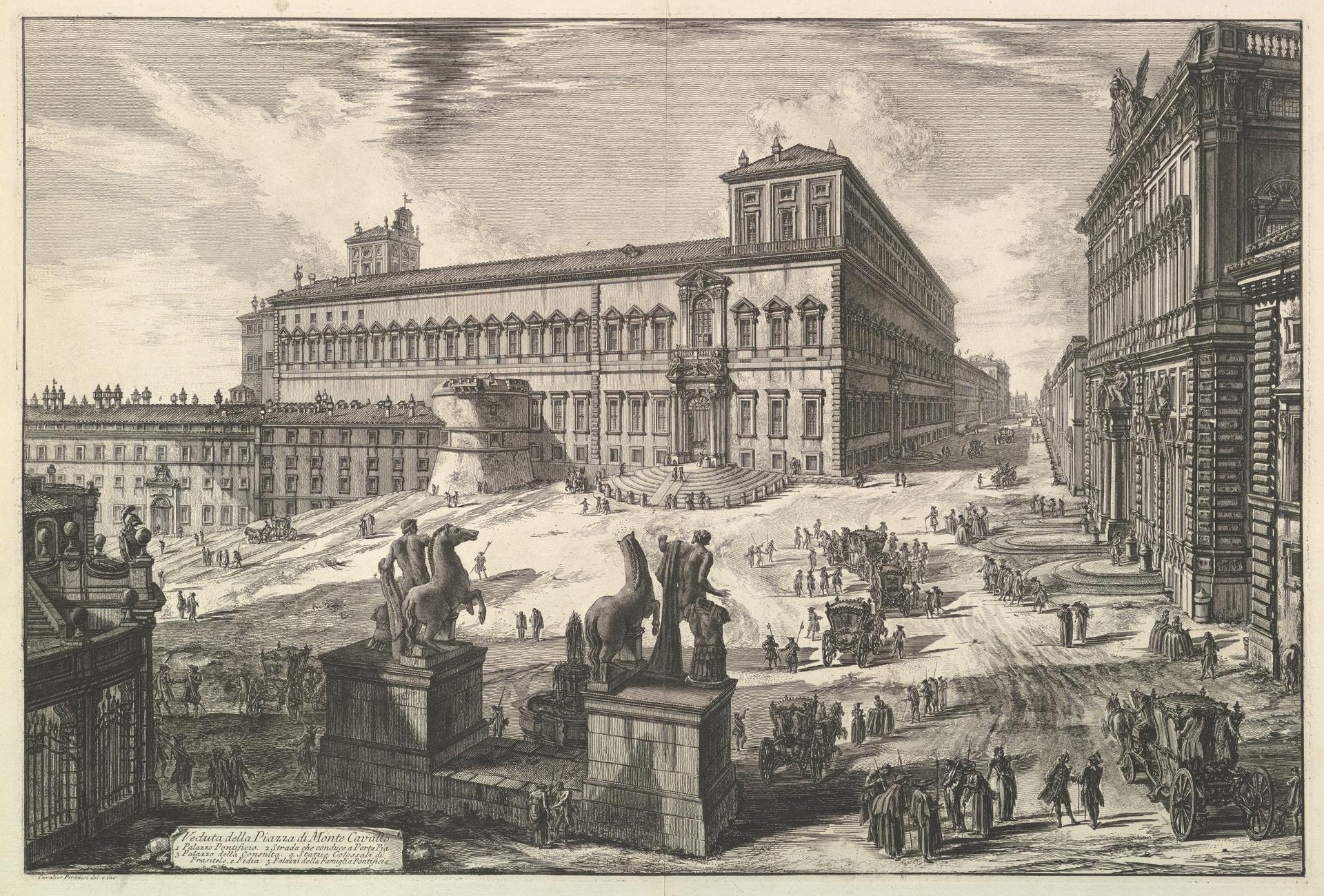
View of the Piazza di Monte Cavallo
Original title: View of the Piazza di monte Cavallo, from Vedute di Roma (Roman Views)
kurzbeschreibung
This etching by Giovanni Battista Piranesi, made around 1773, presents a view of the Piazza di Monte Cavallo in Rome. It belongs to the series Vedute di Roma and is here in the first of four states (per Hind). Measuring 53.6 by 76.5 cm, the print captures the urban space where antique statues meet baroque architecture.
Description
The foreground is dominated by the colossal Dioscuri statues with their horses, which enclose a fountain on pedestals. Behind them rises a massive, multi-storey representational building with a striking roof. Other houses line the sides, while people and carriages populate the street. Monochrome throughout, the image comes alive through carefully graded hatching; light falling from above enhances the sense of depth.
Context
Between 1748 and 1778 Piranesi worked on the Vedute di Roma, a series of etchings with which he recorded Roman architecture both ancient and contemporary. The Piazza di Monte Cavallo, today's Piazza del Quirinale, formed a centre of the city with the papal palace and the antique equestrian statues. In those years Rome attracted Grand Tour travellers, and vedute sold briskly to collectors. Piranesi combined topographical accuracy with effective staging to make the grandeur of Rome tangible.
Impact
Antique statues and baroque facades together give the square a monumental presence. The contrast between light and dark areas and the precise linework create an almost theatrical atmosphere that holds the viewer's gaze. At the same time, the activity on the street brings everyday life into the picture, linking historical grandeur with the bustle of the city.
Technique
The print is executed as an etching: the drawing is scratched into a wax layer over the copper plate, and the metal is then etched. Fine lines and hatching allow architectural details and tonal values to be captured with great precision. The first of the four states is evidenced by a plate that knows no later reworkings, so the original sharpness of the lines is preserved.
AI-generated description text
Source: Metropolitan Museum of Art · Public Domain (CC0 1.0)