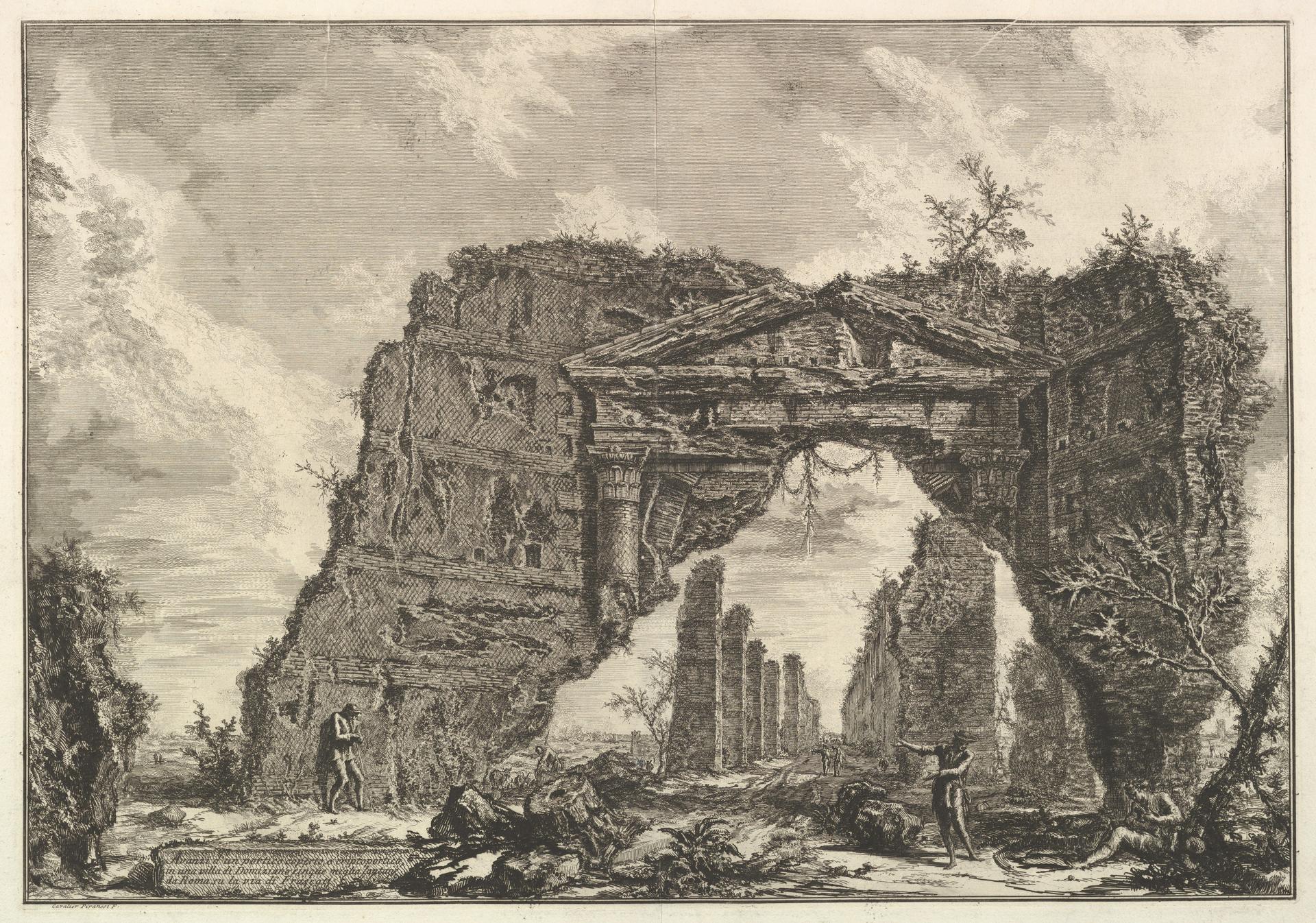
Remains of a covered portico, or a cryptoportiucus, in a villa of Domitian, five miles outside Rome on the Frascati road, from Vedute di Roma (Roman Views)
Original title: Remains of a covered portico, or a cryptoportiucus, in a villa of Domitian, five miles outside Rome on the Frascati road, from Vedute di Roma (Roman Views)
kurzbeschreibung
The print records what survives of a covered colonnade, a cryptoporticus, on a villa of Domitian a short distance from Rome. It belongs to Giovanni Battista Piranesi's Vedute di Roma and was executed as an etching around 1766.
Description
The eye is pulled toward the middle, where the portico stands, then drifts off along the flanking rows of columns that step back into depth. Two figures linger near the overgrown ruins. An arch and several columns carry the image, with a cloudy sky above them. Grey tones dominate throughout, as is usual for a copperplate engraving.
Context
The Vedute di Roma gathers views of ancient and contemporary buildings of the city. Domitian's villa stood on the Via Frascati, about five miles beyond the gates of Rome. In those years Piranesi was studying Roman architecture closely and committing it to his prints.
Impact
The viewer is first caught by the receding ranks of columns and the calm grey of the sky, and only afterward by the details of the ruin. Encroaching vegetation and the small figures give the picture depth and atmosphere and draw the eye into a vanished past. Archaeological precision and painterly appeal join here in a way that presents decay as a picturesque subject.
Technique
The lines were etched into a copper plate and printed from it; this is the second of four states (after Hind). The plate measures 42.8 x 61 cm, the sheet 52.5 x 73.5 cm.
AI-generated description text
Source: Metropolitan Museum of Art · Public Domain (CC0 1.0)