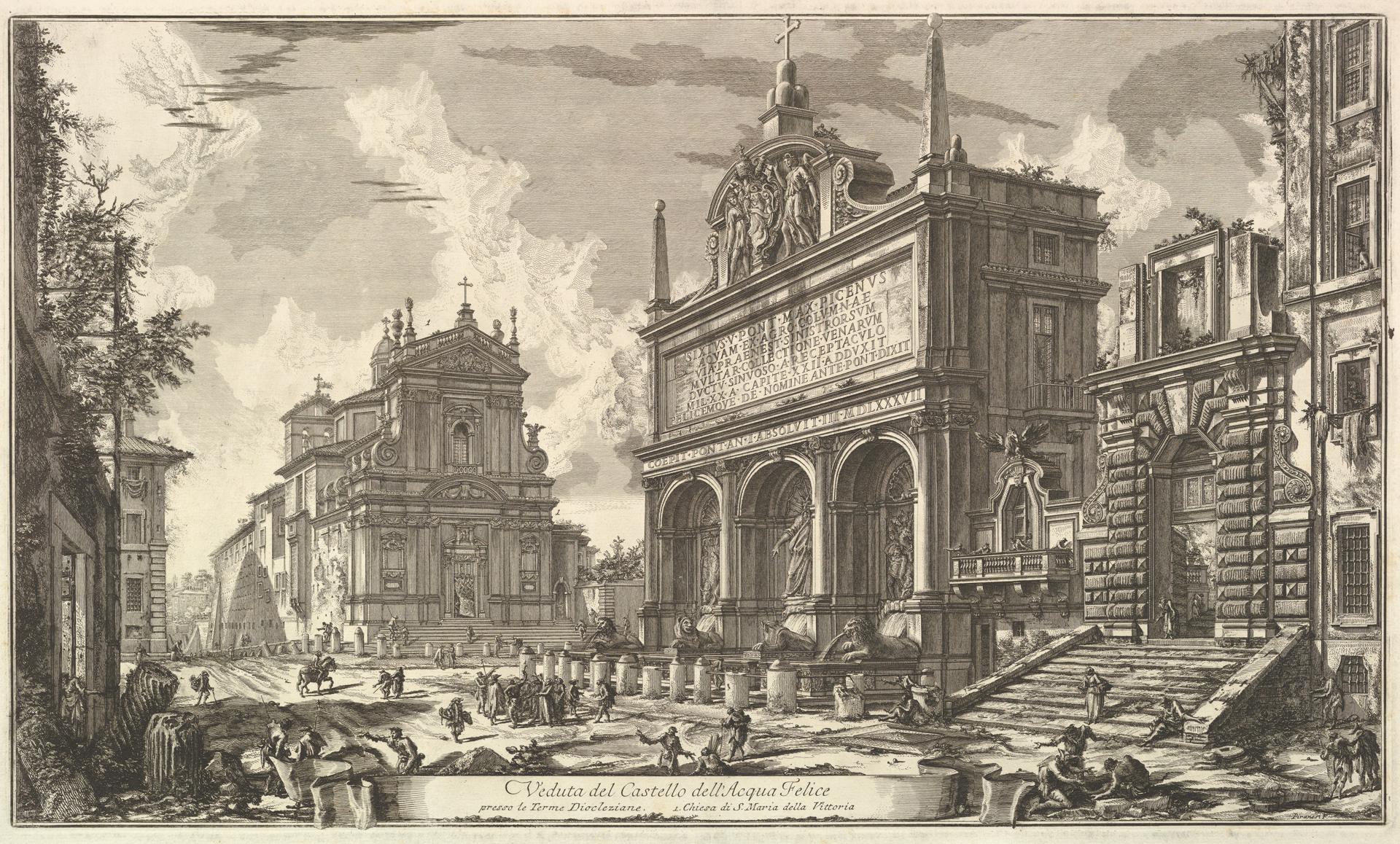
View of the Fountainhead of the Acqua Felice, from Vedute di Roma (Roman Views)
Original title: View of the Fountainhead of the Acqua Felice...., from Vedute di Roma (Roman Views)
kurzbeschreibung
Made around 1751, this etching by Giovanni Battista Piranesi belongs to his series Vedute di Roma. It records the monumental fountain head of the Acqua Felice in Rome. The sheet survives in the first of five states (Hind). Ancient aqueduct and Baroque architecture meet the busy round of daily life in this view.
Description
A powerful fountain with several columns and an inscription panel dominates the foreground; steps and a wall frame it. Behind, a church with a tower and a cross on its roof rises up. To the left stand trees and a building with columns. Figures people the street and the area around the fountain. A clouded sky and diffuse light emphasize shadows and architectural detail.
Context
The Vedute di Roma is a series of etchings in which Piranesi recorded Roman buildings and city views. The Acqua Felice is an ancient aqueduct restored in 1586 under Pope Sixtus V. In his vedute Piranesi combined precise topographical recording with effective staging. This print belongs to a period of intense work in Rome, when he was establishing himself as an architectural draughtsman.
Impact
The monumental fountain and the lively staffage of figures give the etching a sublime, almost theatrical presence. The meticulous rendering of the architecture and the handling of light create an atmospheric depth that draws the viewer into historical Rome. Technical precision and artistic drama are closely bound together here.
Technique
For this etching the lines were bitten into a copper plate, which accounts for the sharp contours and fine detail. With delicate needlework Piranesi recorded architectural structures and figures exactly. Printing was done on laid paper, as was usual for eighteenth-century vedute production.
AI-generated description text
Source: Metropolitan Museum of Art · Public Domain (CC0 1.0)