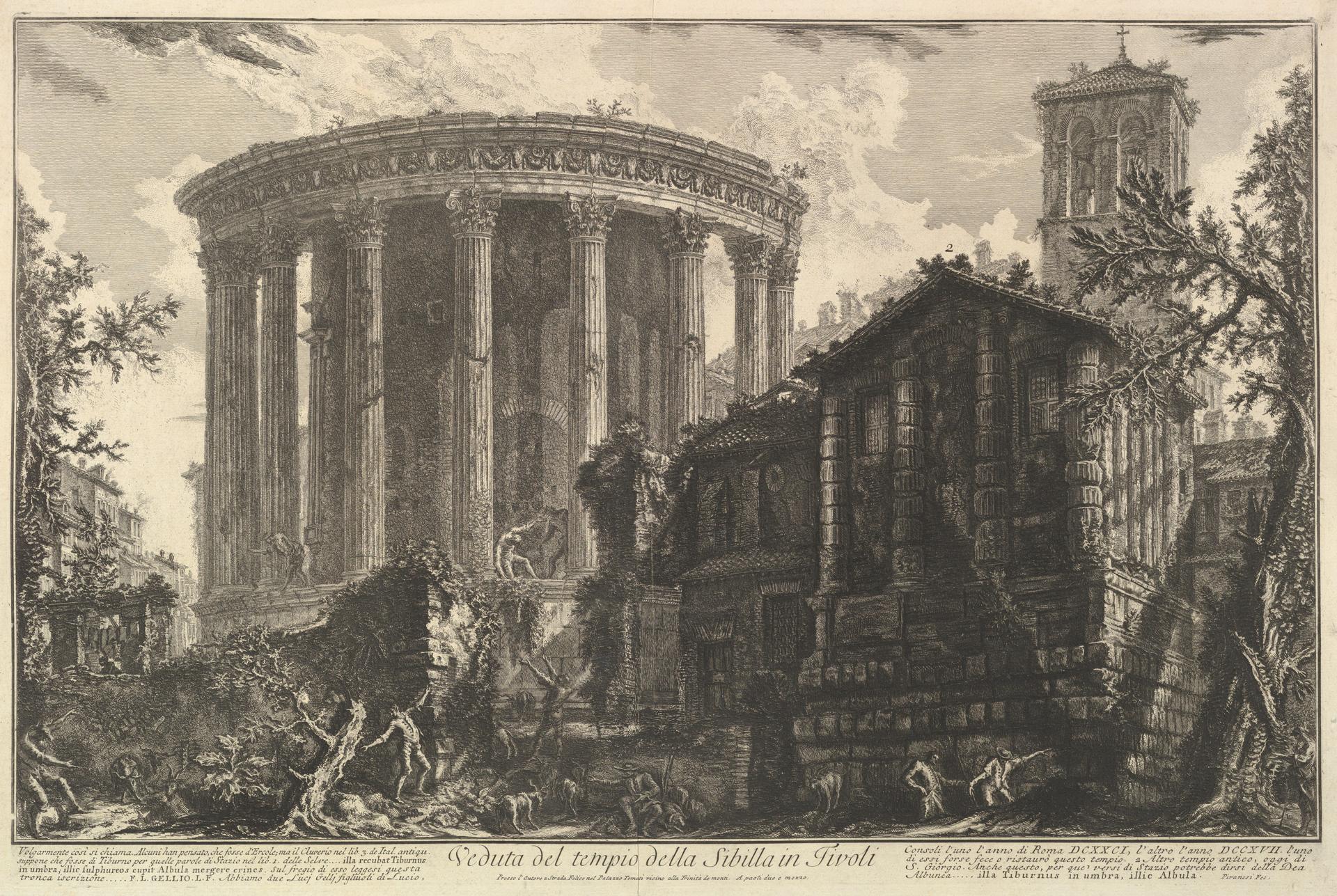
View of the Temple of the Sibyl at Tivoli, from Vedute di Roma (Roman Views)
Original title: View of the Temple of the Temple of the Sibyl at Tivoli, from Vedute di Roma (Roman Views)
kurzbeschreibung
Piranesi turns his attention in this etching to the round Temple of the Sibyl at Tivoli, a subject he folded into his Vedute di Roma. The sheet dates from around 1761 and survives here in the first of five states. Precise recording of the ancient architecture meets its landscape setting, the two held together on a single plate.
Description
The circular temple, its Corinthian columns intact, holds the middle of the sheet, framed by trees and shrubs. To the right a smaller building with a roof and door stands half swallowed by vegetation. A further structure with a tower rises behind, likewise ringed with trees. The layout reads as symmetrical, the light spread evenly across the whole. Greys come from the etched lines and hatching alone.
Context
The Vedute di Roma, a series of etchings devoted to Roman and ancient buildings, occupied Piranesi over many years. In the eighteenth century the Temple of the Sibyl at Tivoli ranked among the favourite motifs of artists. This view follows the vedutista ideal of exact transcription. The print belongs to that series, which Piranesi issued in instalments.
Impact
A quiet, contemplative mood settles over the sheet, helped by the symmetrical arrangement and the even illumination. Setting the architecture so squarely amid lush vegetation gives the print a painterly quality. The clear sky and the density of detail invite slow, close looking.
Technique
For an etching the drawing is scratched through a wax ground on a copper plate and then bitten with acid. Lines and hatching build the delicate greys. Printing was done on paper measuring 53.5 x 75.5 cm; the plate itself measures 42.8 x 64 cm.
AI-generated description text
Source: Metropolitan Museum of Art · Public Domain (CC0 1.0)