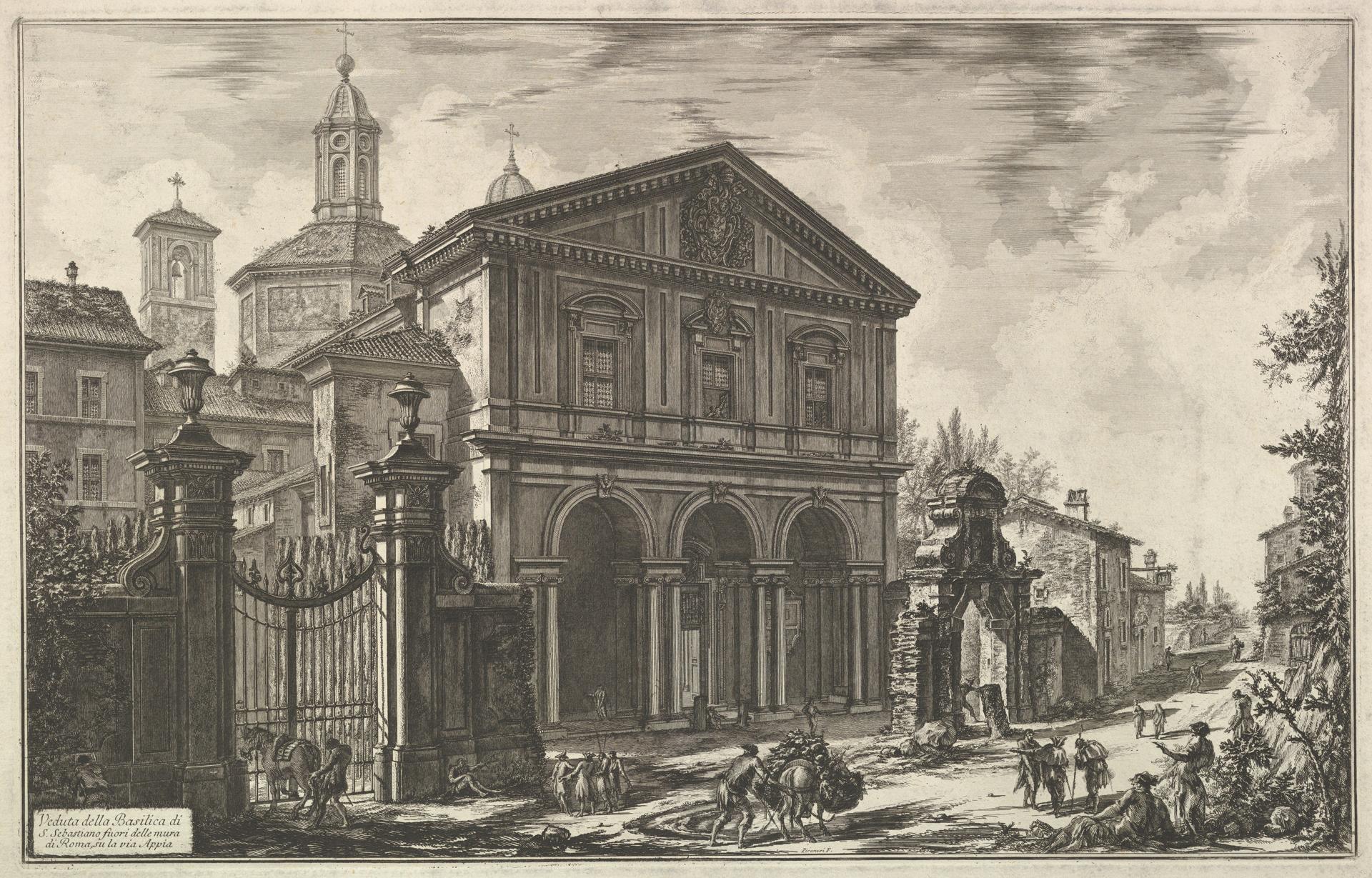
View of the Basilica of San Sebastiano fuori delle mura [St. Sebastian outside the Walls] on the Appian Way, from Vedute di Roma (Roman Views) (ca. 1750, Met-Objekt 3972)
Original title: View of the Basilica of San Sebastiano fuori delle mura [St. Sebastian ouside the Walls] on the Appian Way, from Vedute di Roma (Roman Views)
kurzbeschreibung
Around 1750 Giovanni Battista Piranesi etched this view of the Basilica San Sebastiano fuori delle mura on the Via Appia, a sheet from his series Vedute di Roma. It survives in the first of four states as described by Hind. The plate measures 49 x 73 cm, and the subject belongs to the veduta genre.
Description
The basilica rises at the front, its columns and arcades setting the tone of the image. To the left a gateway with a grille door and flanking columns adjoins it. Beyond, further buildings and church towers step back in layers. A road runs through the gateway opening, carrying riders and pedestrians. Cloud banks and restless hatching fill the sky, and the light stays subdued.
Context
Piranesi's Vedute di Roma, with more than 130 etchings of Roman architecture, grew between 1748 and 1778. The San Sebastiano view dates from around 1750, when the church on the Via Appia was a much-visited pilgrimage destination. Since settling in Rome in 1740, Piranesi had devoted himself above all to recording ancient and contemporary buildings.
Impact
Monochrome tonality and soft light give the sheet a quiet, historically charged ring. Precisely observed architecture and the bustle on the road join into a view both lively and removed from time, bringing eighteenth-century Rome before the eye.
Technique
In etching, the lines are bitten into a copper plate that has first been worked with acid. The first state according to Hind shows the fine, detail-rich linework characteristic of Piranesi. This process allows architectural particulars and graded shadows to be rendered exactly.
AI-generated description text
Source: Metropolitan Museum of Art · Public Domain (CC0 1.0)