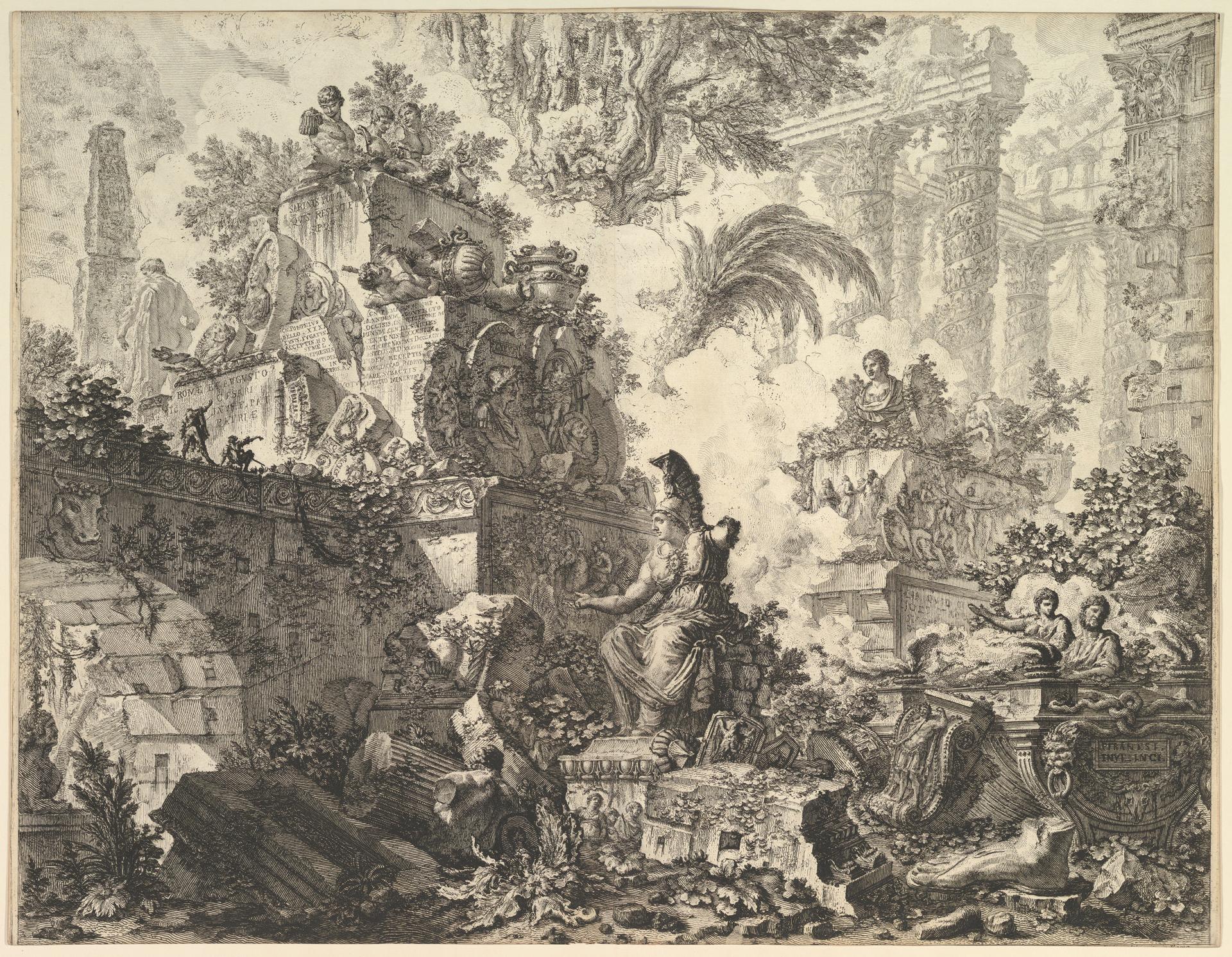
Frontispiece, with Statue of Minerva, from "Vedute di Roma" (ca. 1748, Met-Objekt 3967)
Original title: Frontispiece, with Statue of Minerva, from "Vedute di Roma"
kurzbeschreibung
Unlike the other views in the 'Vedute di Roma', this frontispiece opens the series with a ruin scene, and a statue of Minerva stands at its heart. Giovanni Battista Piranesi made the etching around 1748 as the title page of the celebrated collection of Roman views.
Description
A symmetrical layout carries the statue of Minerva on a pedestal at the centre of the image. Ruins, columns, trees and bushes frame the motif. Further figures and small scenes are scattered across terraces and chambers of the ruins, stressing the depth of the space through several levels. Diffuse light and monochrome tones define the sheet, as is typical of etching.
Context
With the 'Vedute di Roma' Piranesi produced a series of etchings recording the ancient and contemporary buildings of Rome. From 1748 the sequence appeared in several editions and established his international reputation. The frontispiece with the Minerva statue refers both to Roman antiquity and to the tradition of veduta painting.
Impact
The meticulous execution makes the grandeur of the Roman ruins palpable. Thanks to the symmetrical arrangement and the monumental statue, the print takes on a solemn, almost theatrical character.
Technique
For an etching, the drawing is incised into a copper plate coated with wax and then bitten with acid. The impression on paper brings out the delicate lines and hatching that shape architectural details and effects of shadow.
AI-generated description text
Source: Metropolitan Museum of Art · Public Domain (CC0 1.0)