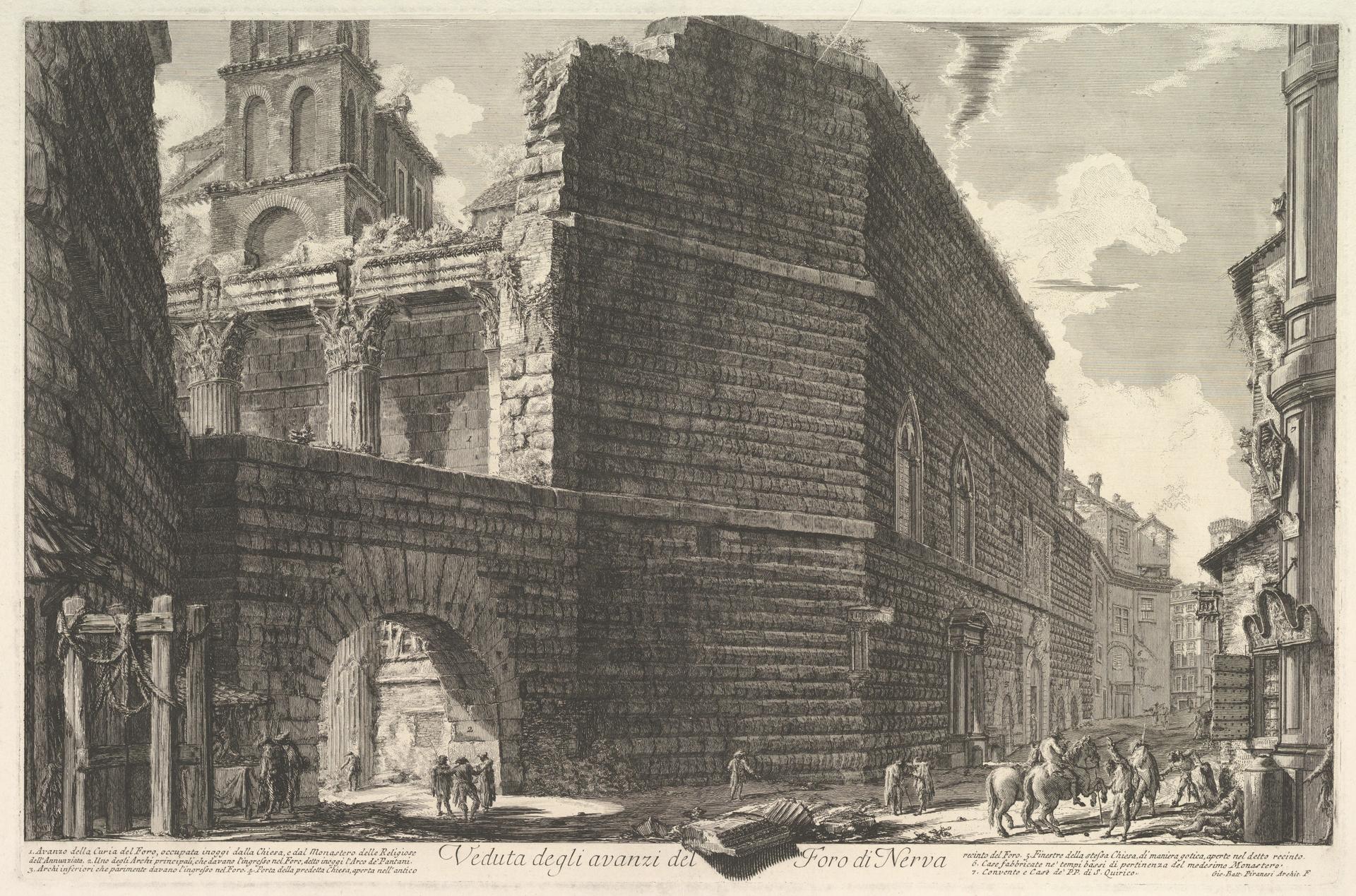
Veduta degli avanzi del Foro di Nerva, l'arcade et la muraille (The Forum of Augustus [erroneously called the Forum of Nerva])
Original title: Veduta degli avanzi del Foro di Nerva, l'arcade et la muraille (The Forum of Augustus [erroneously called the Forum of Nerva])
kurzbeschreibung
Giovanni Battista Piranesi made this etching in 1757, devoted to the surviving remains of the Forum of Augustus in Rome, which at the time were still wrongly attributed to the Forum of Nerva. The sheet belongs to his series of vedute and was executed as an etched print.
Description
A massive stone wall dominates the foreground, one of the ancient remains. An arch on the left opens a view into the neighbouring alley. Behind it further ruins rise in tiers, along with a church with columns and a bell tower. The scene is enlivened by people walking or going about their work, while the street is lined with houses, some of them of more recent date. Light falling from above creates a clear yet restrained mood that finds its expression in the fine lines and hatching of the characteristic etching grey.
Context
The print was made in 1757, during a period in which Piranesi was studying Roman antiquity in depth. The correct identification of the Forum of Augustus came only later; in the eighteenth century the remains were read as the Forum of Nerva. In his vedute Piranesi recorded such ruins, and these sheets were highly popular with travellers on the Grand Tour.
Impact
A lofty and at the same time melancholy mood emanates from the etching, as is typical of Piranesi. Where monumental ruins and everyday activity meet, the transience of ancient grandeur becomes directly perceptible.
Technique
For this etching the drawing was incised into a wax layer on a copper plate, and the metal was then etched. Fine lines and hatching produce a detailed rendering of light and shadow. Printing was done in black on paper, which yields the characteristic grey tones.
AI-generated description text
Source: Metropolitan Museum of Art · Public Domain (CC0 1.0)