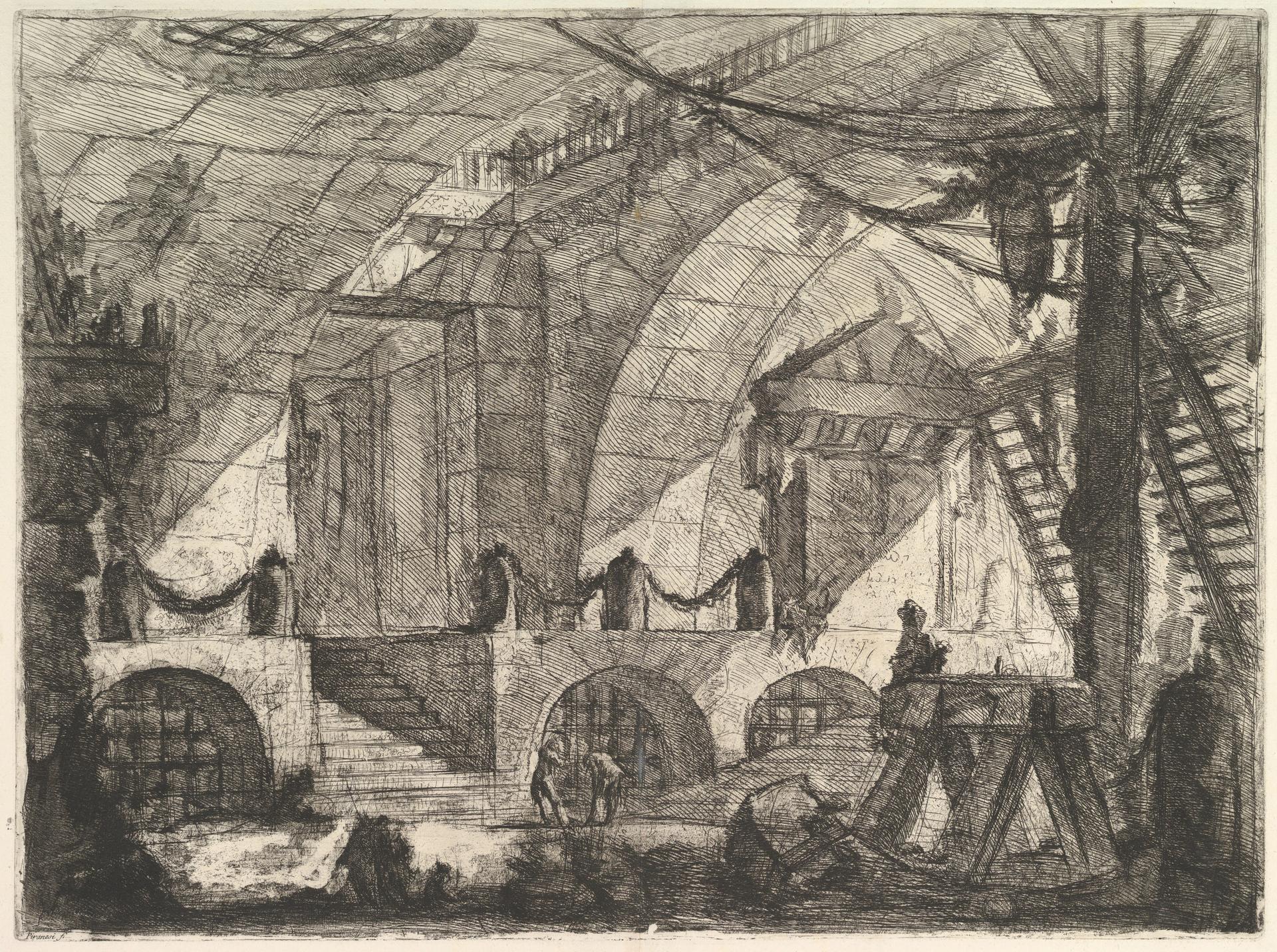
The Sawhorse, from "Carceri d'invenzione" (Imaginary Prisons)
Original title: The Sawhorse, from "Carceri d'invenzione" (Imaginary Prisons)
kurzbeschreibung
Giovanni Battista Piranesi made the etching 'The Sawhorse' around 1749–50 as part of his series 'Carceri d'invenzione'. The print leads into a monumental, subterranean-looking hall, combining architectural fantasy with a gloomy atmosphere. It is executed in etching, engraving and other techniques.
Description
Two figures appear in the foreground of an extensive hall dominated by arches and columns; they seem busy with work or transport. Stairs and further arches in the rear deepen the sense of space. Diffuse light falls from above, modelling the structure with dramatic accents. The image remains monochrome in graduated greys produced by line and shadow. The precise, detailed linework is characteristic of the etching technique.
Context
During his early years in Rome, where he worked as an architect and printmaker, Piranesi created the 'Carceri'. The series was made without a direct commission and shows imaginary prisons inspired by Roman architecture and stage designs. Later the plates were reworked and published in a second edition, which helped their dissemination. The works reflect the contemporary interest in ruins and monumental antiquity.
Impact
An oppressive yet fascinating mood arises from the superimposition of monumental architecture and small figures. The play of light and shadow heightens the dramatic effect and makes the space seem threatening. The abundance of detail invites prolonged looking and underlines the fantastical nature of the scene.
Technique
The print combines etching with engraving, sulphur tint or open bite, and scratching techniques to achieve different tonal values. These processes allow fine lines and soft shading, as visible in the greys. Piranesi used the techniques to attain plastic depth and atmospheric effects.
AI-generated description text
Source: Metropolitan Museum of Art · Public Domain (CC0 1.0)