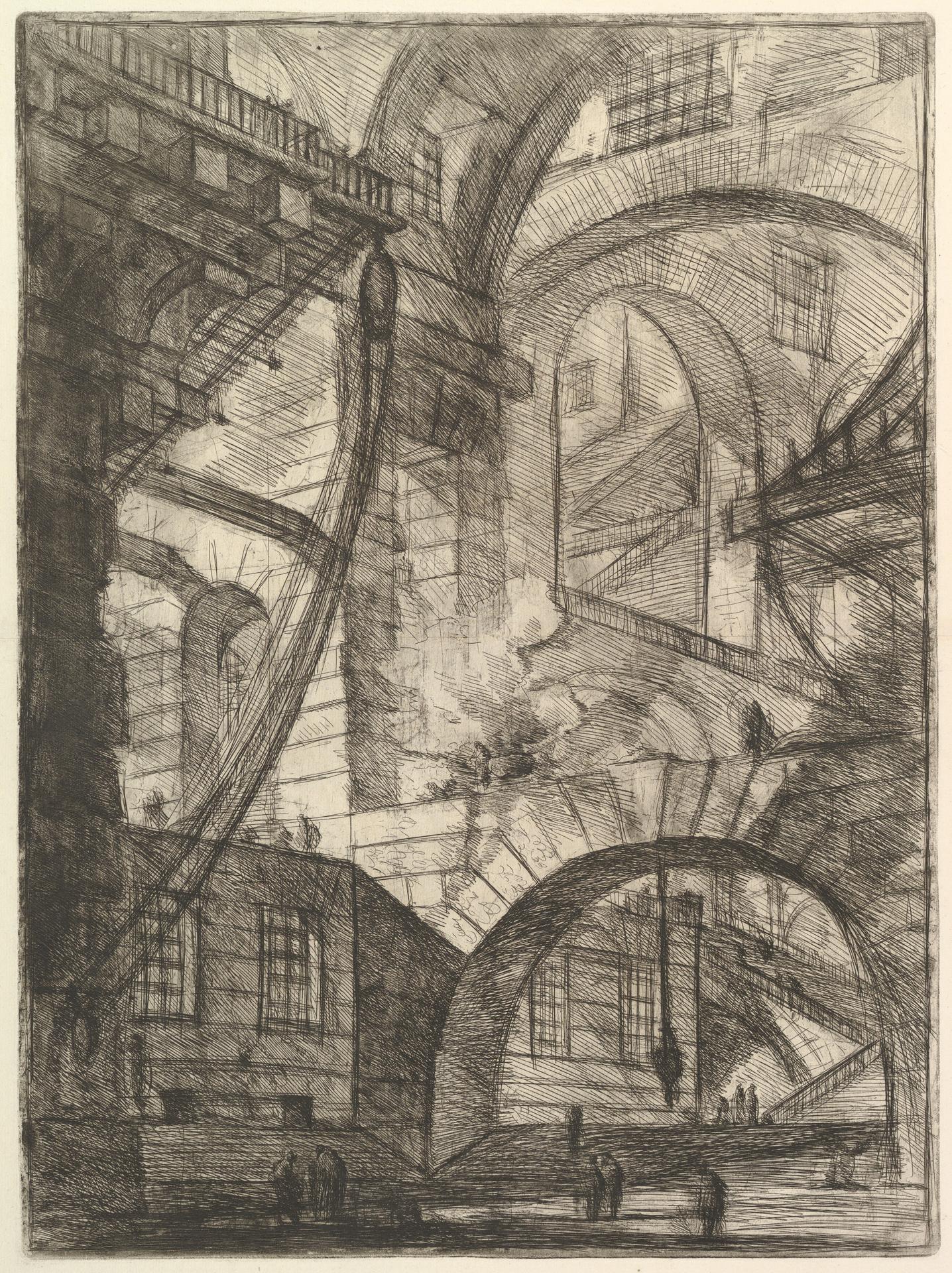
The Smoking Fire, from "Carceri d'invenzione" (Imaginary Prisons)
Original title: The Smoking Fire, from "Carceri d'invenzione" (Imaginary Prisons)
kurzbeschreibung
Giovanni Battista Piranesi made Das rauchende Feuer around 1749–50 as part of his series 'Carceri d'invenzione' (Imaginary Prisons). An etching with engraving, sulphur tint or open bite, and burnishing, the sheet is the first of seven states (Robison). It presents a monumental, prison-like architecture with several figures in the foreground.
Description
Arches, arcades, columns, balconies, and windows stack across multiple levels into a layered spatial complex. In a hall or courtyard in the foreground, several people move about. Light falling from above emphasizes the depth and the tiered structure. Fine hatching and cross-hatching produce a monochrome range of grays.
Context
The Carceri were created in Rome, where Piranesi worked as a draftsman and etcher of architecture. In those years he was deeply engaged with ancient Roman building and its monumental impact. The early states of the prints appeared around 1749–50; he reworked them for later editions. The series influenced 18th-century fantasy and Romanticism.
Impact
The gloomy, overwhelming architecture creates an oppressive yet fascinating mood. The complex perspective and the light from above make the space seem boundless and threatening.
Technique
Etching, supplemented by engraving and burnishing, allows fine lines and graduated gray values. Sulphur tint or open bite brings out soft tonal areas. This makes it possible to render architectural details precisely and to work out the interplay of light and shadow in a nuanced way.
AI-generated description text
Source: Metropolitan Museum of Art · Public Domain (CC0 1.0)