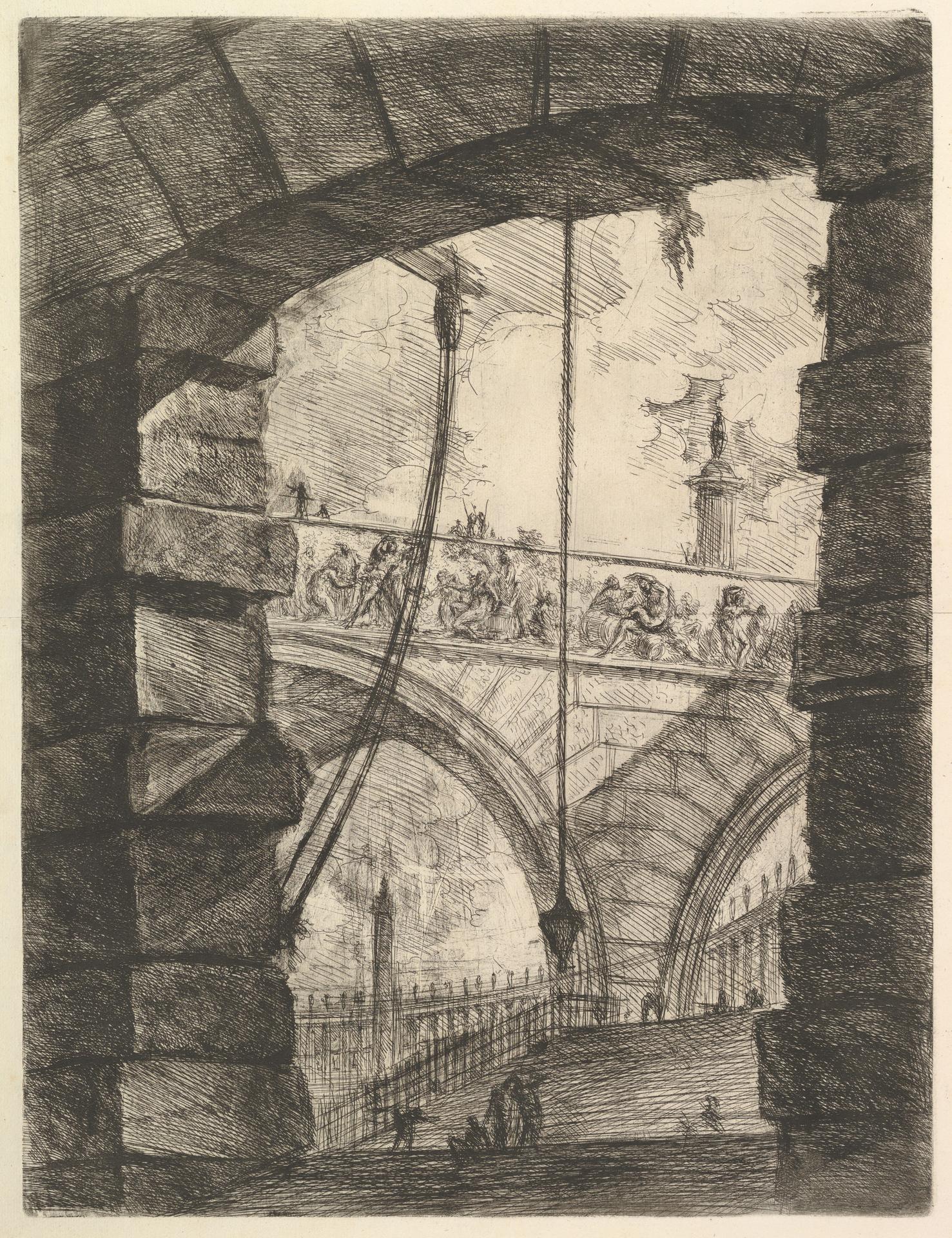
The Grand Piazza, from "Carceri d'invenzione" (Imaginary Prisons)
Original title: The Grand Piazza, from "Carceri d'invenzione" (Imaginary Prisons)
kurzbeschreibung
Giovanni Battista Piranesi made 'The Great Piazza' around 1749–50 as one sheet of his series 'Carceri d'invenzione' (Imaginary Prisons). It presents a colossal, wholly invented square framed by arches and columns and populated by many small figures. The work is an etching, engraving and sulphur tint, and it corresponds to the first of six states.
Description
A wide-spanning arch opens onto an expansive piazza. Figures are scattered across the square: some dance and celebrate, others stand or sit together. Lamps or columns line the space, catching the light and bringing out its depth. At the back, another column rises, with a figure visible on top. The print stays in shades of grey; bright light falls from above and emphasizes the spatial breadth.
Context
The 'Carceri' comprise fourteen etchings, first published by Piranesi in Rome in 1749/50. In those years he was deeply engaged with Roman architecture and ruins; stage designs and contemporary prison images also provided inspiration. The sheets were not intended as documentary records of real prisons but as fantastic architectural visions, which were revised in later editions.
Impact
The oversized architecture and the tiny, restless figures create an atmosphere that is oppressive and at the same time captivating. Light and shadow alternate, perspective opens the space far into the distance, and so the print gains something dramatic, almost surreal. Standing before it, one enters a world that wavers between order and threat.
Technique
To achieve graduated grey tones, Piranesi combined etching and engraving and added sulphur tint or open bite as well as burnishing. The plate measures 54.2 x 41.2 cm; the linework is fine and rich in detail, as is characteristic of his prints. The sheet is recorded as the first of six states, which points to later reworking of the plates.
AI-generated description text
Source: Metropolitan Museum of Art · Public Domain (CC0 1.0)