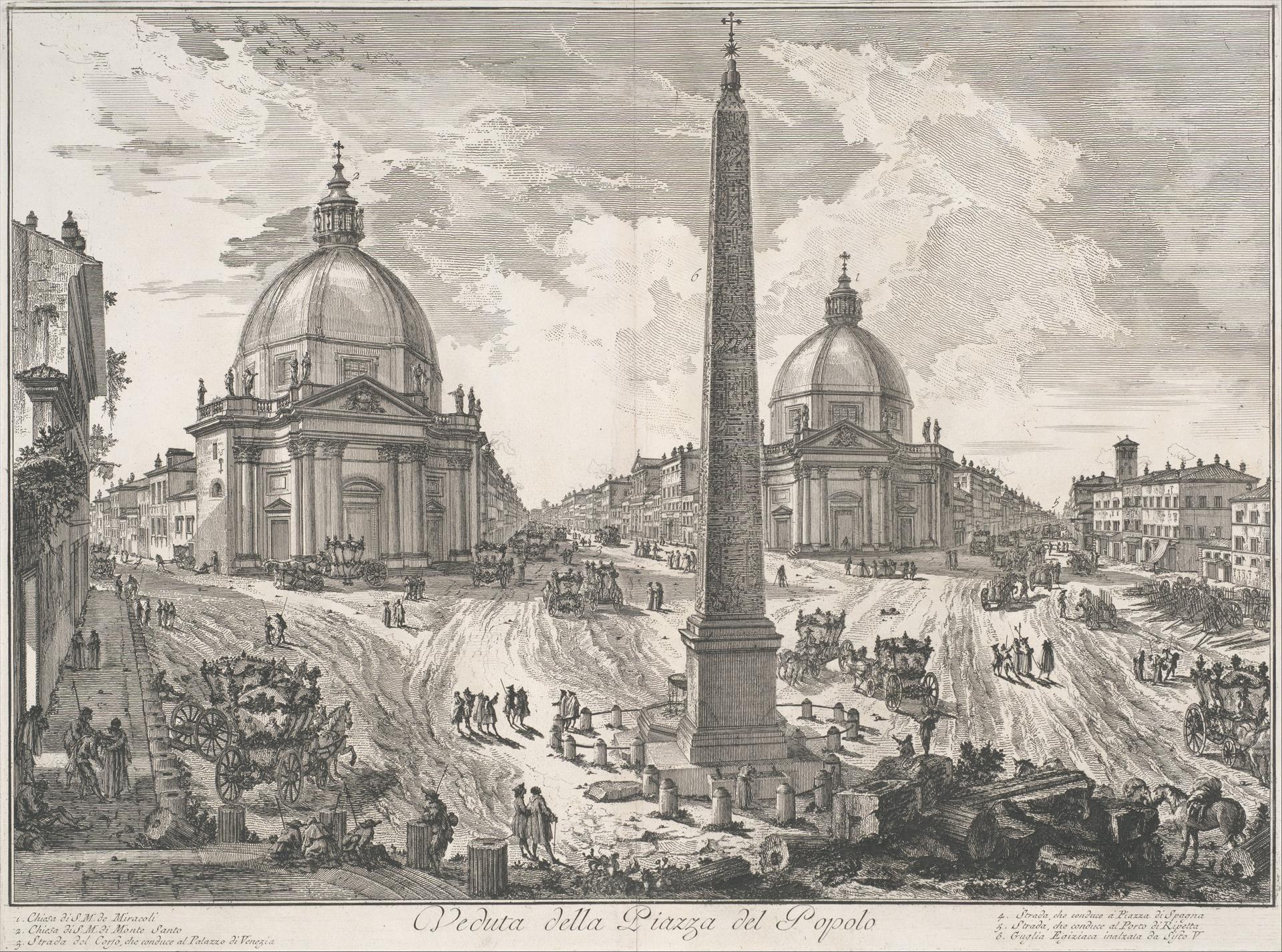
The Piazza del Popolo (Veduta della Piazza del Popolo), from "Vedute di Roma"
Original title: The Piazza del Popolo (Veduta della Piazza del Popolo), from "Vedute di Roma"
kurzbeschreibung
An obelisk rises on a broad square – Giovanni Battista Piranesi captured the Piazza del Popolo in an etching around 1750. This print belongs to the series 'Vedute di Roma' and shows the expansive square with its flanking churches and bustling activity.
Description
In the foreground stands an obelisk, beside which a massive domed church towers up. Carriages, pedestrians and horses fill the street, creating a lively urban scene. Behind, further churches and buildings of Roman architecture are staggered. A cloud-covered sky provides subdued light and soft shadows; the gradations of grey reinforce the historical impression of the print.
Context
With the 'Vedute di Roma', Piranesi produced an etching series that records both ancient and modern buildings of Rome. In the 18th century, the Piazza del Popolo served as an important arrival point and venue for public ceremonies. The view was both a work of art and a souvenir for Grand Tour travellers. Piranesi was regarded as a master of precise architectural representation, often with dramatic perspective and rich detail.
Impact
Precisely crafted architecture and lively everyday activity shape the impression of this print. The gloomy, cloud-rich atmosphere gives the view something melancholic and almost monumental. Viewers feel transported to historical Rome and experience the piazza as a vibrant place.
Technique
For this etching, the drawing was engraved into a metal plate and then etched with acid. This allowed fine lines and shading that serve the detailed reproduction of the architecture. The grey values arise from lines of varying density and direction, which bring out light and shadow.
AI-generated description text
Source: Metropolitan Museum of Art · Public Domain (CC0 1.0)