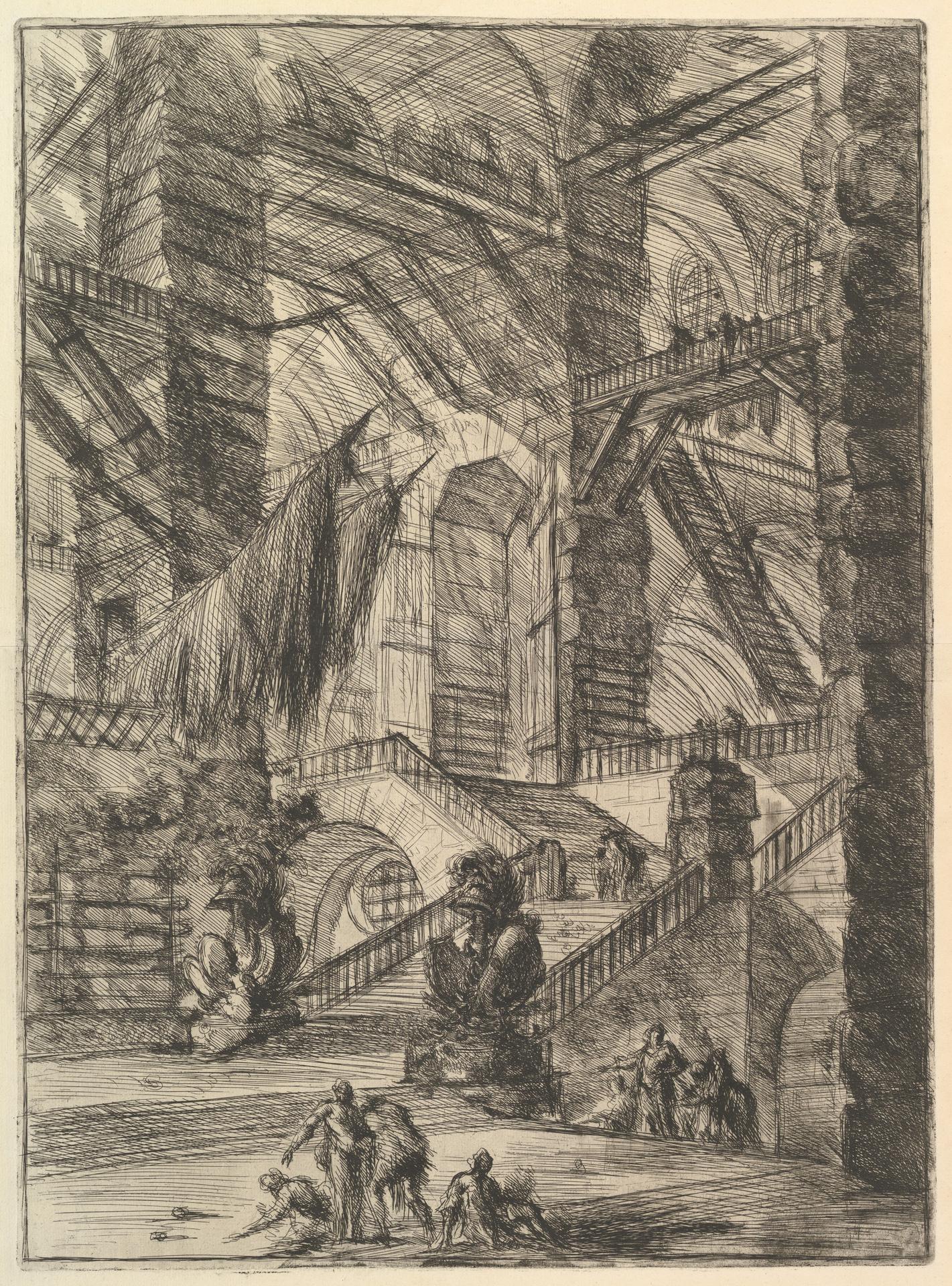
The Staircase with Trophies, from "Carceri d'invenzione" (Imaginary Prisons)
Original title: The Staircase with Trophies, from "Carceri d'invenzione" (Imaginary Prisons)
kurzbeschreibung
Giovanni Battista Piranesi made this etching around 1749–50 as part of his series 'Carceri d'invenzione' (Imaginary Prisons). It shows a vast staircase within a fantastic dungeon architecture, where tiny figures move about. The sheet is the first state of six (Robison) and combines etching and engraving.
Description
A massive stone staircase descends into depth, flanked by a balustrade. In the foreground, several figures in contemporary dress act, some on the steps, some in the passage. Behind them, arches and columns dominate and make the structure appear interlocked and overly rich. Light falls diffusely from above, enveloping everything in mysterious half-darkness. Dense, parallel lines emphasize depth and tectonic structure.
Context
Piranesi worked as a draughtsman and architect in his early Roman period when the 'Carceri' were created. The etchings initially belonged to a series of 14 plates, later expanded. At a time of growing interest in ancient Roman architecture, Piranesi drew on his vedute and archaeological studies. Yet the 'Carceri' show no real prisons but imaginary architectural fantasies, inspired by stage sets and Roman ruins.
Impact
A sense of oppression sets in, almost surreal, carried by the monumental staircase and the gloomy light. The overloaded architectural forms press in and make the figures seem small and lost. The viewer is drawn into a world without scale, into a mysterious depth.
Technique
Etching and engraving were both used: some lines were etched, others directly engraved. Dense hatching and parallel lines create fine transitions between light and shadow. In the first state, the arrangement still appears brighter and less crowded than in later reworkings.
AI-generated description text
Source: Metropolitan Museum of Art · Public Domain (CC0 1.0)