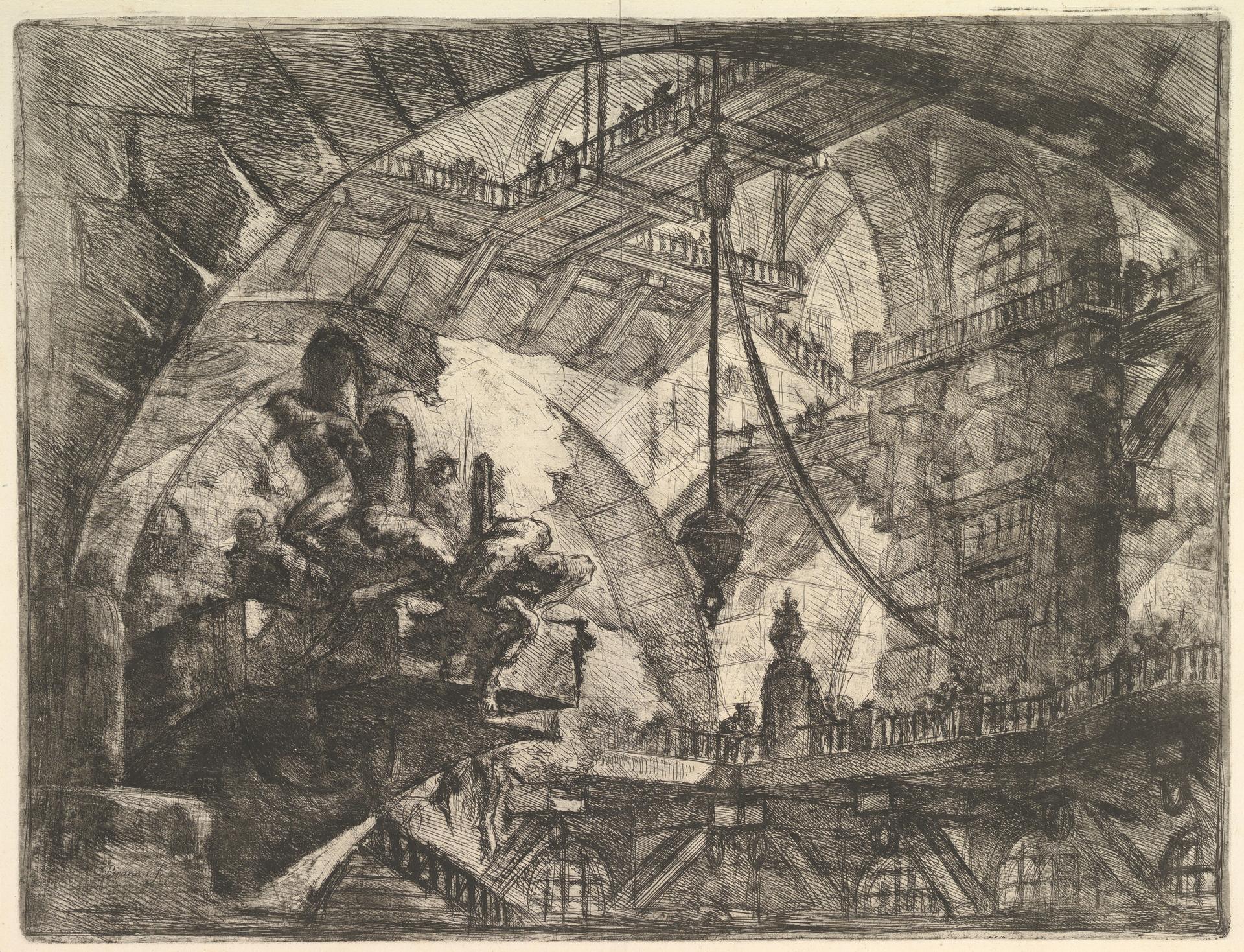
Prisoners on a Projecting Platform, from "Carceri d'invenzione" (Imaginary Prisons)
Original title: Prisoners on a Projecting Platform, from "Carceri d'invenzione" (Imaginary Prisons)
kurzbeschreibung
Giovanni Battista Piranesi made this etching around 1749–50 as part of his series 'Carceri d'invenzione'. The print presents a vast, hall-like prison architecture. It is executed as an etching with engraving, supplemented by sulphur tint or open bite and burnishing.
Description
On a projecting platform or balcony, several figures have settled and are watching the scene. Above this area, an arch construction curves deep into the space; to the side, further platforms and balconies are crowded with people in various poses. A soft, almost hazy light covers the entire view, creating an oppressive mood. The grey tones of the monochrome print arise from graduated line depths and the contrast of shadow and light. The style relies on perspective and rich detail, producing an impression of depth and interweaving.
Context
The 'Carceri' first appeared in 1749/50 in Rome as a series of etchings. Piranesi did not intend them as depictions of actual prisons but as architectural fantasies drawing on Roman buildings and stage designs. A revised second edition followed in 1761, in which the contrasts became stronger. The series influenced later artists and is regarded as a precursor of Romanticism and Surrealism.
Impact
The overwhelming architecture and the interplay of light and shadow give the print an oppressive yet captivating aura. Within the gigantic construction, the figures appear small and lost, making captivity and existential isolation palpable. The abundance of detail draws the viewer into a surreal, labyrinthine world.
Technique
Piranesi combined etching and engraving and also used sulphur tint or open bite to achieve soft tonal gradations. The print is in the first of four states (after Robison), thus showing the original, lighter version before later revisions. The process allowed fine lines and graduated shading that bring out the architectural details clearly.
AI-generated description text
Source: Metropolitan Museum of Art · Public Domain (CC0 1.0)