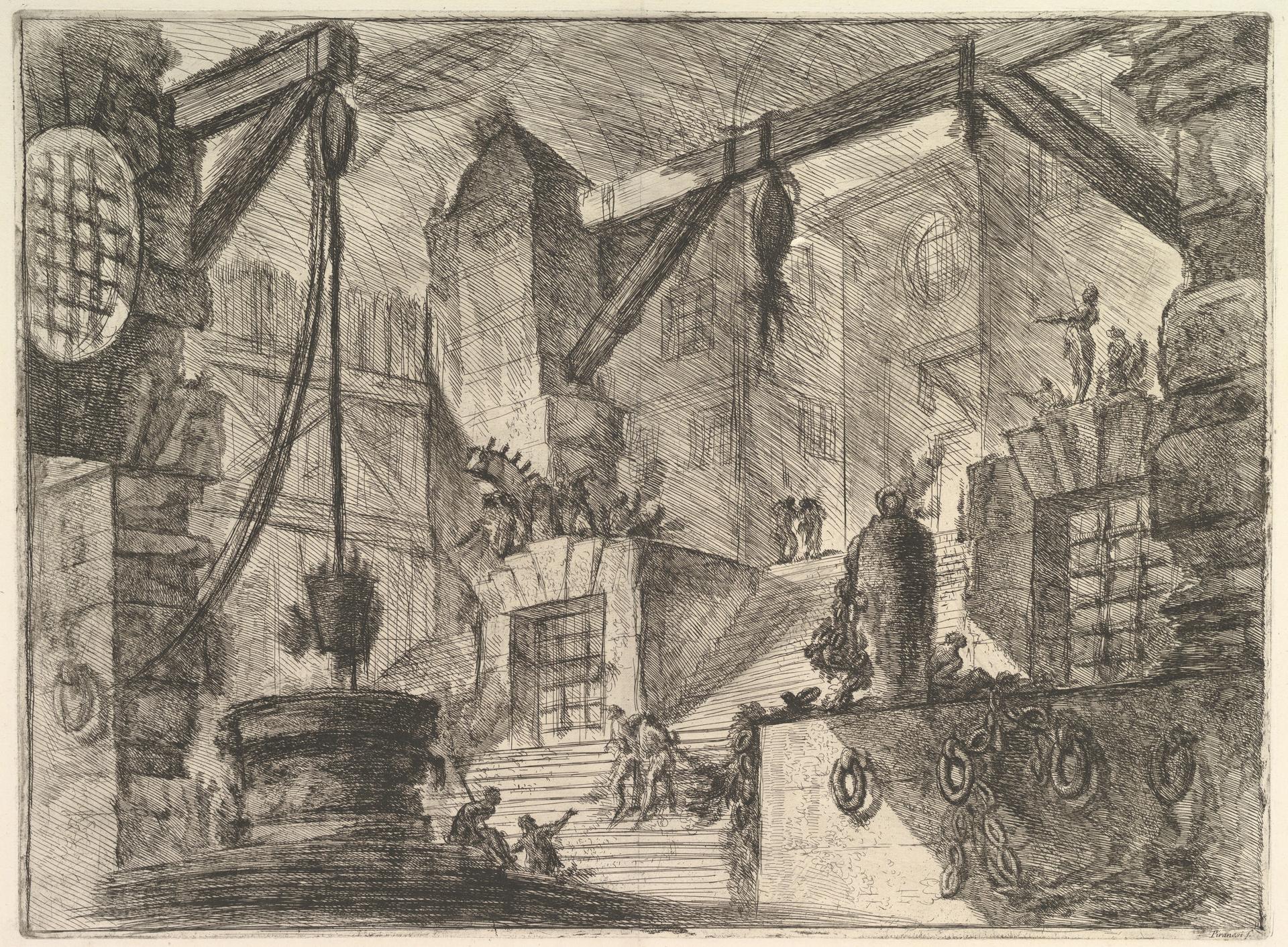
The Well, from "Carceri d'invenzione" (Imaginary Prisons)
Original title: The Well, from "Carceri d'invenzione" (Imaginary Prisons)
kurzbeschreibung
Giovanni Battista Piranesi made 'The Well' around 1749–50 as part of the first series of his 'Carceri d'invenzione'. This etching presents a colossal, fantastical prison interior and measures 49.4 by 63.5 cm (sheet).
Description
Figures move across the foreground on a staircase leading to a cage-like cell, some of them descending. To the right, several people watch from a raised platform. Beyond them rise buildings with windows and towers that suggest a city or fortress. A large crane spans a round well, and light falls from above onto the contours.
Context
The 'Carceri' first appeared in Rome around 1749–50 as an independent print series. Stage designs and Roman ruins served as inspiration, along with contemporary images of prisons. Several editions with revisions followed; this impression is the first of six states.
Impact
An oppressive, labyrinthine mood draws the viewer into an irrational world of space. Stairways, well, and architecture overlap into a fascinating confusion.
Technique
Piranesi worked the plate in etching with additional engraving, scratching, burnishing, and lavis. Fine lines and hatching build depth and texture, while shifting stroke directions strengthen the illusion of light and shadow.
AI-generated description text
Source: Metropolitan Museum of Art · Public Domain (CC0 1.0)