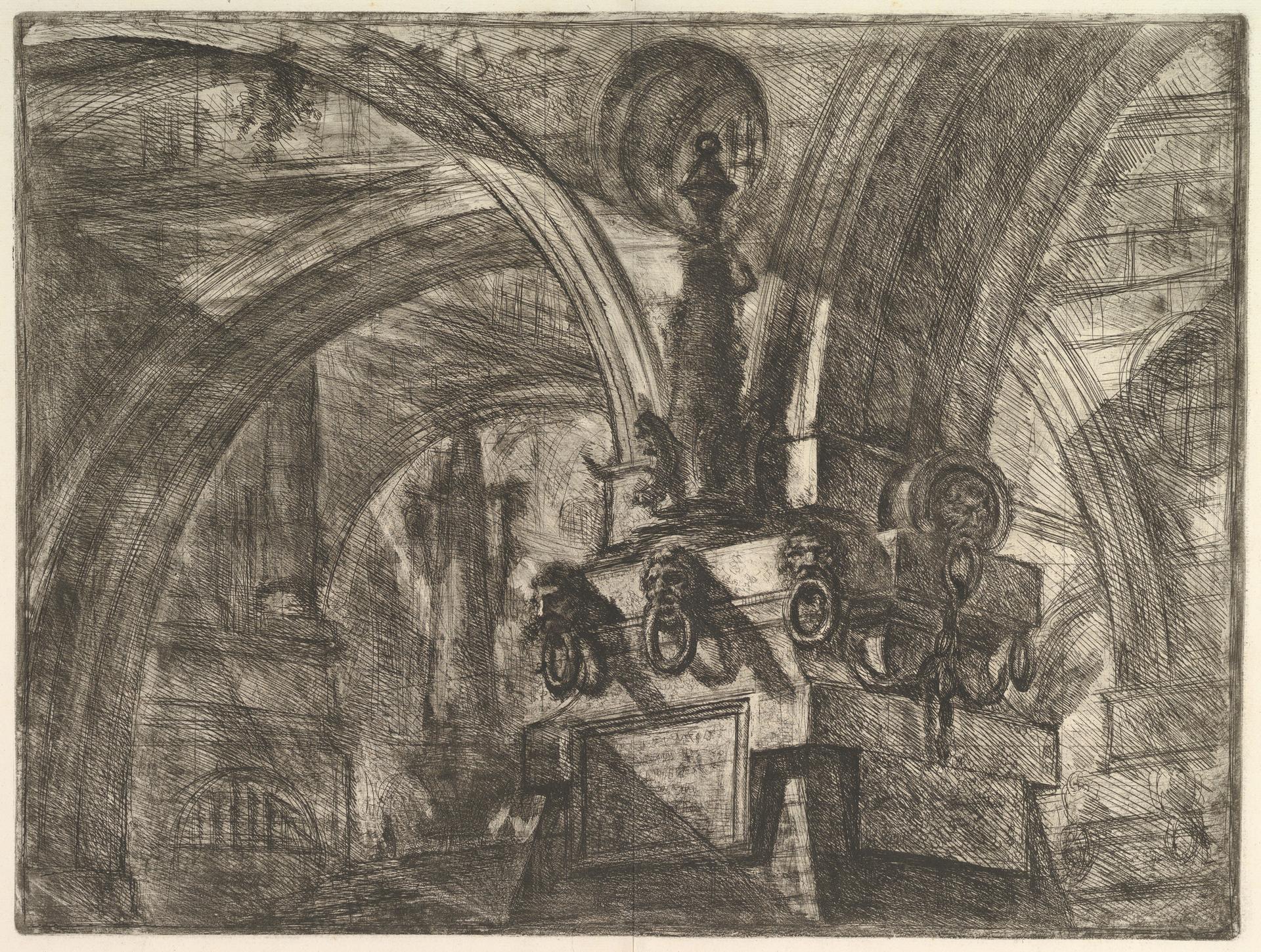
The Pier with a Lamp, from "Carceri d'invenzione" (Imaginary Prisons)
Original title: The Pier with a Lamp, from "Carceri d'invenzione" (Imaginary Prisons)
kurzbeschreibung
Giovanni Battista Piranesi made 'The Pier with a Lamp' around 1749–50 as part of his etched series 'Carceri d'invenzione' (Imaginary Prisons). The print, an etching combined with engraving and sulphur tint, presents a monumental, gloomy architectural hall in which an altar-like structure bearing a lamp stands.
Description
A vast space vaulted by mighty arches opens up before the eye. In the foreground rises a monumental, richly ornamented object reminiscent of a sarcophagus or altar, studded with round decorative forms. On its top sits a lantern whose faint light diffuses weakly into the room. Deep shadows run through walls and floor, created by dense hatching. The vertical lines emphasize the height of the space and heighten the mysterious, almost dreamlike effect.
Context
The 'Carceri' comprise 14 etchings that Piranesi first published in Rome around 1749–50. In those years he was intensively occupied with ancient Roman architecture and with stage designs. The 'Carceri' do not reproduce real prisons but are fantastic architectural visions, inspired by Roman ruins and contemporary stage sets. The first edition, to which this sheet belongs, was later revised and reissued by Piranesi.
Impact
Oppression and fascination seize the viewer at once, transporting them to an unreal underworld. The lamp's meagre light contrasts with the deep darkness and lends the scene something mysterious, almost otherworldly. The monumental architecture weighs heavily, making the human figure seem small and lost within it.
Technique
For this print Piranesi used etching combined with engraving, a sulphur tint and, in places, open bite. This produces fine, dense hatching and soft tonal gradations that carry the dark, atmospheric mood. The sheet is in the first of seven states, as documented by Robison.
AI-generated description text
Source: Metropolitan Museum of Art · Public Domain (CC0 1.0)