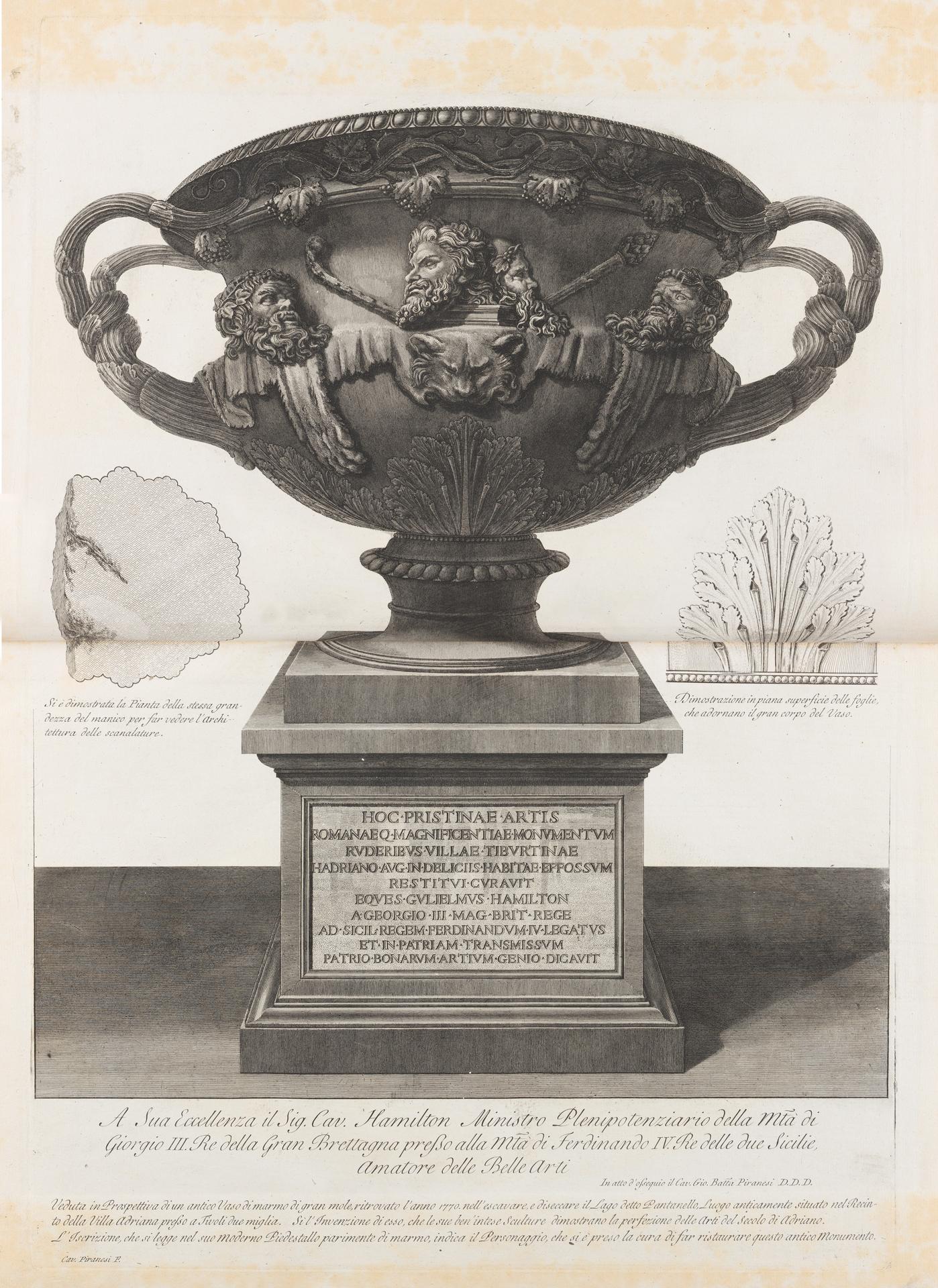
Large vase found at the Pantanello, Hadrian's Villa, Tivoli, in 1770 (The 'Warwick Vase')
Original title: Large vase found at the Pantanello, Hadrian's Villa, Tivoli, in 1770 (The 'Warwick Vase'), from "Vasi, candelabri, cippi, sarcofagi, tripodi, lucerne, ed ornamenti antichi disegnati ed incisi dal Cav. Gio. Batt. Piranesi, Vol. I" (Vases, candelabra, grave stones, sarcophagi, tripods, lamps, and ornaments designed and etched by Cavalieri Giovanni Battista Piranesi)
kurzbeschreibung
The monumental Warwick Vase, unearthed in 1770 at Hadrian's Villa near Tivoli, appears here in an etching by Giovanni Battista Piranesi made between 1778 and 1780. The plate belongs to his series Vasi, candelabri, cippi, sarcofagi, tripodi, lucerne, ed ornamenti antichi and renders the ancient marble original with great precision. Piranesi sets the vase on a pedestal and adds a Latin inscription together with smaller detail studies.
Description
Raised on a pedestal, the vase dominates the sheet, accompanied by a Latin inscription naming where it was found and its context. Figurative reliefs run around the body of the vessel, linking human heads with fruits and leaves. The setting stays restrained so that the vase stands out clearly. Below the vessel are smaller sketches recording particular features of the decoration or individual parts of the vase. Executed in black and white, the drawing is extremely detailed.
Context
The Warwick Vase came to light in 1770 during excavations at Hadrian's Villa in Tivoli and later entered the collection of George Greville, 2nd Earl of Warwick. Piranesi included the piece in his large plate work, published in Rome between 1778 and 1780, which made ancient finds accessible to a European audience. Connoisseurs and collectors used the etching as a reproduction, and it spread knowledge of Roman antiquity.
Impact
Monumental and solemn, the vase commands attention, filling the entire sheet and gaining a documentary character from the inscription. The precise rendering of the ornaments and the delicate lines give it an almost tangible presence that carries the viewer back to antiquity. The plain layout directs the eye to the ornamental splendour of the object.
Technique
For this etching Piranesi scratched the drawing into a wax ground on a copper plate and then bit it with acid. The image was printed on paper; the plate measures 71 x 47.3 cm and sits horizontally on a larger sheet of 55 x 80 cm. Fine lines and hatching demonstrate his confident command of the etching process, which permits a high degree of fidelity to detail.
AI-generated description text
Source: Metropolitan Museum of Art · Public Domain (CC0 1.0)