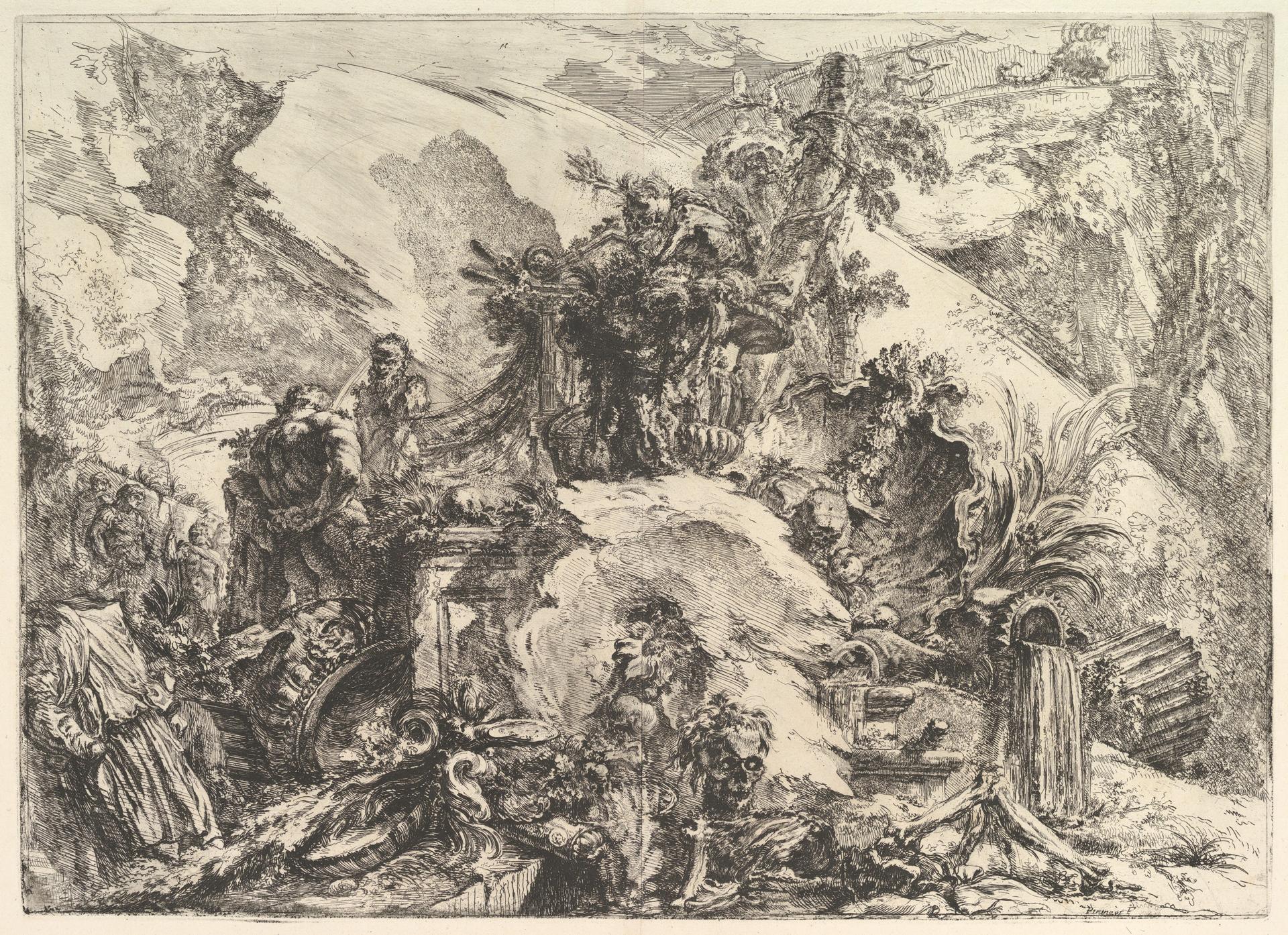
The Skeletons, from "Grotteschi" (Grotesques)
Original title: The Skeletons, from "Grotteschi" (Grotesques)
kurzbeschreibung
Unlike the capricci of its time, Piranesi's etching 'The Skeletons' from the 'Grotteschi' series, made around 1748, sets a rocky landscape against skeletal figures and agitated bodies. The print combines etching, engraving, and drypoint, giving it a texture all its own.
Description
A towering rock anchors the image, flanked by trees and scrub. On the left, two figures in traditional dress grapple with each other, while more figures stir on the right. Mountains and clouds in the distance suggest the expanse of the terrain. The layout is asymmetrical, with the rock dominating. Varying line weights and contrasts of light and dark create depth and surface texture in the monochrome etching.
Context
The 'Grotteschi' series emerged during Piranesi's early Roman period, when he was deeply engaged with ancient architecture and ruins. At this time his interest grew in capriccio-like fantasies and macabre subjects. The work reveals influences from Roman antiquity as well as from Venetian veduta painting, which Piranesi had encountered in his native Venice.
Impact
A dark, theatrical mood emanates from the print, carried by the agitated figures and the rocky setting. The pairing of skeletons and struggling bodies gives it a morbid yet gripping presence. Piranesi's assured linework draws the eye and immerses the viewer in the detailed scene.
Technique
Etching, engraving, drypoint, and burnishing came together in this print, allowing fine gradations of line and shadow. The second of five known states shows refined work on the plate with precise details. The large paper of 49.5 x 64 cm reinforces the monumental effect of the composition.
AI-generated description text
Source: Metropolitan Museum of Art · Public Domain (CC0 1.0)