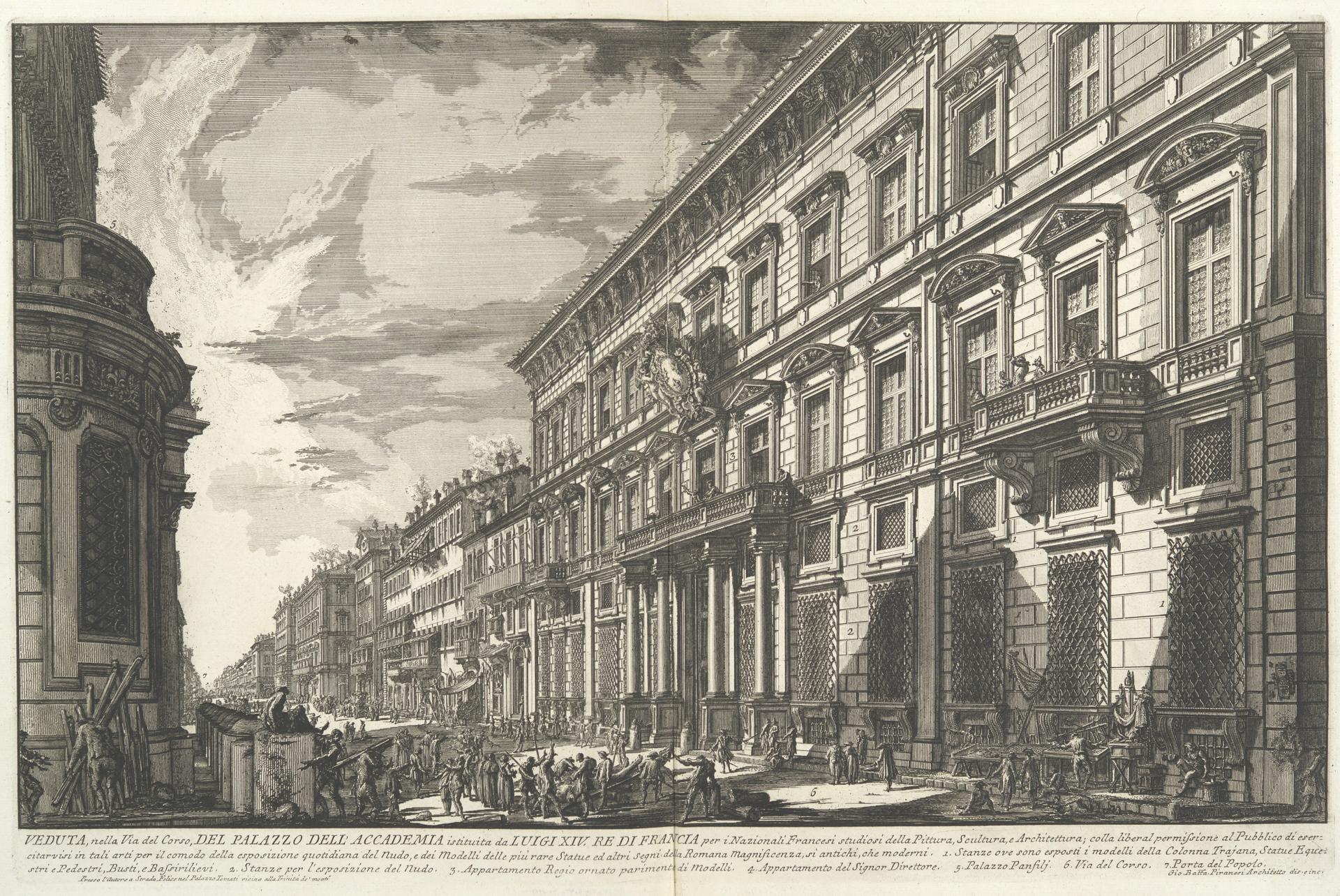
View along the Via del Corso of the Palazzo dell'Accademia, established by Louis XIV, King of France for French students of Painting, Sculpture and Architecture..., from "Vedute di Roma" (Views of Rome), part I
Original title: View along the Via del Corso of the Palazzo dell'Accademia, established by Louis XIV, King of France for French students of Painting, Sculpture and Architecture..., from "Vedute di Roma" (Views of Rome), part I
kurzbeschreibung
Giovanni Battista Piranesi made this etching between 1750 and 1778. It shows a view of the Via del Corso in Rome with the Palazzo dell'Accademia and comes from the series 'Vedute di Roma'. The print is in the third of five states (according to Hind). The baroque palace facade and the activity on the street are the main focus.
Description
A wide street lined with palazzo buildings leads toward the elaborately designed Palazzo dell'Accademia. Its facade is articulated by columns, balconies, and windows. On the street, several people can be seen examining sculptures and models. On the left, part of a church with a tower appears. Fine gray gradations and the distribution of light and shadow—caused by clouds in the sky and building shadows—shape the image.
Context
The Palazzo dell'Accademia was built under Louis XIV for French art students and points to the presence of the Académie de France in Rome. Piranesi published this veduta as part of his series 'Vedute di Roma', which began appearing in the 1740s and captured both ancient and contemporary Rome. In an era when Rome was a principal destination of the Grand Tour, Piranesi established himself as one of the leading veduta artists.
Impact
The precise linework and high-contrast shading give the architecture a monumental presence. At the same time, the busy street scene feels lively and almost documentary; the viewer is transported to eighteenth-century Rome.
Technique
The etching is an intaglio process: the drawing is scratched with a needle into a wax layer on a copper plate. Fine lines and hatching produce the detailed rendering of architecture and figures. The sheet measures 52 x 74.5 cm, the plate 40.5 x 62 cm; this is the third of five states.
AI-generated description text
Source: Metropolitan Museum of Art · Public Domain (CC0 1.0)