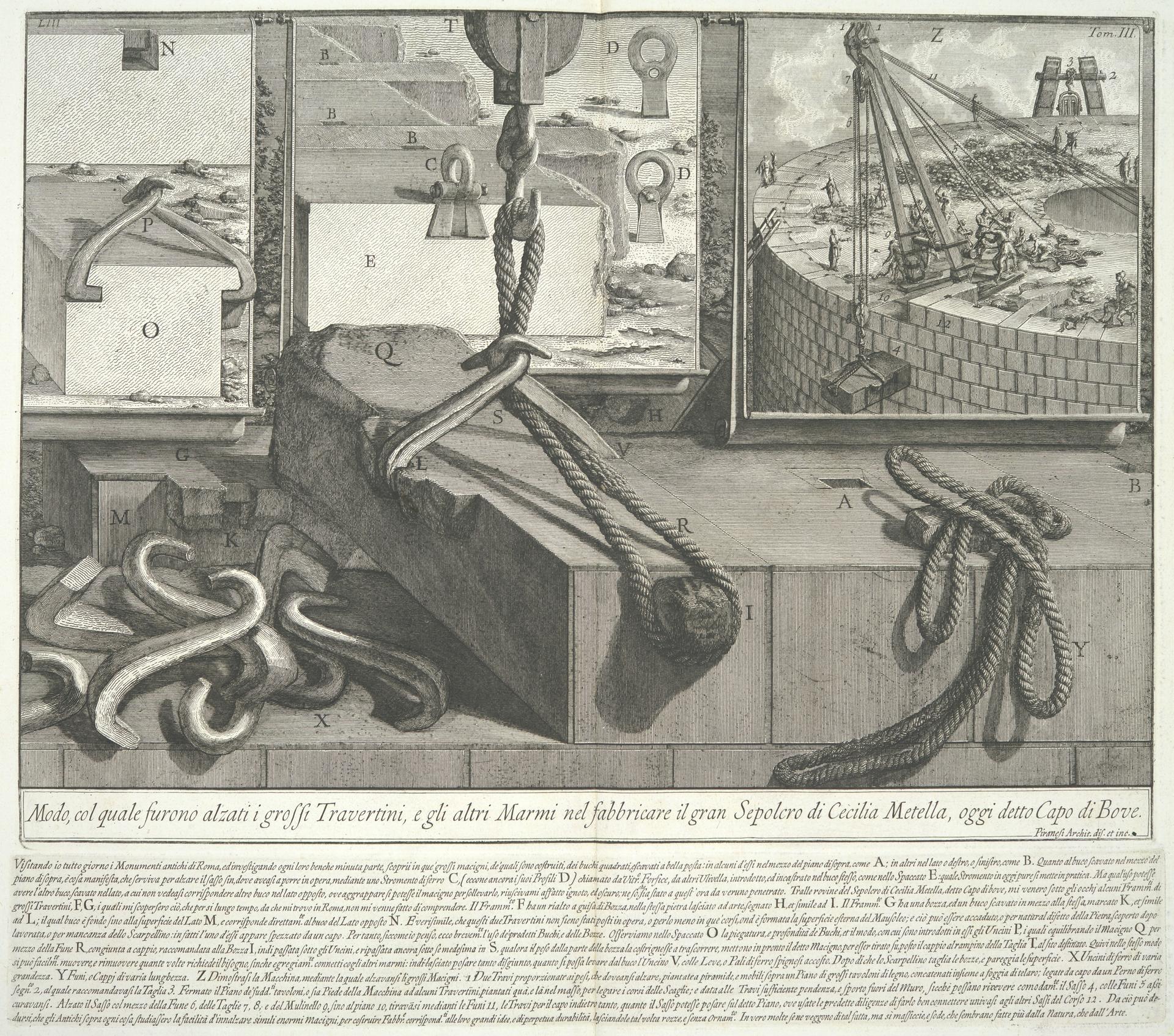
Means by which the large blocks of travertine and marble were lifted during the construction of the large Tomb of Caecilia Metella, tome 3, tavola 53 from "Le Antichità Romane" (Roman Antiquities)
Original title: Means by which the large blocks of travertine and marble were lifted during the construction of the large Tomb of Caecilia Metella, tome 3, tavola 53 from "Le Antichità Romane" (Roman Antiquities)
kurzbeschreibung
Published in 1756–57 as part of the three-volume series 'Le Antichità Romane', this etching by Giovanni Battista Piranesi focuses on the lifting devices used to move heavy travertine and marble blocks during the construction of the tomb of Caecilia Metella. The print showcases ancient building technology and forms part of a comprehensive documentation of Roman architecture.
Description
The sheet is divided into several zones: at top and bottom, meticulous details of ropes, loops, and pulleys attached to stone blocks. Between them lies a larger view of the tomb along with its lifting apparatus. Numerous workers are busy operating the mechanical parts. Fine lines and graded shading in grey tones create spatial depth and make the workings of the devices comprehensible.
Context
With 'Le Antichità Romane', Piranesi presented a comprehensive survey of Roman buildings and their construction methods. The three volumes appeared in 1756 and 1757 and were aimed at scholars as well as readers interested in architecture. Plate 53 belongs to the third volume, which deals with the tombs along the Via Appia, including the mausoleum of Caecilia Metella. Piranesi combined archaeological accuracy with technical reconstructions to convey the engineering achievements of antiquity.
Impact
Technical precision and the clear arrangement of the various views characterize the print. The rendering of the elaborate lifting devices remains objective and yet reveals the scale of ancient construction tasks. Fine hatching enlivens the surfaces and makes the etching a vivid document of building history.
Technique
Piranesi worked in etching: the drawing was scratched into a wax layer on a copper plate and then etched. Different etching times and varied line work produced the graded grey tones and shading. The sheet is printed on laid paper; the plate measures approximately 46 x 53 cm, the full sheet 54 x 77 cm.
AI-generated description text
Source: Metropolitan Museum of Art · Public Domain (CC0 1.0)