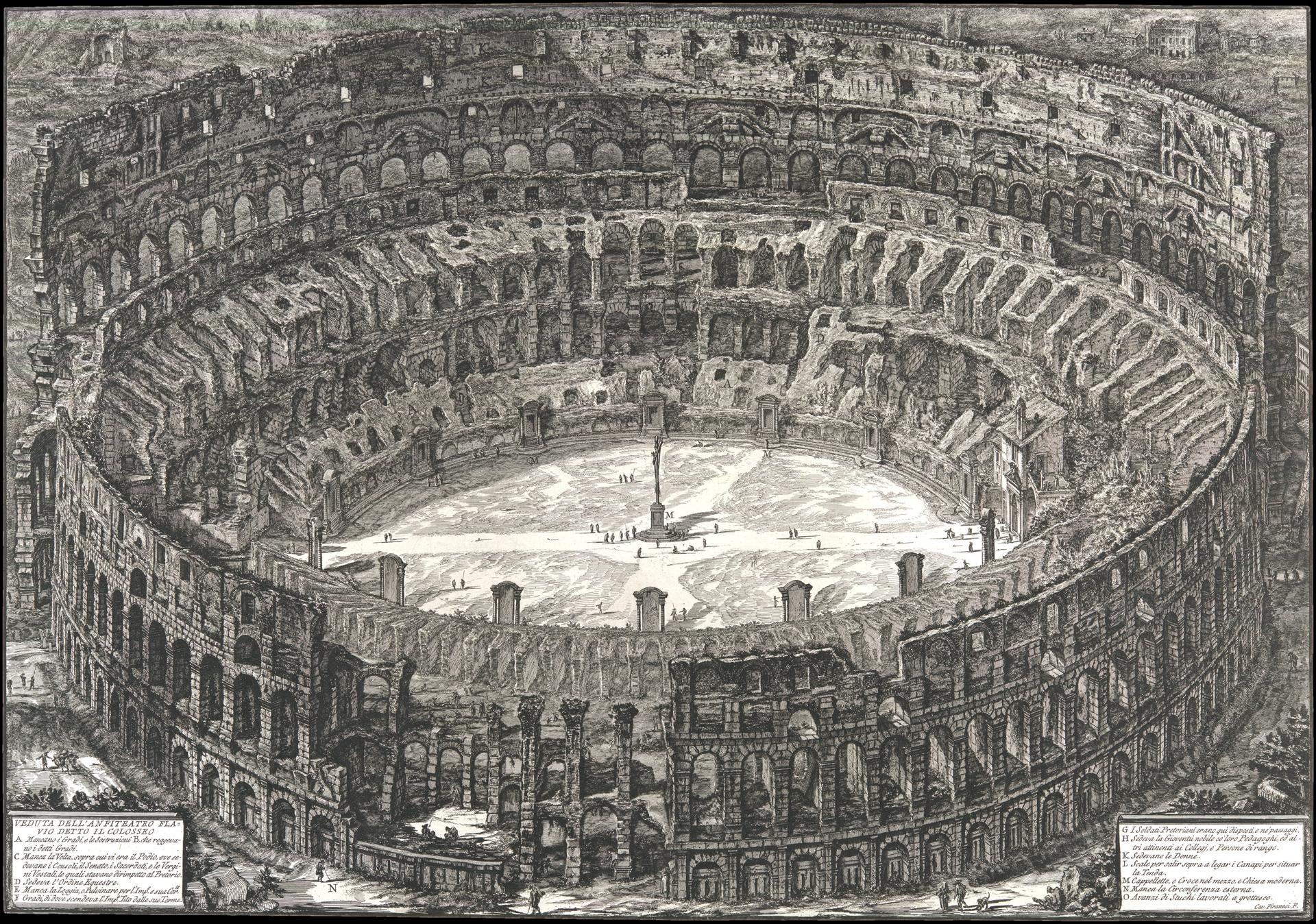
Veduta dell'Anfiteatro Flavio detto il Colosseo
Original title: Veduta dell'Anfiteatro Flavio detto il Colosseo. From 'Vedute di Roma' (Views of Rome)
kurzbeschreibung
Unlike many vedute of Rome that present the city from without, Piranesi here directs the eye into the interior of the Colosseum. This 1776 etching belongs to the series 'Vedute di Roma' and lays out the vast ruin with its many architectural particulars. Tiny figures in the foreground bring out the true scale of the structure.
Description
The view drops into the interior of the Flavian Amphitheatre, sweeping across several tiers of seating down to the exposed arena. Weathered stretches of wall and remnants of the ancient construction are recorded with great precision. A handful of people in the foreground provide a measure of size. The layout is symmetrical, with the rows of arches radiating outward from the centre. The black-and-white tones and even light are characteristic of the etching process.
Context
Piranesi published the 'Vedute di Roma' as a series of Roman views between 1748 and 1778. This sheet from 1776 dates from a period when Rome was a favoured destination of the Grand Tour and artists recorded its ancient ruins. Piranesi was regarded as a master of exact architectural representation, often emphasising the grandeur of Roman building.
Impact
The minute figures along the lower edge make the Colosseum appear an overwhelming ruin. Clear symmetry and the precise recording of decay evoke a mood of sublimity and historical weight. The viewer is transported to the eighteenth century, when ancient architecture served as a model and source of inspiration.
Technique
For the etching, a drawing was bitten into a copper plate that had first been coated with an acid-resistant ground. Piranesi worked with very precise, richly detailed line, as is typical of his architectural prints. Even distribution of light and fine hatching create volume without imitating natural illumination.
AI-generated description text
Source: Metropolitan Museum of Art · Public Domain (CC0 1.0)