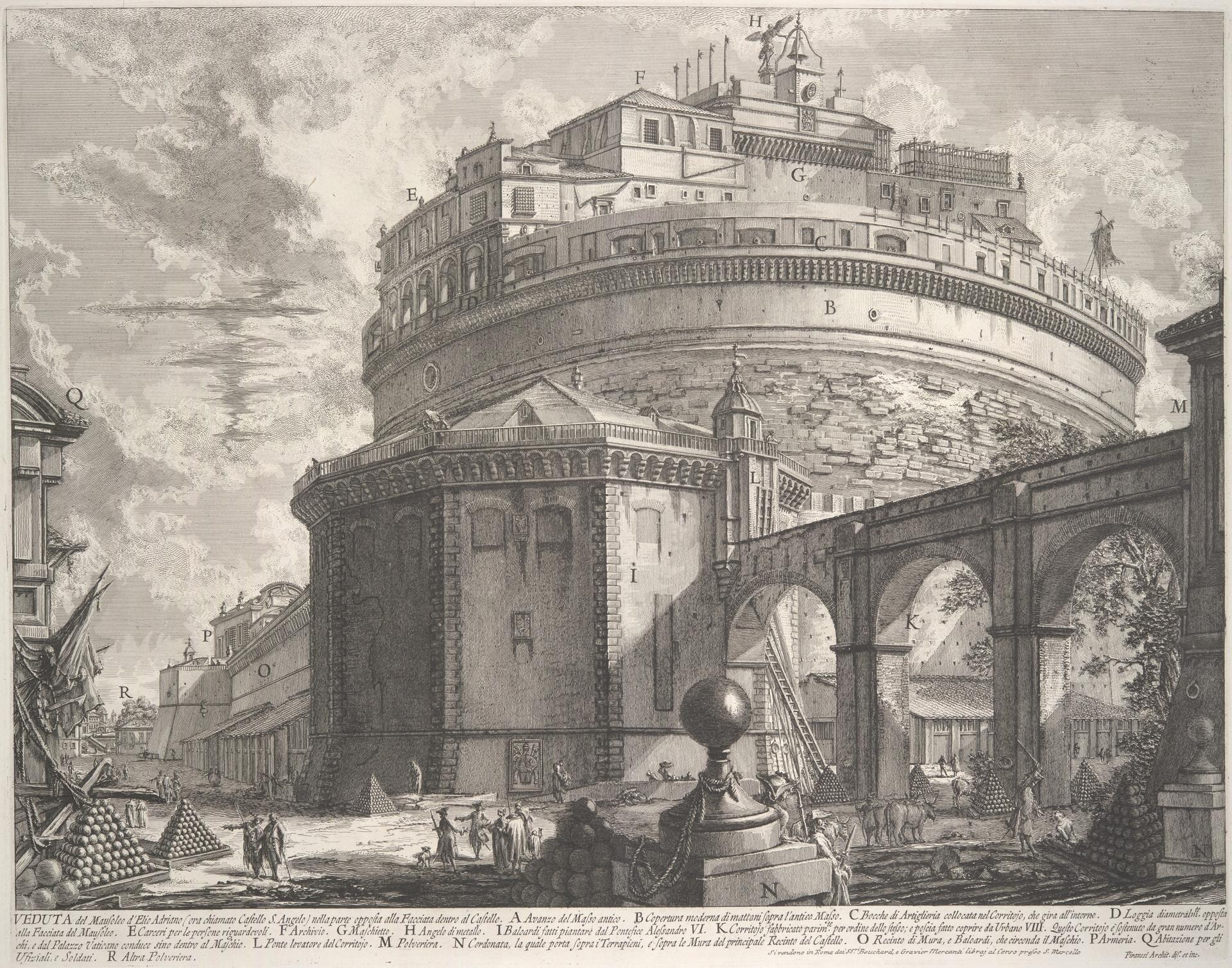
View of the Mausoleum of the Emperor Hadrian (now called Castel S. Angelo) from the rear, from Vedute di Roma (Roman Views)
Original title: View of the Mausoleum of the Emperor Hadrian (now called Castel S. Angelo) from the rear, from Vedute di Roma (Roman Views)
kurzbeschreibung
Made around 1756, this etching by Giovanni Battista Piranesi shows the Mausoleum of Emperor Hadrian — now Castel Sant'Angelo — from the rear. It belongs to the Vedute di Roma series and was executed as an etching. The mighty circular structure of the mausoleum dominates the foreground, while behind it urban life unfolds with people and buildings.
Description
The rear of Hadrian's mausoleum fills the foreground, its distinctive round arches and thoroughly worked architecture close at hand. Behind it, further buildings rise in tiers and a street where people handle crates. Figures carry loads or offer goods for sale, enlivening the place. This black-and-white etching uses graduated greys to bring out shadows and surfaces. Light falling from above accents the masonry of the mausoleum.
Context
Piranesi published this view as part of his Vedute di Roma, which began appearing in the 1740s and recorded ancient and baroque monuments of Rome for Grand Tour travelers and collectors. The present sheet shows the state before reworking and bears the publisher's address of Bouchard. In his vedute, Piranesi combined topographical accuracy with a staged, dramatic presentation.
Impact
The mausoleum feels monumental yet remains a living part of the urban space, despite its historical distance. Architectural precision and everyday bustle merge into a dense atmosphere. The viewer is transported to eighteenth-century Rome, where ancient grandeur meets present life.
Technique
The drawing was scratched into a metal plate and etched with acid — an etching. The lines are fine and detailed, typical of Piranesi, who varies stroke strength and uses hatching. At roughly 50.8 x 65 cm, the paper size is generous for a veduta, supporting the impact of the architecture.
AI-generated description text
Source: Metropolitan Museum of Art · Public Domain (CC0 1.0)