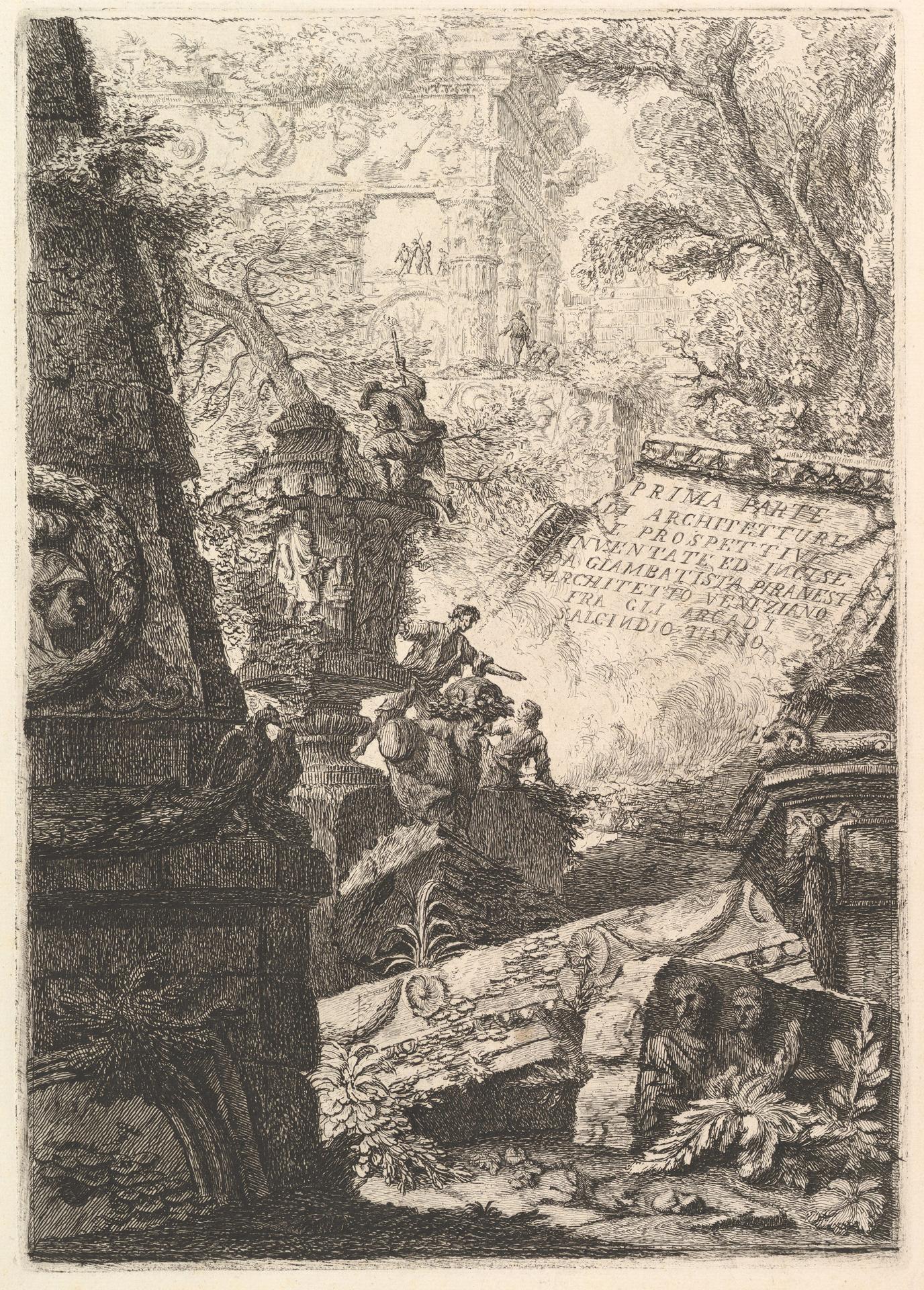
Frontispiece from "Prima Parte di Architetture, e Prospettive"
Original title: Frontispiece from "Prima Parte di Architetture, e Prospettive"
kurzbeschreibung
With this frontispiece, Giovanni Battista Piranesi opens his series 'Prima Parte di Architetture, e Prospettive' (around 1750). The etching presents a landscape of ancient ruins with columns and a lone figure, pointing to the artist's fascination with Roman architecture. As a title page, the sheet introduces the graphic collection.
Description
The print is tall and narrow. Massive columns and fragments of masonry fill the foreground, with trees and shrubs growing up among them. Roughly at the middle of the image a figure holds or supports a statue. Beyond rises another stretch of the ruin, and on its bridge or platform a second person can be made out. Fine lines and hatching build the gradations of light and shade in this monochrome etching.
Context
The series 'Prima Parte di Architetture, e Prospettive' was made between about 1743 and 1750, while Piranesi was working in Rome and studying ancient architecture in depth. The frontispiece opens the set almost as a manifesto: real ruins are joined here with imagined reconstructions. The print belongs to a series that established his reputation as a draughtsman of views and architecture.
Impact
A monumental yet elegiac mood emanates from the motif, characteristic of Piranesi's ruin pictures. Overgrown columns and the small figure make the transience of former greatness palpable and invite reflection on antiquity.
Technique
In etching, the drawing is scratched into a wax layer on the copper plate, and the plate is then bitten with acid. This allows light and shadow to be rendered precisely through fine lines and hatching. The sheet measures 40.2 x 25.5 cm, the plate 36 x 33.8 cm.
AI-generated description text
Source: Metropolitan Museum of Art · Public Domain (CC0 1.0)