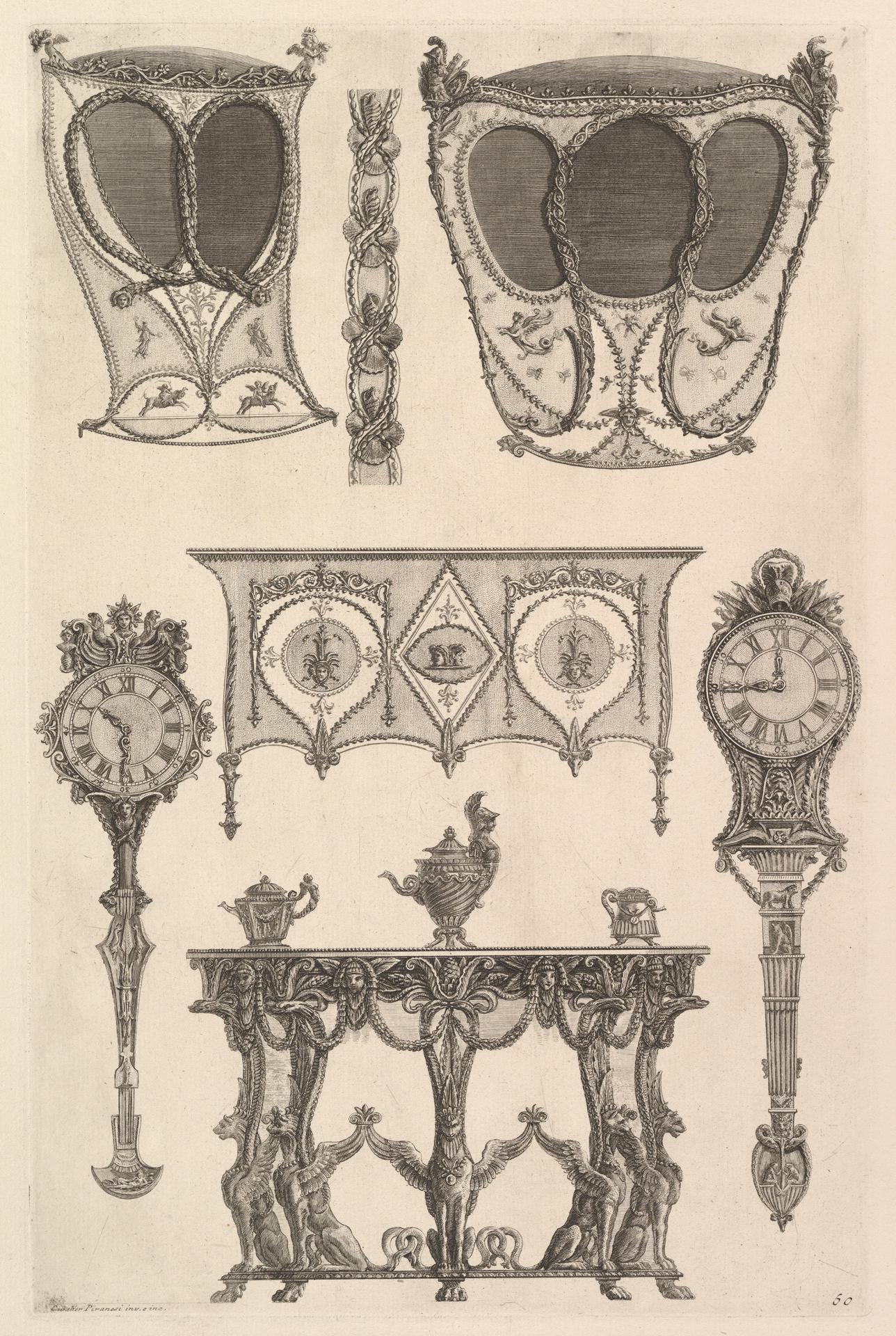
A sedan chair, a coach, a commode, a side table and two clocks (Deux ch. à porteurs v. de côté, une commode, une console, deux pedules, un meuble indét), from Diverse Maniere d'adornare i cammini ed ogni altra parte degli edifizi...(Different Ways of ornamenting chimneypieces and all other parts of houses)
Original title: A sedan chair, a coach, a commode, a side table and two clocks (Deux ch. à porteurs v. de côté, une commode, une console, deux pedules, un meuble indét), from Diverse Maniere d'adornare i cammini ed ogni altra parte degli edifizi...(Different Ways of ornamenting chimneypieces and all other parts of houses)
kurzbeschreibung
This etching by Giovanni Battista Piranesi, from the pattern book 'Diverse Maniere d'adornare i cammini' of about 1769, gathers various pieces of furniture and accessories on a single sheet. Two sedan chairs, a carriage, a commode, a side table and two clocks are presented in a decorative arrangement.
Description
At the top of the sheet stand two elaborately decorated sedan chairs, their surfaces covered with ornaments and figurative scenes. Below them follow two clocks, one a wall clock, the other a pendulum clock. The lower area is taken up by a richly adorned table with figures, on which various vessels are placed. The outlines and surfaces of the objects are worked out with great care, and the whole remains in black and white.
Context
Around 1769 the sheet appeared as part of the publication 'Diverse Maniere d'adornare i cammini', with which Piranesi presented designs for interiors and decoration. It belongs to a series of engravings aimed at architects and craftsmen. The grouping of furniture and accessories reveals Piranesi's interest in combining ancient and contemporary ornament.
Impact
The viewer's eye is first drawn by the clear, precise linework and then glides over the symmetrically ordered objects, leaving a calm, orderly impression. The many details of the ornamentation invite a longer look and make luxury and craftsmanship palpable.
Technique
For this sheet a copper plate was incised with fine lines and hatching, produced by etching; afterwards the printing ink was transferred to paper. The black-and-white reproduction brings out the contours and textures of the objects clearly.
AI-generated description text
Source: Metropolitan Museum of Art · Public Domain (CC0 1.0)