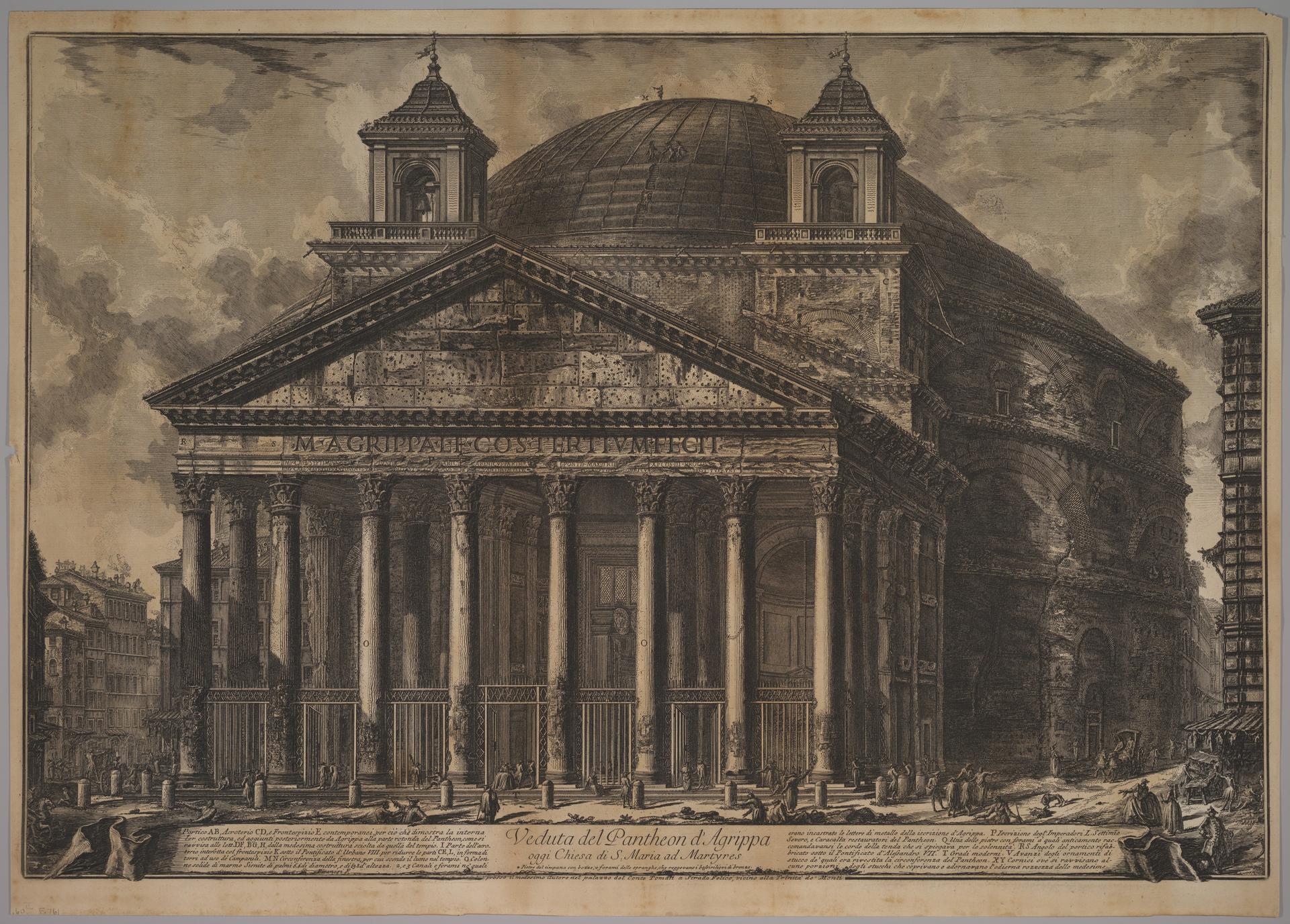
The Pantheon exterior (Veduta del Pantheon d'Agrippa oggi Chiesa di S. Maria ad Martyres)
Original title: The Pantheon exterior (Veduta del Pantheon d'Agrippa oggi Chiesa di S. Maria ad Martyres)
kurzbeschreibung
Giovanni Battista Piranesi (1720–78) recorded the Pantheon in Rome in an etching; the ancient round building has served as the church of Santa Maria ad Martyres since the seventh century. Measuring 47 by 69.9 cm, the sheet belongs to his series of Roman vedute. The rotunda with its portico and the surviving fragment of the dedicatory inscription forms the heart of the image.
Description
A broad colonnade and an immense domed structure fill the foreground. Above the entrance runs the inscription "M. AGRIPPA L. F. COS. TERTIUM FECIT". Many small figures people the square in front of and beside the building. The layout is symmetrical, with the Pantheon as its fixed point. Grey tones govern the monochrome sheet, and light and shadow rest in delicate hatching on walls and figures.
Context
This view was made in the eighteenth century, when the Grand Tour drew many travellers to Rome. Piranesi recorded ancient buildings with great precision and so contributed to archaeological research. By then the Pantheon had long been a consecrated church, which explains the sheet's subtitle. Such vedute were published in his collections of Roman views, which circulated throughout Europe.
Impact
The monumental force of the ancient building arises from the exact rendering of its proportions. The staffage figures let us gauge the size of the structure, while the bustle on the square stays lively. Finely graded lines and shading create a calm, clear mood and carry the viewer back to the eighteenth century.
Technique
The drawing was scratched into a wax ground on a copper plate, and the metal was then etched. Printing is done with black ink on paper, which produces the characteristic grey values. Piranesi set delicate and forceful lines side by side to capture architectural detail and effects of shadow precisely.
AI-generated description text
Source: Metropolitan Museum of Art · Public Domain (CC0 1.0)